

Student-backed election winners demand sweeping resignations in Serbia
Days after ousting Aleksandar Vučić's party from power, Student List MPs call for top figures to stand down.
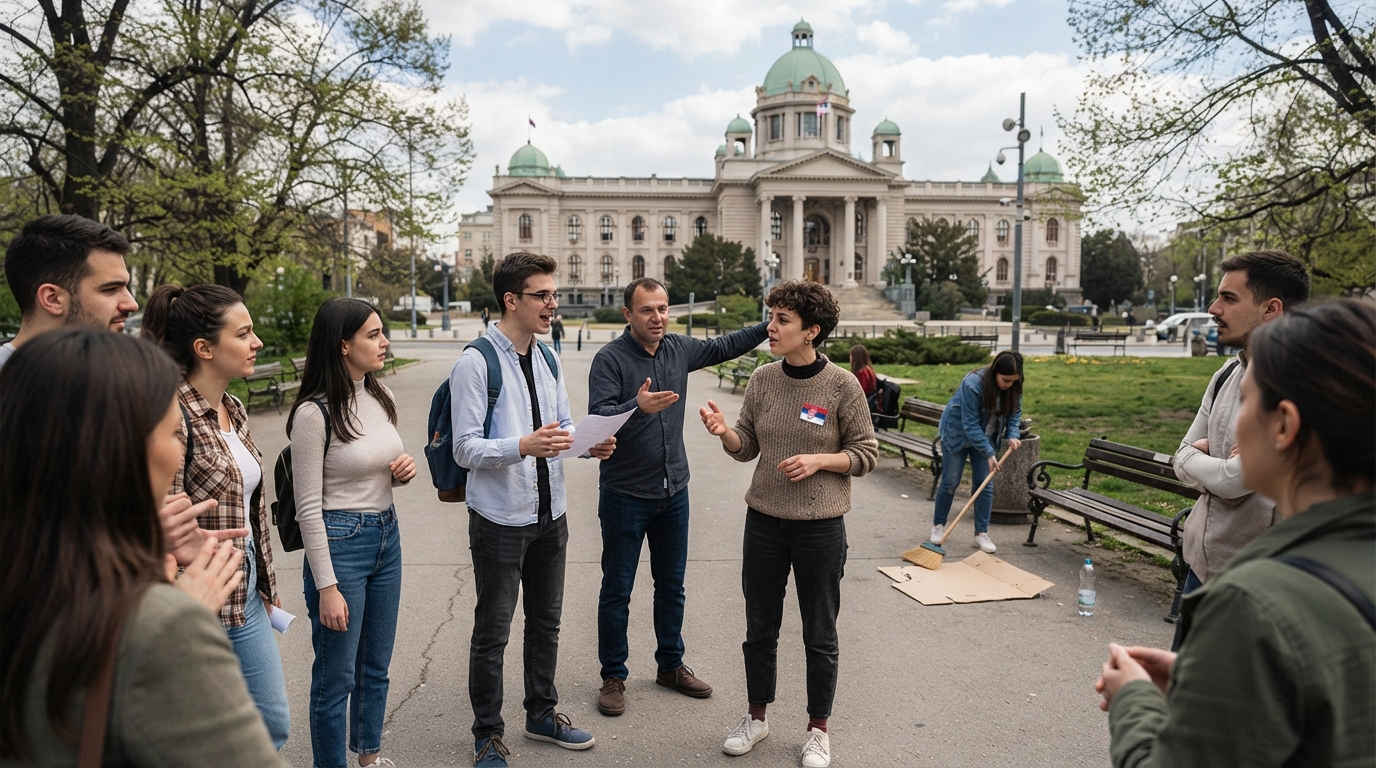
Student-backed election winners call for sweeping resignations in Serbia
Serbia’s triumphant student-led movement has demanded that senior figures in the police, intelligence services and judiciary step down, just days after removing ex-president Aleksandar Vučić’s party from power.
Speaking in Pioneers’ Park, across from parliament, newly elected MPs from the Student List called for the immediate dismissal of every police officer who had broken the law, naming the heads of the police, the BIA security agency and the anti-terror unit.
It is rare for a European country to vote to completely reset its political system overnight, and Serbians have chosen to entrust that task to a group of political newcomers drawn from intellectuals, professors, artists, athletes and as many as 12 medical doctors and surgeons.
Yet the transfer of power will take weeks, and the students’ movement fears that evidence of possible wrongdoing could be wiped out in that period.
Only days earlier, the park where they stood on Thursday had been a tent camp packed with Vučić supporters outside his office.
Within hours of his conceding defeat on Sunday night, the camp was taken down, and on Monday morning a volunteer team arrived to clear away the debris.
“This is just the first wave of spring cleaning, the new ones are coming now - we are very excited but ready to do it too,” said Marija Milovanović, 25, while cleaning a park bench.
The student movement grew out of protests after the deadly collapse of a railway station canopy that killed 16 people in November 2024 in Novi Sad, Serbia’s second-largest city.
Their aim was to bring those responsible to justice and examine widespread corruption allegations blamed for one of the most tragic incidents in modern Serbian history.
They have made ambitious pledges.
Under their Student Plan, they promise to “halt the plunder, return stolen goods to the state budget, and invest directly in education and the economy”.
The clearing out of Vučić loyalists has already started at Serbia’s state broadcaster RTS, where director Manja Grčić has resigned.
Newly elected MP Mirjana Nikolić said Serbian citizens deserved truthful information and that RTS had served the government’s interests for years.
The new MPs are also targeting Telekom Srbija chief Vladimir Lučić.
Vučić loyalist Ana Brnabić, who is currently Serbia’s acting president, has accused her rivals of opting for “revolutionary justice, not rule of law,” and of seeking to shut down “all of the media they dislike”.
But one of the incoming government’s best-known MPs, Dejan Šoškić, says essential reforms must be introduced quickly.
“In the first six months, I would like to see the media scene liberated, fighting against corruption on the way, the institutions operating as prescribed by laws and a lustration law introduced,” said Šoškić, an economist who was governor of the central bank from 2010 to 2012.
By lustration, he means barring from public office members of the Vučić government or party machine who are found to have violated Serbians’ rights.
Such a purge will take time, since all of Serbia’s main centers of power have been controlled by Vučić and his party for so long, warns Strahinja Subotić of the Belgrade-based European Policy Centre.
In the end, he believes the new administration will need to “build bridges to the segments that have been operating well in the past”.
All 141 successful candidates were selected by students from universities across Serbia through a long, secretive and carefully designed process, and were assigned the task of carrying out the movement’s plan for a total reconstruction of the country.
That political program took months for a very diverse group of students to agree on. Now it is up to the equally varied group of winning candidates to put the plan into action, rather than the students themselves.
Another notable figure on the Student List is Radomir Saičić, a professor of organic chemistry at the University of Belgrade.
“While the practical mechanisms will be developed on the go, the new MPs will stick to the students’ 1200-page long and detailed plan,” he told the BBC.
“Parliament is making decisions, but since this change was led by students’ efforts, we would highly value their opinion and work closely with them,” he promised.
Not only are they new to politics, but Serbia’s election winners also have no clear leader and face a range of difficult challenges, including managing the country’s highly complex balancing act on the international stage.
Serbia is both a candidate for European Union membership and maintains close ties with Russia. Its accession bid has long been pushed to the back burner, while its Western Balkan neighbours move ahead.
The EU quickly welcomed the Student List’s victory and has promised to support their drive for reforms to the rule of law, media freedom and the fight against corruption.
But EU integration takes up a strikingly small part of the students’ election manifesto, which describes the bloc only as Serbia’s “most important economic partner”.
For years, Belgrade has balanced its foreign policy between the EU and its eastern partners, Russia and China. Belgrade has stood out in Europe by refusing to impose sanctions on Moscow since the start of its full-scale invasion of Ukraine in 2022.
In return, Serbia has benefited from preferential gas prices that have helped preserve domestic stability, and Vladimir Putin publicly backed Vučić’s effort to stay in power.
That does not mean the students intend to change course, and altering Serbia’s foreign policy may not be high on their agenda.
“Serbia had it own experience with sanctions in the 1990s and we know that they mostly harm ordinary people and do not affect policies of a state,” said Dejan Šoškić, referring to UN sanctions imposed during the wars in former Yugoslavia.
The new government will most likely focus first on domestic reform, and time is already running short before the next election campaign, with presidential elections due in December.
Aleksandar Vučić is legally barred from seeking a third presidential term, but he has vowed that his defeated Serbian Progressive Party will strike back: “We will beat them much faster than they can even imagine.”