

The Serbian phenomenon. Parallels are appropriate
Why the outcome of the Serbian elections is more than just a defeat for Vučić — expert opinion
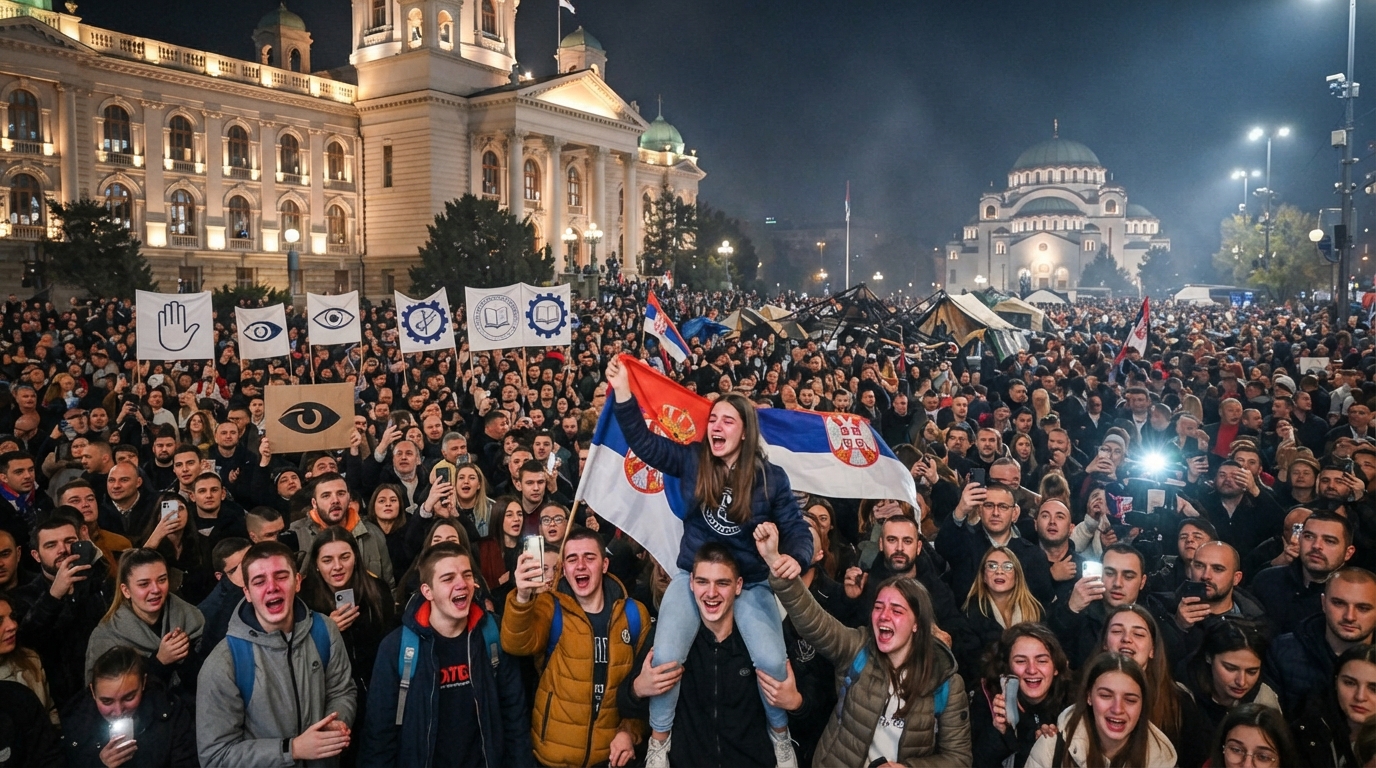
The Serbian Phenomenon. The Parallels Are Apt
On October 25, Aleksandar Vučić’s Serbian Progressive Party, which had governed the country for 14 years, lost the parliamentary elections to the "Student List"—a movement that emerged from protests following the collapse of a station canopy in Novi Sad. Behind the winners stand no oligarchs, no defectors from the elite, nor the West; within the movement itself, liberals and nationalists coexist, united by the demand for quality governance. These elections have become one of the first examples where the street did not destroy the old institutional structure, but peacefully filled it instead. Now, it must prove that the power of protest is capable of becoming the power of governance.
Conceding defeat on the evening of October 25, Aleksandar Vučić made an important statement: apart from the "Student List" and his own coalition, no one else had made it into parliament—national minority parties aside. According to preliminary data from the electoral commission, the "Student List" received 52.5% of the vote, while Vučić’s list garnered 39.3%. Ivica Dačić's Socialist Party, created back by Slobodan Milošević, received 2.2% and failed to clear the 3-percent threshold. Other lists, including the coalition of the old opposition "European Serbia," did not even reach 1%.
Therefore, the main takeaway in Serbia is not the victory of a pro-European democratic opposition over an emerging non-European autocracy. The essence lies elsewhere: it is a victory of the horizontal over the vertical—of a networked movement that fielded political nonentities in the elections over the veteran Vučić, who has been in politics since the 1990s and has led the country since the mid-2010s, as well as over the old opposition parties.
This resembles less the victory of some politicians over others, and more the victory of the people over politicians in general. On the night of October 26, Belgrade celebrated as if Serbia had scored the winning goal in the World Cup: it was a unifying popular celebration, not a divisive political one. The fate of the pro-government tent camp in the city center is also telling. As late as the evening of polling day, groups of men in black hoodies and new tents were being brought there. But after Vučić conceded defeat, they did not simply leave the camp—some, according to eyewitnesses, began to blend into the crowd of students and chant victory slogans alongside them. Vučić is leaving; the contract with him has expired.
Many in this government support group are linked to the football hooligan scene, making the analogy of the winning goal even more convincing. Incidentally, the abandoned pro-government tent camp was partially burned down on the night of the victory, which appears to have been the only instance of material damage in the two years of protests that led to the victory of the street over the offices.
The image of a popular victory at the polls is further reinforced by a very high turnout—10 to 15 percentage points higher than usual. By the time the polls closed, the figure, excluding diaspora votes, approached 70%. On the same day in neighboring Bulgaria, 22.5% of voters turned out for the presidential election—three times fewer. In other words, everyone in Serbia danced, even those who usually stand awkwardly by the wall at the disco.
The student movement itself did everything to remain popular and avoid turning into a party, let alone a leader-driven one. The equally grassroots "yellow vests" in France faced an internal crisis of trust as soon as they began looking within their ranks for negotiators with the authorities. In November 2018, out of eight "emissaries" chosen by an online vote, only two turned up for a meeting with Prime Minister Édouard Philippe, and one left almost immediately, demanding a live broadcast. The distrust of authority that had brought people into the movement was instantly transferred to their own leaders the moment the doors of the government office closed behind them. Such is the crumbling funnel of modern anti-elitism.
For the Serbian students, it was fundamentally important to show that they were not fighting for power for themselves. They spent more than a year compiling a list of 250 candidates at plenums, but the students themselves and the protest organizers are not on it: in this way, they emphasize their lack of personal self-interest in power and try to avoid a crisis of trust like the one experienced by the "yellow vests." Nor are there professional politicians on it, as far as one can judge. The students handed over the spots on the list to professors they trust and to people with varying degrees of public visibility from the world of liberal professions, sports, economics, and medicine. The list was headed by Ilija Srdanović, a professor at the Faculty of Medicine in Novi Sad. In addition, it included, for example, the chemist Radomir Saičić, sociologist Jovo Bakić, former head of the National Bank Dejan Šoškić, basketball player Dejan Bodiroga, actor Tihomir Stanić, eco-activist Zlatko Kokanović, and decathlete Mihail Dudaš. At the same time, it is unclear whether the mandates obtained—around 140 of them—will be distributed strictly according to the order of the list, or whether the names will be shuffled, and whether the movement has a bench of reserves.
In part, this recalls the victory of the party of nonentities, "Servant of the People," in Ukraine in 2019, which pushed aside the old parties—but there, an incumbent president was already in the capital, and the new party was "presidential" from the very beginning. The mobilization of the Ukrainian Orange Revolution of 2004 was built around political candidates and a classic protest narrative of a stolen election. In Serbia, neither exists.
Unlike other cases where unknown newcomers overturn the old system, the Serbian case lacks explicit oligarchic support. Strictly speaking, Serbia has nothing comparable to Ukrainian or Russian oligarchs: local big money is not large enough by post-Soviet standards, so the situation here is closer to other Central and Eastern European countries. Nor is there any sign in Belgrade of a famous split among the elites. In Hungary, where Viktor Orbán lost the election in April after 16 years in power, the opposition was led by Péter Magyar, a former member of the ruling Fidesz party. In Serbia, by contrast, the movement is led neither by disappointed functionaries of the ruling party nor by representatives of the old, previously defeated elite.
Nor does the West stand behind the Serbian winners in the conventional sense of the word. Vučić was banking on Donald Trump—as recently as September, the Serbian leader stated from the UN rostrum that Serbia supported his administration's actions—while the White House did not immediately react to the students' victory. Conceding defeat, Vučić blamed "various European countries" and the "American deep state, which opposes President Trump."
However, Europe was more of a sympathetic observer, primarily interested in a fragile stability in the Balkans. The absence of clear pro-European leaders made the movement uncomfortable for European capitals: it is difficult to support a pig in a poke—a list of 250 people chosen by the votes of who knows whom.
Unlike the second Ukrainian Maidan, Serbia also lacked a clear narrative of choosing between a pro-Western and, say, a pro-Moscow orientation. Serbia received EU candidate status even before Vučić came to power, but even under him, joining the European Union remained the official goal of the country: it was Vučić who opened negotiations with the EU on this topic. Russia, meanwhile, is currently too toxic for an election to be won on the idea of pivoting toward it, even in a country like Serbia. Conceding defeat, Vučić scared his supporters by claiming that "by March or April" the new authorities would introduce sanctions against Russia—yet one of the winning candidates, Jovo Bakić, assured that there would be no sanctions. Furthermore, during the protests, unlike in many other capitals of the former socialist camp, there was no noticeable presence of anti-Moscow slogans. In this respect, the Serbian protests resembled the surges of street political confrontation in Armenia, where "with Moscow or against Moscow" was not the central theme, leaving European capitals and Western media struggling to choose a side.
The movement managed to build its campaign not on the dichotomies of "Europe vs. non-Europe" or "conservatism vs. progress," but on contrasting good governance with bad governance—much like in Ambrogio Lorenzetti's frescoes in Siena.
Demands against corruption, for efficient spending, effective economic management, and the quality of infrastructure and the living environment (everything began on November 1, 2024, with the collapse of the concrete canopy at the Novi Sad station, which killed 16 people) united those dissatisfied with the political class as a whole. This allowed them to overcome the traditional split in the Serbian opposition between liberal Europeans and conservative nationalists, who were equally dissatisfied with Vučić but unable to agree among themselves.
Inside the movement, these two forces continue to coexist. From the very beginning, only Serbian flags and faculty emblems were permitted at demonstrations. At a rally on June 28, 2025, on the Vidovdan holiday, nationalist rhetoric and the Kosovo myth resounded from the stage. Liberal supporters were offended, but not a single pro-European party or prominent figure turned away from the movement. In 2026, the students adopted a memorandum on Kosovo as part of Serbia—and simultaneously organized symbolic bike rides and runs to Strasbourg and Brussels, as well as attending meetings with European Commissioners. In this sense, the Serbian winners resemble the coalitions of liberals and nationalists that won elections and revolutions in post-communist countries—from Poland and the Balkans to Russia in 1991, Georgia, and Ukraine.
It was precisely this combination that forced European governments to keep their distance. Europe welcomes the very fact of a change of power through elections where it might not have happened: von der Leyen and Costa congratulated the winners on the record turnout and promised to support reforms. Russia, by contrast, dislikes the rotation of power, especially in favor of street politicians. Russian structures found themselves in an uncomfortable state of confusion, facing a choice of stance. Fortunately, the Kremlin's options are limited by Serbia's geographical distance.
Few expected the veteran Vučić to lose, let alone yield without a fight. Yet he conceded defeat roughly an hour and a half after the polls closed. Firstly, the students' victory was too decisive to be challenged by force or cunning: the gap exceeded half a million votes. Secondly, the movement was too broad-based and diverse—it was difficult to paint it with a single brush and pit "the people" against it. Finally, the European prospect—despite Serbia's special eastern policy—remained an important part of Vučić's political strategy. EU membership acted as a safeguard against autocracy in Hungary, where Viktor Orbán personally phoned the winner with congratulations in April, while candidate status did so in Serbia.
For Vučić, his own political future—which he undoubtedly has—also mattered. In September, he stepped down as president to lead the list and run for prime minister, and Serbia faces presidential elections by December 27, 2026. He had been in opposition before 2012, and it was from there that he came to power. Had Vučić clung to power now, momentum would have thrown him away from Europe and toward Russia. But Russia is far away, occupied with war, and for that reason alone extremely unattractive. Serbia fought in every war in the 1990s except a civil one, and Vučić clearly has no desire to become the cause of one. Moreover, what makes the movement strong at the moment of the election will become its weakness during government formation and in administration. Here, Vučić holds all the advantages of experience and a reserve of personnel.
Vučić headed a system that can be described as a competitive autocracy. The incumbent power in such systems utilizes all available administrative, media, and even security resources, but—due to external oversight or public refusal to accept further autocratization—does not resort to outright fraud or the physical destruction of opponents. An example is the snap elections of December 2023. OSCE observers recorded pressure on voters and a decisive advantage for the ruling party, abuse of office and state resources, while the independent NGO CRTA noted the organized busing of voters to Belgrade. And yet, those same observers acknowledged, the elections provided voters with a real choice between alternatives. In such a system, a politician values the reputation of a fair fighter—a line Venezuelan leader Hugo Chávez maintained up to a certain point—and even enhanced state resources hit institutional boundaries, however broadly stretched in the regime's favor.
To repeat: the main takeaway in the Serbian narrative is not the opposition's victory over an autocrat, but the victory of the street, which agreed to play by institutional rules, over the political system as a whole—of the horizontal over the vertical.
Over two years, we have seen all stages of this process. The moral shock following the loss of life in Novi Sad triggered the articulation of grievances and demands. The dissatisfied crossed the threshold between complaining and acting. Then, the action proved to be extraordinarily resilient—it lasted for two years. Horizontal protests often have a short half-life (recall Bolotnaya Square or the "yellow vests"), and the fact that the Serbian protest managed to assume a sustainable form is an achievement in itself.
Most importantly, however, a sustained protest action found a way to inhabit the existing institutional framework and use it without breaking it.
The transfer of power in Belgrade did not occur out of fear of a revolution or a violent takeover (as happened after Benito Mussolini's March on Rome in 1922). Nor did it happen under external pressure (like Philippine dictator Marcos after a call from Washington). Nor out of a ruler's personal fear (as in the flight of Viktor Yanukovych, and many others before him). Nor was it in the face of street violence, where the average citizen desires order at any cost—even at the cost of the government stepping down, just to see normal life return (Charles de Gaulle's departure less than a year after May '68).
In Belgrade, one could say, not a single boutique was harmed. We are witnessing one of the first pure cases of a peaceful occupation of an old vertical framework by new horizontal politics. It is as if the student movements of 1968 had gone to the polls and won. Not later, in the form of the "generation of '68" in power decades down the line, but immediately. Just like in Serbia, where the students did not support one set of politicians over another, but stepped up themselves—leaving the flock intact, and the shop windows, for now, unbroken.