

Staying Connected in Uzbekistan? Traveler's eSIM Guide
How much data a Silk Road trip needs, where coverage drops between Tashkent, Samarkand and Bukhara, and how to activate an eSIM before you land.
Staying Connected in Uzbekistan? Traveler's eSIM Guide
In brief, this guide explains why a home carrier’s roaming plan is seldom practical in Uzbekistan, how much data a Silk Road trip between Tashkent, Samarkand and Bukhara really uses, what coverage is like on that route, and how to prepare an eSIM before arriving at Tashkent International.
Uzbekistan is outside the roaming zones that make travel within the EU or across some nearby regions easy. As soon as the plane lands at Tashkent International, most home carriers switch to standard international roaming rates, often charged per megabyte, and the costs climb quickly once maps, messaging apps and translation tools are used throughout the day.
Business travelers going to Tashkent, tour groups following the Silk Road circuit, and independent travelers extending a Central Asia journey generally face the same three choices: pay whatever the home carrier asks for a roaming add-on, wait in line for a local SIM with a passport ready, or arrange an eSIM in advance with a fixed price and no queue.
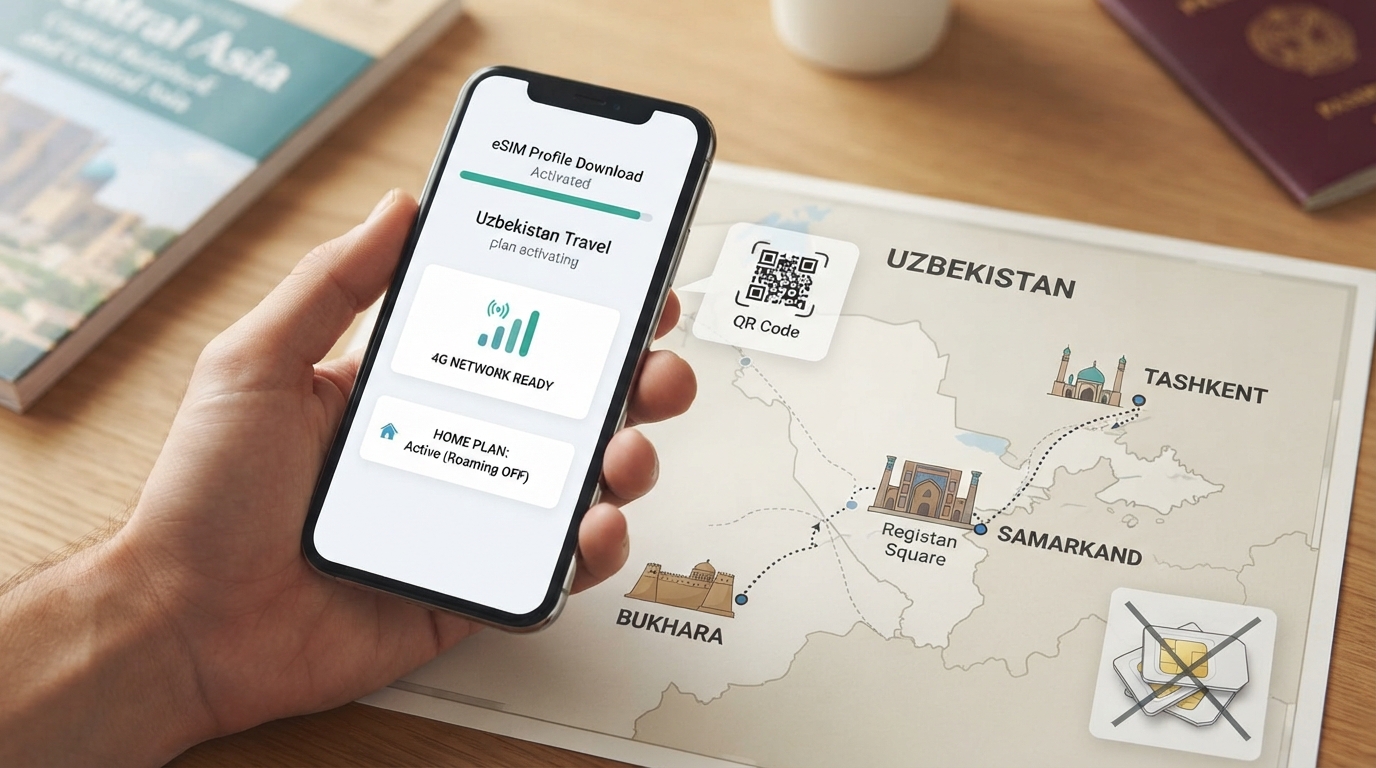
An eSIM is a carrier profile downloaded straight onto the phone instead of a physical card. A data plan for Uzbekistan is purchased beforehand at a set price, while the home number remains active in the background for calls and texts.
The most frequent error is choosing a package for one city instead of the full route.
Navigation and map checks use about 5 to 10 MB per hour of active use, which becomes important on the long desert stretches between cities, where a wrong turn can cost real time. Messaging apps and translation tools together consume around 40 to 60 MB per hour of steady use. A standard-quality video call uses about 300 MB per hour, and thirty photos sent through a messaging app total roughly 90 MB.
A day spent mostly sightseeing and messaging comes to around 300 to 500 MB. A one-week itinerary covering Tashkent, Samarkand and Bukhara is comfortably covered by 3 to 5 GB, and a longer two-week trip that adds Khiva usually fits within 8 to 10 GB, as long as offline maps are downloaded before departure.
Daily filming or uploading, joining work video calls while traveling, or sharing a hotspot with a companion all justify a larger allowance. Outside those situations, an unlimited plan is usually paying for peace of mind rather than a real need.
eSIM providers do not run their own towers; they resell access to a local carrier’s network. Coverage quality depends on which partner a plan uses, not on the brand shown on the sales page.
Tashkent has reliably strong 4G, and the high-speed rail corridor linking it with Samarkand and Bukhara is well covered for most of its length, since the line runs near populated areas. Coverage becomes noticeably weaker in the open desert sections away from the rail line and in some of the more remote approaches to Khiva, where a phone may drop to a slower connection or lose signal for stretches at a time.
Downloading offline maps for the desert parts of the trip, instead of depending on a live connection, is the habit that avoids the most frustration on this route.
Prices for the same amount of data to the same destination can vary greatly between providers. Spending fifteen minutes comparing before buying is usually worthwhile, especially because the entire process is online and there is no time pressure.
If you want to compare several providers side by side and see the best eSIM for Uzbekistan in one place, it saves the back-and-forth between tabs the night before a flight.
The biggest benefit of an eSIM is that the whole setup is done at home, on your own wifi, without any pressure.
After purchase, a QR code arrives by email. It is scanned from the phone’s settings, under the section for SIM cards and cellular network. The profile downloads in seconds and appears alongside the home carrier’s line. Giving it a clear label, such as the destination name, helps avoid confusion the next time you travel.
One thing to verify: downloading the profile is not the same as starting the plan’s validity period. Most providers begin counting days from the first connection to the local network, but some start from the purchase date. If the package is bought well in advance, it is worth checking which rule applies.
Set the Uzbekistan profile as the default for data, and keep the home line active for calls and texts. Turning off data roaming on that line is the one setting that stops the phone from quietly switching back to expensive home data whenever the local profile briefly loses signal in the desert stretches, which is the most common reason for surprise charges after a trip.
Ten gigabytes for a five-day Tashkent-Samarkand-Bukhara loop is usually money left unused. Buying a smaller package and topping up through the provider’s app takes only a few minutes if necessary.
Begin with the simplest fix: switch airplane mode on for about fifteen seconds, then off. This makes the phone search for a network again and solves most cases right after landing. Next, check in settings that mobile data is assigned to the correct profile, since a restart can sometimes reset it to the default.
If that does not work, turn off automatic network selection and manually choose the operator named by the provider. Also check the APN settings, which some plans require entering manually, usually listed in the same email as the QR code.
Before contacting support, make sure the plan has actually been activated rather than only downloaded, and that the data allowance has not already been used.
Uzbekistan is outside the roaming agreements that make travel within the EU simple, so connectivity along a Silk Road route is something to plan for rather than assume. An eSIM bought in advance, sized at 3 to 5 GB for a week covering Tashkent, Samarkand and Bukhara, meets the needs of most travelers using maps, messaging and translation tools.
The preparation takes about fifteen minutes at home: checking that the phone is compatible and unlocked, comparing a few offers, buying the package that matches the actual route, and downloading the profile. Once you land, the rest takes care of itself.