

"Someone must take responsibility." A family from Chirchik is seeking compensation for a house destroyed in an accident involving heavy machinery
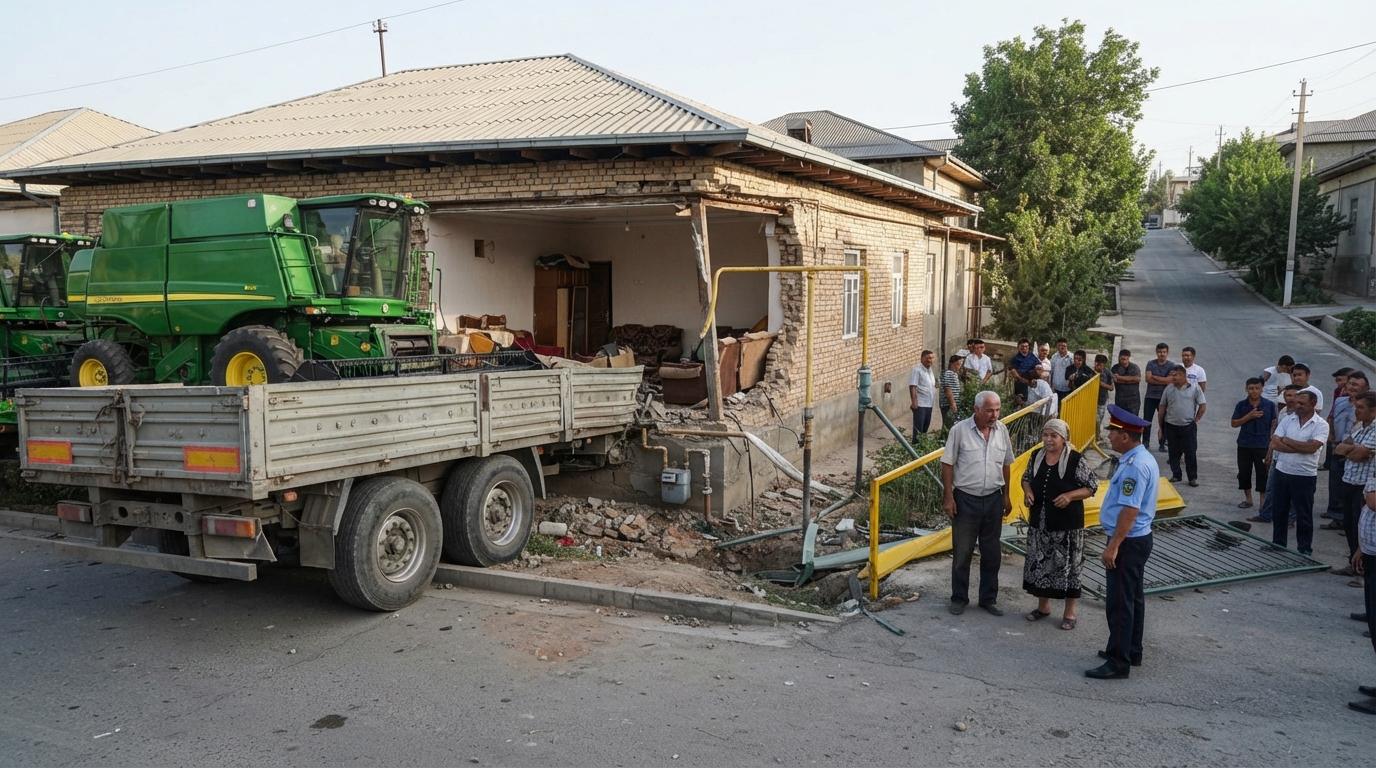
In Chirchiq, a semi-trailer loaded with combine harvesters detached from a truck and crashed into the home of the Berdibekov family. As a result of the incident, the walls and roof were destroyed, and a gas pipe was damaged. A month later, the residents have still not received compensation and are restoring the house on their own. "Gazeta" investigated the situation.
"Someone must take responsibility." A family from Chirchiq is seeking compensation for a house destroyed in an accident involving heavy vehicles
On September 10, on Sadriddin Ayni Street in the city of Chirchiq, Tashkent region, a semi-trailer carrying two combine harvesters detached from a truck. It rolled down the road and crashed into a private house belonging to an elderly couple, Gulbi Turdikulova and Abduvali Berdibekov. The semi-trailer destroyed a brick fence, walls, and part of the roof, and damaged the interior finish, property, and a gas pipe.
According to the city khokimiyat, the circumstances of the incident are being investigated by the Chirchiq City Road Safety Department. The Ministry of Internal Affairs reported that the inspection is being conducted by the city Department of Internal Affairs. A month has passed, but the family has not yet received an official assessment of the damage or learned who has been held responsible for what happened. The gas supply has still not been restored, and the residents have begun repairing the house on their own.
Gulbi Turdikulova and Abduvali Berdibekov settled in the one-story house No. 5/1 in 8 March Passage in Chirchiq in 1986. Their children grew up here, later starting their own families and moving away. The couple remained living together alone.
One side of the house faces the roadway. The family considers this section of the street dangerous. The road goes downhill and makes a turn near the houses. Gulbi Turdikulova recalls that trucks had lost control here before, hitting guardrails and posing a threat to neighboring houses.
"Our street is very dangerous, there are many turns here. Cars have crashed into the walls of neighboring houses several times and knocked down protective barriers installed by the authorities along the road. ZIL trucks also ran off the road and nearly crashed into the houses. We spoke about this to the officers of the Department of Internal Affairs, but they only came, looked around, and left. I regret that we didn't film everything on video back then — now we could show that similar incidents have already happened here," says Gulbi Turdikulova.
On September 10, around three o'clock in the afternoon, the woman performed her prayers and left for the market. Her husband stayed at home. Usually at this time, he rested in the living room facing the street. But that day, Abduvali Berdibekov first sat down to eat in the kitchen, and then was going to move to the hall to lie down.
"We spend almost all our time in the living room. Fortunately, that day I left for the bazaar, and my husband hadn't managed to lie down to rest yet. God saved us," the woman says.
At approximately 15:30, Abduvali Berdibekov heard a loud impact. He tried to open the door to the living room, but it would not budge: the impact shifted the structures, and the passage was blocked. Leaving the house, the man saw a semi-trailer carrying two cotton harvesters on the street, which had demolished the brick fence and crashed into the house. According to the couple, there were two combines on the platform. One of them is visible in a photograph taken after the incident.
Gulbi Turdikulova was informed about what happened around four o'clock in the afternoon. When she returned from the market, the house was already destroyed, and the combines were standing in the yard.
"It was terrifying to look at. Everyone around was doing something, various emergency services arrived, but I was in a state of shock and didn't understand who exactly had arrived and what documents they were drafting. It was a great shock for my husband and me. My blood pressure rose, and the paramedics who arrived gave me an injection. My husband's blood pressure was also higher than usual," the woman says.
Later, officers of the internal affairs bodies, the road safety service, the Ministry of Emergency Situations, the gas supply organization, and medical personnel arrived.
According to the family's version, the truck tractor with the semi-trailer was going up Sadriddin Ayni Street. At the turn, the vehicle collided with a passenger car. The impact damaged the coupling device, and the semi-trailer rolled backward down the slope.
"The semi-trailer was very long — about 20 meters. Together with the two combines, it weighed, according to my estimates, 50–60 tons. As I learned later, when the truck was turning, a passenger car came out toward it. A collision occurred, the driver steered right, and the hitch failed. The trailer detached and rolled backward down the incline. First it clipped our neighbor Tahir's house, then crossed the curb, demolished protective structures, and drove into our house," Berdibekov says.
The couple themselves did not see the moment of the accident and reconstructed the course of events from the words of eyewitnesses. Official authorities have not yet confirmed a possible collision with a passenger car. The Ministry of Internal Affairs only reported that the semi-trailer detached for technical reasons.
"A sign prohibiting the movement of trucks is installed on this section, as well as a sign warning of a 12% slope. This means such vehicles are not allowed to drive on this road. In addition, this is oversized cargo. As far as I understand, such transportation must be escorted, and the route checked in advance," Gulbi Turdikulova explains.
The semi-trailer carrying the combines. Photo taken by the family on the day of the accident.
Clearing the aftermath of the accident took several hours. According to Abduvali Berdibekov, they first removed one combine from the semi-trailer, then the second. After that, workers tried to pull out the semi-trailer itself, but the power of one crane was not enough, and additional equipment had to be brought in. The work continued until approximately midnight.
"When all the equipment was finally removed, representatives of the khokimiyat, gas service, and police gathered near our house. They said that tomorrow at ten o'clock they would meet here again to decide what to do next. The next day we waited for them, but no one [from the authorities] came," the man says.
When the equipment left the yard, the couple was able to fully assess the damage. Part of the outer wall of the living room collapsed from the impact, the ceiling and roof suffered, and windows were shattered. Furniture and household appliances were destroyed in the room. The trailer also damaged a gas pipe running along the wall and the meter.
The combines being transported through Chirchiq were intended for LLC Toshkent traktor zavodi, a state producer of agricultural machinery that has been operating under the AgroTech Klaster brand since March 21, 2021. The enterprise was created as part of the formation of an agricultural machinery manufacturing cluster in Chirchiq. The plant produces tractors, grain harvesters, and cotton harvesters.
According to General Director Ulugbek Matkarimov, the enterprise did not organize the transportation, did not select the transport company, and did not hire the driver. These responsibilities lay with the Chinese supplier — Xinjiang Boshiran Intelligent Agricultural Machinery.
"Under the contract, the Chinese company was supposed to deliver the combines to the territory of our plant. It hired the drivers and transport. The truck did not belong to us, the driver did not work for us. Our enterprise acted as the recipient of the machinery, and the supplier was responsible for delivery," Matkarimov said.
In a reference provided to the editorial office, the plant cites a contract with the Chinese company Xinjiang Boshiran Intelligent Agricultural Machinery dated June 9, 2026. According to the enterprise, the parties agreed on delivery under CIP — Chirchiq terms according to Incoterms 2020 rules, and Xinjiang Boshiran was to select the carrier, conclude a contract with it, and pay for transportation and insurance.
Matkarimov stated that he does not know the name of the logistics company, as the plant did not conclude a contract with it. The editorial office was also not informed about who owned the truck tractor and semi-trailer or which company employed the driver. It was not possible to contact him.
The enterprise also provided a report dated September 12. It was drawn up by representatives of the plant, the makhalla, the city khokimiyat, and internal affairs bodies. The document states that the combines were transported by a logistics company engaged by Xinjiang Boshiran, and that it must fully compensate for the damage caused.
In turn, the Chinese supplier sent a letter to the plant expressing its readiness to settle the consequences of the incident at its own expense. However, the document mainly concerns damage to the combine, its diagnostics, and repair. The letter does not name the owners of the damaged house, nor does it specify the amount, timeline, or procedure for receiving compensation.
The day after the incident, the general director of AgroTech Klaster and his deputy met with the owners of the house.
According to Gulbi Turdikulova, they promised to help with repairs. However, the woman asked to first inspect the house, assess the damage, and secure the enterprise's obligations in writing. She feared that without this, the builders would only fix the visible damage to the wall and roof without checking the rest of the structure.
"I looked at the house and replied that you can't just patch it up. I asked one of the representatives: 'Would you live in such a house yourself?' After such an impact, it needs to be inspected, the damaged part dismantled, and rebuilt from scratch. I offered two options: either let them build us a small room in place of the destroyed one, or invite a commission, assess all the damage, and pay this amount so that we can do everything with good quality ourselves," Turdikulova says.
Abduvali Berdibekov also says that the enterprise only offered "feasible assistance," without specifying what exact work it was ready to perform and who would be responsible for its quality. The family asked to draw up a document recording the scope and timeline of the restoration.
"They said they would help as much as they could. But what does 'as much as they can' mean? We didn't know what materials they would bring, what the quality of the work would be, and what exactly they intended to restore. If they quickly lay a few bricks, raise the roof, and leave, and then an earthquake happens or the ceiling collapses again, who will be responsible? Therefore, we asked that everything be done legally. If they don't want to handle the repairs, let them pay the cost, and we will hire craftsmen ourselves," says Abduvali Berdibekov.
According to the couple, monetary compensation was mentioned, but representatives of the enterprise did not agree to transfer money to the family. Gulbi Turdikulova emphasizes that the owners did not refuse the restoration of the house as such — they wanted to understand the scope of work and receive guarantees that the building would remain safe after repairs.
Representatives of the enterprise describe the meeting differently. Ulugbek Matkarimov told Gazeta that the enterprise had no legal obligation to restore the houses, since the transportation was organized by another company. Nevertheless, according to him, the plant offered help "out of human considerations."
"We came to the house owners and asked what help they needed: repairs, legal advice, or something else. Although it was not our duty, we offered to restore the damaged parts. As I understood, the elderly people agreed, but a young woman who was there said we shouldn't do anything. She explained that the family has a lawyer and they would resolve the issue with the logistics company. We also reported this to the authorities conducting the investigation," Matkarimov stated.
In support of its position, the enterprise provided an act drawn up on September 12 and signed by representatives of the plant, makhalla, khokimiyat, and internal affairs bodies. It states that the plant offered to help repair the damaged part of the house, but a relative of the owners, Zhazira Baikuatova, asked not to start work before consulting a lawyer and promised to contact the enterprise if necessary.
Neither she nor the owners of the house signed the act, so the document reflects only the position of those who compiled it and does not confirm that the family definitively refused repairs or compensation. The couple noted that on that day, their son and his wife spoke with the plant's representatives, voicing the position of the affected family — not to start work until its scope and the safety of the house are determined.
Failing to agree with representatives of the enterprise on the procedure for restoring the house, the family turned to a lawyer for help. A separate appeal was sent to the Transport Control Inspectorate under the Ministry of Transport. Having received no specific decision, on September 23 the family wrote to the Virtual Reception of the President.
"We were forced to hire a lawyer because we ourselves do not know all the laws and cannot go to various organizations. We asked for only one thing: let everything be legal. Let a commission come, inspect the house, calculate the damage, and say who should compensate it. We don't need anything belonging to others; we want to restore what was destroyed. But so far there is no result," says Gulbi Turdikulova.
The khokimiyat of the city of Chirchiq confirmed to Gazeta that it had received the family's appeal. It was considered by the city housing and construction department. The causes of the traffic accident are being investigated by the city road safety department, which must also give a legal assessment of the circumstances of the incident.
However, the khokimiyat did not report whether the interdepartmental commission requested by the family was created, which means there is also no information about a technical inspection of the walls, roof, and other structures.
The administration noted that the amount of material damage and the procedure for its compensation must be determined by authorized bodies after a legal assessment of the incident. At the same time, the specific organization required to conduct such an assessment was not named in the response.
"Currently, the owners are repairing the part of the house damaged as a result of the traffic accident. The roof has been completely replaced with corrugated metal sheeting; construction and repair work continues. If specialists establish that the condition of the structures threatens the safety of citizens, authorized organizations will take the necessary measures," the khokimiyat's response states.
The issue of gas supply also remains unresolved. The khokimiyat confirmed that as a result of the traffic accident, the gas infrastructure of the house was damaged. The administration indicated that restoration falls within the competence of the gas supply organization and is possible after checking the technical condition of the network. The response does not state exactly when specialists will conduct such a check and resume the gas supply. According to the family, there has been no gas in the house since September 10.
The circumstances of the traffic accident are being investigated by the Chirchiq City Department of Internal Affairs. In response to an inquiry from Gazeta, the Ministry of Internal Affairs reported that the inspection is being conducted under Article 133 of the Code of Administrative Responsibility. It provides for liability for a driver's violation of traffic rules resulting in minor bodily injury or significant material damage.
The MIA statement also says that damage to the house will be compensated in accordance with the procedure established by legislation. However, the response does not clarify who exactly must pay compensation, how its amount will be determined, or what actions the victims need to take.
At present, none of the agencies has informed the owners of specific results regarding the consideration of their appeals. There have been no new meetings with representatives of the enterprise since early October.
"After the incident, various services came, everyone wrote something down and inspected. We thought that later they would give us documents and explain what to do next. But to this day we have neither an official damage assessment nor a conclusion on the condition of the house. Everyone says the issue is being studied, and we have to decide for ourselves how to cover the destroyed part of the house," says Abduvali Berdibekov.
Without waiting for the damage assessment and the start of restoration work, the family was forced to dismantle the damaged structures on their own. The owners dismantled the roof and are now rebuilding the wall of the destroyed room.
"The rainy season is beginning, it is getting colder, and my wife and I are left in this house alone. We couldn't wait any longer, so we started the repairs ourselves. We dismantled the damaged parts of the house — leaving them was dangerous. No one helped us," Abduvali Berdibekov relates.
"More than a month has passed, but after the first days of the incident, no one else took an interest in our situation — neither from the makhalla, nor from the khokimiyat, nor from the plant. As if nothing happened. We are not asking for much. For us, the main thing is that we be compensated for material and moral damage and that someone finally takes responsibility for what happened," Gulbi Turdikulova adds.
The family emphasizes that the repairs they have begun do not mean a waiver of claims against those responsible for the incident. The house owners fear that further waiting will lead to new destruction, so they are performing only the necessary work without waiting for the investigation to complete. They have not yet calculated the restoration expenses.