

Snow is melting earlier, and glaciers are shrinking. How is Central Asia's water balance changing?
The melting of the Pamir and Tien Shan glaciers is changing the seasonal flow of Central Asian rivers. This could exacerbate water scarcity during the irrigation season, while high-altitude glacial lakes pose a risk of sudden flooding. Scientist Abror Gafurov on how the water balance in the region is changing.
Snow is starting to melt earlier, and glaciers are shrinking. How is the water balance changing in Central Asia?
Climate change is accelerating the melting of glaciers and the reduction of snow cover, while the glacial lakes forming in this process could pose a threat to populations living in mountainous areas. Abror Gofurov, a researcher at the German Research Centre for Geosciences, provided information about these processes and their consequences.
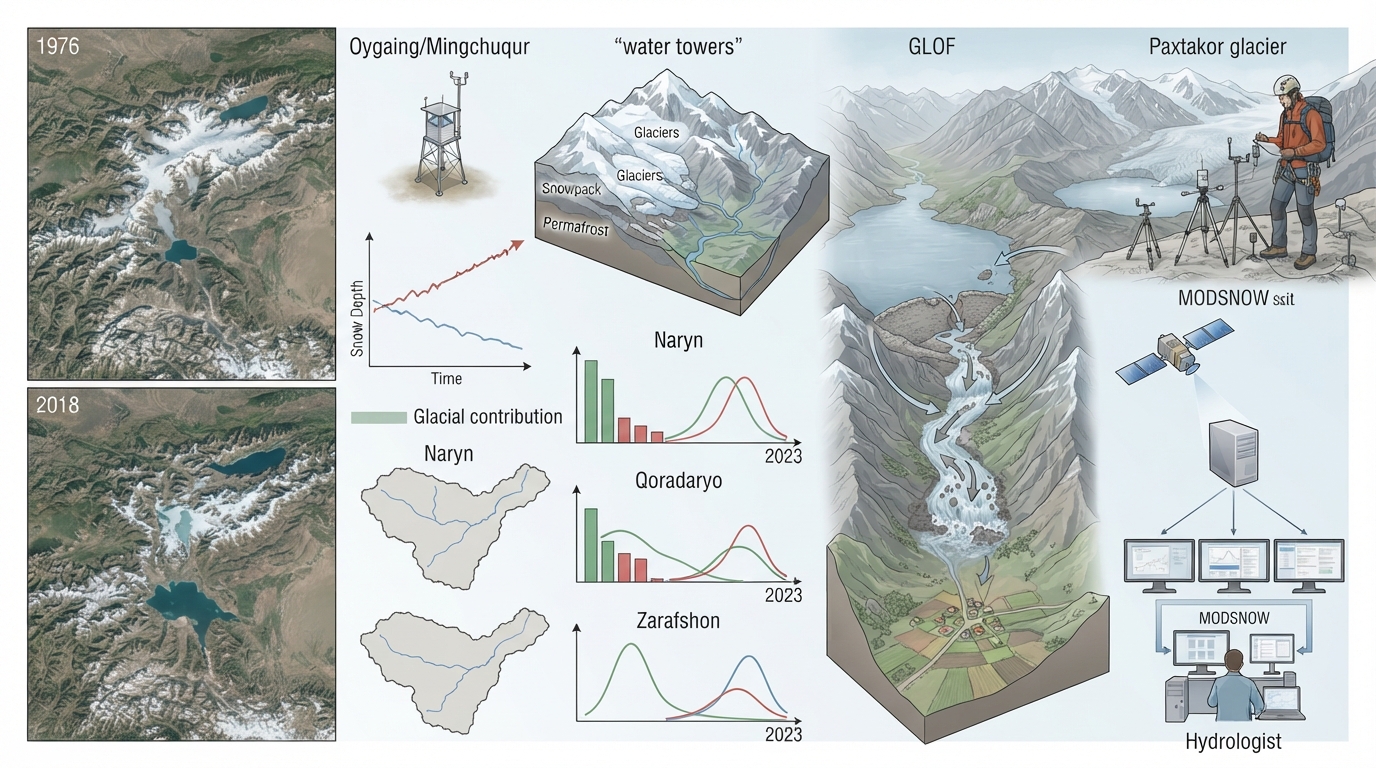
The region's main rivers originate in the high mountains of the Pamir and Tien Shan, which Abror Gofurov called the "water towers" of Central Asia. It is in this area that the main flow of the rivers is formed, and glaciers and melting snow serve as the primary source during the hot summer months when agriculture's water demand is at its highest. Due to climate change, this system is changing: snow cover is shrinking, glaciers are melting, and water supply in the summer season may decrease in the future.
As an example, the scientist cited long-term observation data from two high-altitude meteorological stations in the Kashkadarya region — Oygaing and Mingchuqur. They show a steady increase in average daily and annual temperatures, while the total amount of precipitation remains virtually unchanged. At the same time, the thickness of the snow cover is consistently decreasing, and the most significant trend in this regard has been observed in recent decades.
The Pakhtakor glacier was presented as a clear example of glacier shrinkage. An analysis of a series of satellite images taken from 1993 to 2023 showed that its area had decreased by almost 25 percent over 30 years.
As part of the study, hydrological models were developed for the Naryn, Karadarya, and Zarafshan river basins. The calculations took into account temperature scenarios up to the year 2100.
The models show temperature increases in all considered basins. In the Karadarya basin, glaciers had already disappeared by 2023. Rapid melting is currently being observed in the Naryn basin, while this process is proceeding somewhat slower in the Zarafshan basin.
To forecast future runoff, Gofurov presented data for several gauging stations — Uchkurgan (Uch-Terek), the Andijansay river flow, Dupili, and the city of Naryn. On the graphs, the historical period is represented by a green line, while future scenarios are shown with red and blue lines.
According to the model, the high-water period of the rivers will shift to earlier dates in the future, which could further exacerbate water scarcity in the summer. According to the scientist, the water volume in the Uch-Terek basin will significantly decrease in July and August in the future, which will deal a serious blow to irrigated agriculture. A sharp deficit is not expected in Andijansay, but due to the early melting of snow, the peak flow will shift to early spring.
Abror Gofurov separately analyzed the nature of floods caused by the outburst of glacial lakes — GLOF (Glacial Lake Outburst Flood). Lakes form in place of retreating glaciers, and their outburst can cause sudden floods that are dangerous for downstream settlements.
As a visual example, he demonstrated two satellite images of a glacier near the Big Almaty Lake in Kazakhstan, taken in 1976 and 2018. The images clearly show how the glacier area has shrunk and how new lakes have formed.
The scientist said that he, along with his colleagues, organizes an annual expedition to the Pakhtakor glacier for monitoring purposes. On the way there, the group observed one such lake located in the Pskem River basin in Uzbekistan.
Gofurov also recalled the disaster that occurred in Nepal on August 26, 2026: an outburst flood caused by a glacier collapse claimed the lives of more than 500 people (as of September 19, the death toll exceeded 1,400). He called this event a "wake-up call" not only for the Himalayan region but also for Central Asia, and stressed the need to invest in scientific analysis, monitoring, and data exchange to protect settlements.
The scientist also recalled a similar situation in neighboring Kyrgyzstan — a glacier collapse that occurred in the Issyk-Kul region in July 2022. According to him, no one was injured then only because the area was located in a hard-to-reach place.
Speaking about technical solutions, Gofurov highlighted the MODSNOW tool. This system allows obtaining data on snow cover and glaciers using satellites and modeling, and then presenting them to decision-making authorities. Central Asian hydrometeorological services have been using it for more than 10 years. This very system is also used to monitor the risk of glacial lake outbursts.