

Should, but not obliged
The decarbonization process has swept Central Asia. Not a single country in the region is capable of fully financing the changes on its own
**Should, but not obliged to**
Decarbonization issues are at the center of attention for Central Asian countries. They are regularly raised at international conferences and at meetings of Central Asian state experts with representatives of international organizations and external players. The increased and sustained interest in this topic is explained by expectations of economic benefits.
In recent years, Central Asian countries have set a course toward decarbonizing their economies, which means moving away from high-carbon fuels. One way to address this challenge is the transition to renewable energy sources (RES), which should help reduce the carbon footprint of various sectors of the economy.
The states of Central Asia have set ambitious goals to achieve carbon neutrality. Formally, their aspirations are explained by the need to fulfill the tasks outlined at the Paris Climate Conference. Alongside environmental goals, Central Asian countries hope to create conditions for further integration into the global economy. However, these plans raise many questions: are the countries of the region ready to implement them, what price will have to be paid for decarbonization, and what goals are pursued by the external players promoting this course in Central Asia.
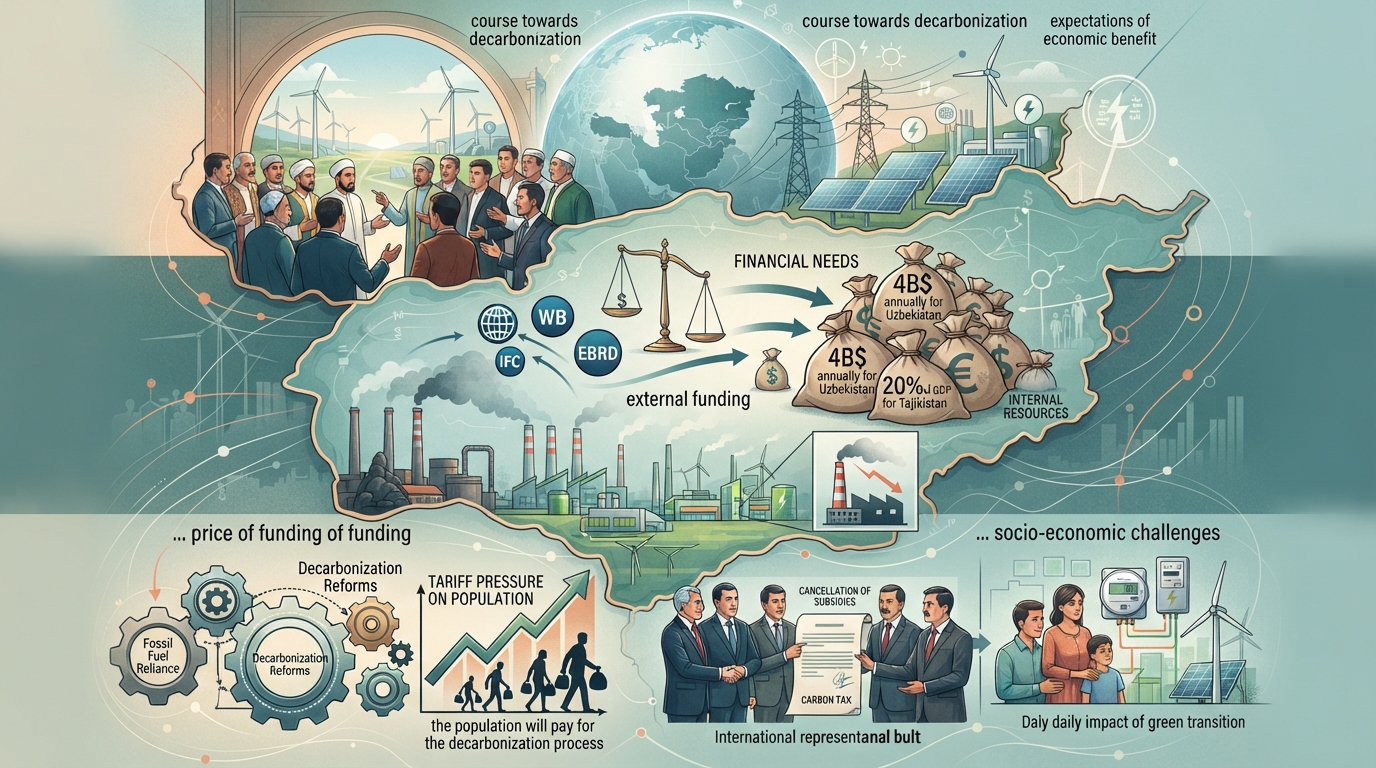
First of all, it is worth noting that Central Asian countries lack the financial resources to implement their decarbonization plans. The capabilities of Central Asian states are highly limited, and they are able to allocate only a small fraction of all necessary costs. Therefore, the main burden of financing is already falling on external sources. These are mainly the Asian Development Bank (ADB), the World Bank, the EBRD, the IFC, and other international financial institutions. In 2020–2025, Central Asian countries received about $25 billion from them. Of this amount, approximately $15 billion was directed directly toward decarbonization, and the rest toward climate change adaptation.
The allocated funds are important for the countries of the region, but at the same time, they fall significantly short of the volumes required for decarbonization. For example, according to estimates from the World Bank Group's "Country Climate and Development Report" (CCDR), by 2060, replacing outdated energy infrastructure and decarbonizing Uzbekistan's energy sector alone will require about $340 billion. Another approximately $60 billion will need to be directed toward adaptation, such as combating land degradation and modernizing irrigation. Overall, all calculations show that Central Asian countries will need enormous sums to transition to a low-carbon economy. For Tajikistan, these are estimated at 20% of GDP, and for Kazakhstan — at 270% of GDP. In particular, according to the Ministry of Finance of Uzbekistan, until 2030, the country needs to spend $4 billion annually on decarbonizing the electricity sector, which is almost 5% of GDP.
But without external financing, the countries of the region will not be able to achieve their stated goals. None of the Central Asian states is capable of fully ensuring decarbonization through domestic sources. This process is associated with serious socio-economic challenges that the countries of the region will have to address. Decarbonization involves developing new areas of energy to achieve carbon neutrality. However, there are no guarantees that Central Asian countries will be able to localize the production of necessary components or avoid becoming heavily dependent on external equipment supplies, which would worsen their technological lag.
In addition, the countries of the region will have to constantly find a balance between the course toward decarbonization and maintaining a high dependence on fossil energy sources. Finally, many developed countries, primarily in the EU, are launching carbon border adjustment mechanisms. This will directly affect Central Asian countries that export raw materials and resources for further processing. For instance, in Kazakhstan, products are manufactured with high greenhouse gas emissions, and a significant portion of the country's electricity is generated using coal. Phasing out coal-fired capacity will require substantial investment. In addition to energy, decarbonization will affect transport — the transition to electric vehicles and the creation of charging infrastructure; agriculture — water-saving technologies and climate-smart agriculture; as well as forest and landscape management.
The most common opinion is that the set goals in the field of decarbonization can be achieved through cooperation and developing partnerships with international institutions and donors. It is they who must provide the necessary resources. Usually, successful cases of implementing individual technologies or using energy-efficient solutions are cited as examples. Indeed, international financial structures declare their readiness to allocate significant funds to Central Asian countries to implement the decarbonization course. Moreover, external players are demonstrating not only a readiness to support the aspirations of Central Asian states in implementing their plans, but are also offering feasibility studies for specific projects and developing roadmaps for cooperation in this area.
However, such experience can only be considered an initial stage. In particular, external donors are raising the issue of conducting reforms to create a favorable environment, which should lead to the elimination of gas and electricity subsidies and the introduction of a carbon tax. All current projects are being implemented against future revenues from the introduction of RES and the development of natural resources, as well as in anticipation of increased tariff pressure on the population. Accordingly, external financing so far covers only the initial costs, which in the future will have to be returned to external players through tariffs, tax increases, and concessions on natural resources.
Decarbonization is not about abstract benefits from reducing risks associated with climate change, but about concrete government expenditures. In the absence of funds, the financing will be shifted to the population of Central Asian countries, who will end up paying for the decarbonization process.