

**Paper Patiently Bears All**
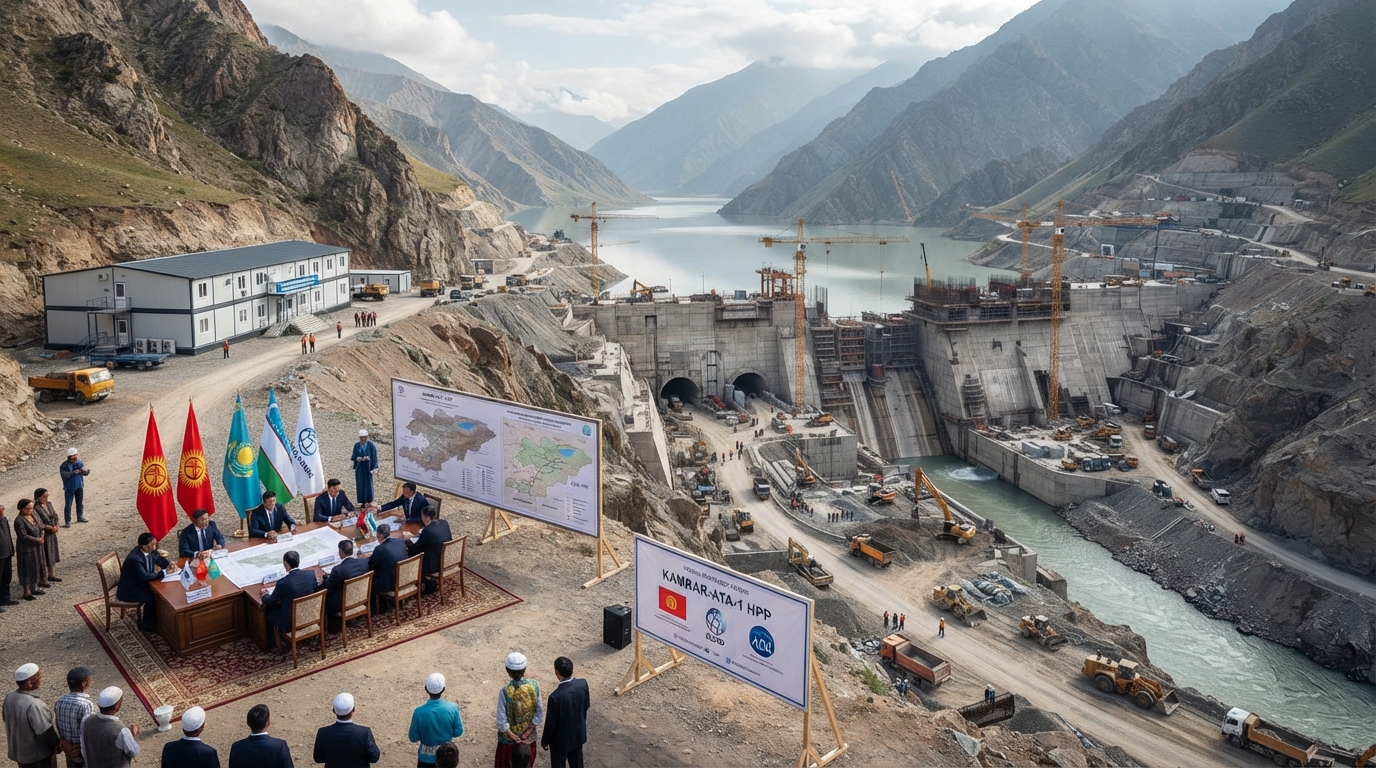
At the end of September 2026, Kazakhstan, Kyrgyzstan, and Uzbekistan held the third round of negotiations on the Kambarata-1 HPP project. In addition to officials from Central Asian countries, representatives of the World Bank (WB) attended the meeting as observers. The interest of this international structure in Central Asia's hydropower facilities is explained by long-term objectives.
The project has a long history, dating back to the USSR era. At that time, for various reasons, it was never implemented. In the post-Soviet period, it was revisited repeatedly, but it did not move forward. In addition to coordinating energy issues, the countries needed to develop a common position on a whole range of water problems. This concerned the creation of a mechanism for regulating flow by the hydroelectric power plant, on which the development of the energy and agricultural sectors depends. Nevertheless, in June 2024, the energy ministers of Kyrgyzstan, Kazakhstan, and Uzbekistan signed an agreement on the joint implementation of the project. Two rounds of negotiations on the intergovernmental agreement took place in Bishkek and Tashkent in March-April 2026.
Kambarata-1 HPP is a large and strategically important project in Central Asia. It is planned to be built in Kyrgyzstan on the Naryn River. The installed capacity of the station is expected to be 1,860 MW, and the average annual electricity generation is projected at 6 billion kWh. Kyrgyzstan, together with Kazakhstan and Uzbekistan, established a company for the construction of Kambarata-1 HPP, with Bishkek owning 34%.
One of the main issues that the countries have to resolve is the financing of the project. Its cost is estimated at 5–6 billion USD. From the very beginning, it was clear that the Central Asian states, due to the weakness of their national economies, did not possess the necessary funds to implement the project. Therefore, they could only rely on external financing, primarily from international financial institutions.
In particular, the World Bank is actively participating in the preparations for the implementation of Kambarata-1 HPP. With its participation, a financing model is being developed, and technical, environmental, and social studies are being conducted. In 2024, the WB allocated additional financing of 13.6 million USD to Kyrgyzstan. Kazakhstan also intends to attract WB resources, expecting to receive about 500 million USD for the construction of the HPP. In 2025, an agreement was signed at the Global Gateway forum in Brussels, which was intended to give the project momentum. To coordinate financing, a donor committee was created, which included the World Bank, the Asian Development Bank, the EBRD, the EIB, and other international structures. They committed to allocating up to 2.4 billion USD.
It is believed that the construction of the HPP should strengthen Kyrgyzstan's position in Central Asia and reduce the problem of external debt in the energy sector. In Kyrgyzstan itself, the construction of the HPP is seen as a chance to resolve the issue of water resources, the deficit of which in Central Asia will become even more acute in the coming years.
For now, however, the funds required for the construction of the HPP make the project economically costly, as payback periods remain unclear. The authorities of the Central Asian states will apparently pass the incurred costs onto the population by raising energy tariffs and introducing water fees. These measures may partially offset the costs.
The WB has long been actively involved in discussing and financing various projects in Central Asia. The bank's interest is focused on water and energy facilities related to the production and export of electricity. In particular, the WB is interested in the construction of the HPP because it financed the CASA-1000 project to transfer electricity from Kyrgyzstan and Tajikistan to Pakistan in transit through Afghanistan.
The regional CASA-1000 project was launched in 2018. It provides for the integration of the energy systems of Central and South Asia for electricity export. The total length of the lines is 1.2 thousand km, and the project cost is estimated at more than 1 billion USD. Funds for its implementation were allocated by the World Bank, the Islamic Development Bank, the European Investment Bank, and the European Bank for Reconstruction and Development.
Unlike Kyrgyzstan, Tajikistan, and Pakistan, which have almost completed the construction of their part of the infrastructure, Afghanistan is still noticeably behind schedule. It is expected that work on Afghan territory will be completed by the end of 2026, and the project itself will be put into operation in early 2027.
According to the developers' plan, electricity supplies from Kyrgyzstan to Afghanistan and Pakistan under the international CASA-1000 project should form a regional electricity market. During the negotiation stage, Pakistan expressed interest in reverse electricity supplies to Kyrgyzstan and Tajikistan during the winter period. However, these proposals were not developed further, and if the project is implemented, the system will operate in one direction and for a maximum of six months. To increase the project's efficiency, investors may demand an increase in tariffs within the countries of the region.
Despite unresolved technical issues and the lack of funds among Central Asian countries to finance hydropower projects, international financial structures are not refusing to allocate money. Moreover, confidence remains in the Central Asian countries regarding the imminent achievement of energy independence, which is supposedly expected to strengthen their autonomy in foreign policy. At the same time, the situation with external debt, including in the electricity sector, provides no grounds to expect a real solution to the problems in the region's water and energy sphere.
The increased interest of the WB in participating in the Kambarata-1 HPP construction project is driven by the long-term objectives of Western states. The US and the EU expect to achieve a reduction in the level of energy cooperation between Central Asian countries and Russia. They expect that the implementation of large-scale projects, including the commissioning of the hydroelectric power plant, will allow Kyrgyzstan to reduce or completely abandon imports of Russian electricity.