

"Second Chance": a nationwide project changing the fate of convicts
The intermediate results of the 'Second Chance' project, which teaches English and computer literacy to prisoners aged 18 to 30 in Uzbekistan, have been summarized. The project is fully funded by UNICON-SOFT.
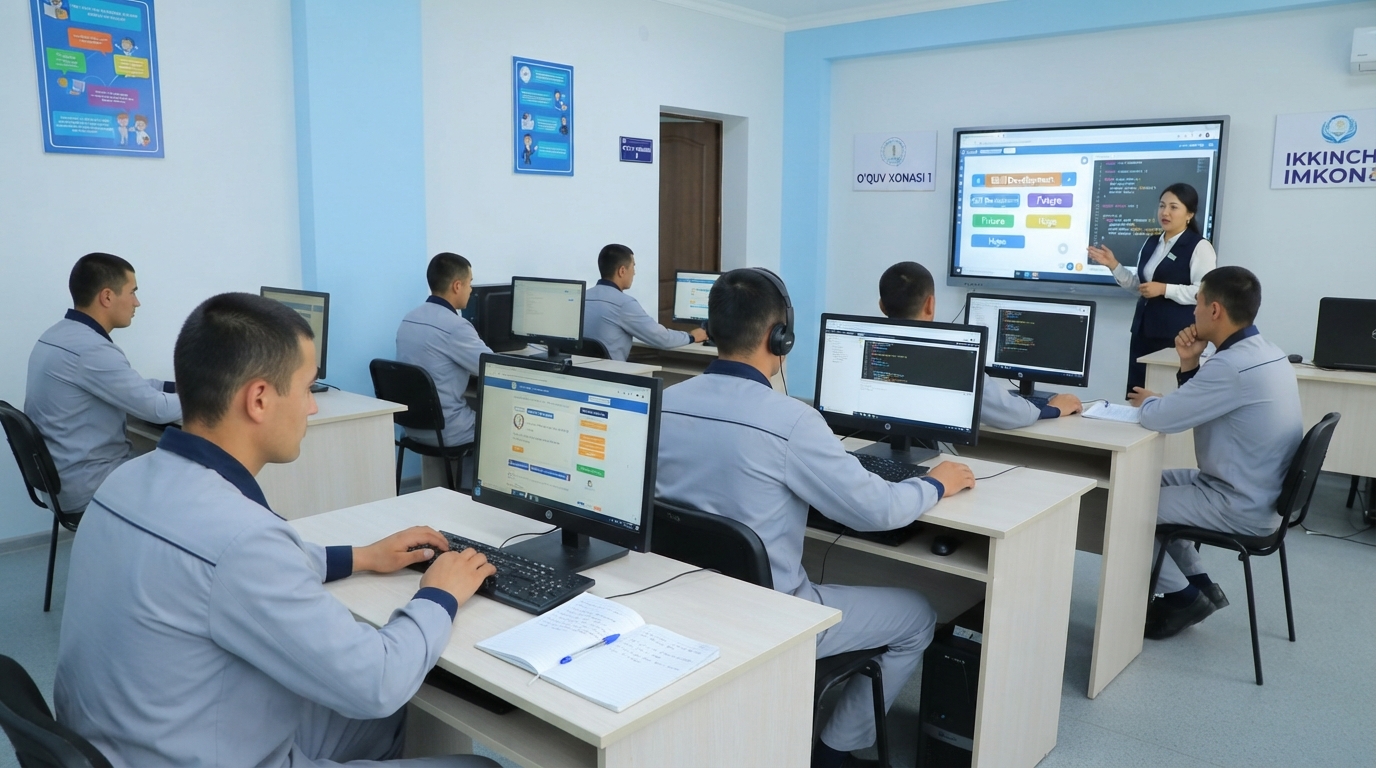
“Second Chance”: a nationwide project changing the lives of inmates
UNICON-SOFT has supported the “Second Chance” project launched at the initiative of the head of state. The project has already begun to yield its first results. In particular, among the inmates participating in it, the average level of English language proficiency stands at 89 percent. In addition, 80 percent of the listeners successfully completed the “Computer Literacy” course, which testifies to the high practical effectiveness of the project.
Today, more than 300 inmates aged 18 to 30 in 11 correctional facilities across the republic are learning English and modern professions. The initial results achieved during a short period — five months of activity — demonstrate just how effective the project is.
Classes within the framework of the project began on June 1 in Tashkent, Navoiy, and Qashqadaryo regions. Selected through test trials and oral interviews, 311 inmates underwent intensive training in foreign language and computer literacy courses over the past period.
Final control assessments were conducted for the A1 level of English and “Computer Literacy” courses. The results show that 88.6 percent of the listeners successfully mastered basic knowledge in English, and 79.5 percent in computer literacy.
The highest results were recorded in Qashqadaryo and Navoiy regions: in particular, in Qashqadaryo, mastery of the A1 level of English reached 96.6 percent, and computer literacy reached 98.3 percent. In Navoiy, these figures were 98.9 and 87.5 percent, respectively.
The knowledge level of the inmates is not assessed by the specialists who taught them. In order to ensure objectivity and transparency, independent experts are involved in the process, and control tests are conducted monthly on a special platform.
Among the correctional facilities, there are those that achieved a 100 percent result. In particular, in Colony No. 5 in Qiziltepa and Colony No. 3 in Karshi, course mastery reached 100 percent in both subjects. These indicators demonstrate how seriously the listeners are approaching their education and that they accept this project as a real opportunity to change their future.
During a dialogue with youth at the “Ko‘ksaroy” residence on February 24, 2026, President Shavkat Mirziyoyev emphasized the importance of the rapid adaptation to society of young people serving sentences and announced the launch of the “Second Chance” nationwide project. On March 27 of the same year, a relevant decision was adopted regarding this matter.
The decision is aimed at two goals: ensuring that a person released from prison does not remain unemployed and without support, as well as preventing reoffending. This project is based on the noble idea that a single mistake should not put an end to a person's future. Because true justice lies not only in punishment, but in giving a person the opportunity to return to the right path.
While the "Second Chance" project initially began as a pilot in three regions, starting from 2027 it will fully cover all correctional facilities in the republic. Most importantly, such a comprehensive rehabilitation system, supported by the state and aimed at fully returning people who have strayed into crime back to society and thereby improving their future, is an absolutely unique initiative not only in Uzbekistan, but in the entire Central Asian region.
While in the first stage the project was implemented as a trial in three regions, starting from 2027 it will cover all correctional facilities in the country. Most importantly, such a comprehensive state-supported rehabilitation system is aimed at helping people who have lost their way to fully return to society and thereby change their future for the better.
In fact, teaching IT and digital fields to incarcerated individuals is very rare in international practice. The The Last Mile / Code.7370 project, which began in 2014 at San Quentin State Prison in California, is considered the world's most famous non-governmental program for teaching coding to inmates. Based on the US experience, the Code4000 project emerged in the UK and was also tested in certain facilities in countries such as Australia, France, Chile, and New Zealand.
While abroad such programs are usually conducted on a limited scale by non-governmental organizations, in Uzbekistan the “Second Chance” project is being implemented at the national level based on a presidential decree, fully covering the correctional facilities in the republic. Providing guaranteed employment to graduates who participate in the project and successfully master knowledge and skills is another bright expression of the strong social policy being carried out in Uzbekistan. Precisely due to these aspects, the “Second Chance” project can safely be described as having no parallel on a global scale.
The “Second Chance” project is designed for inmates aged 18–30, involving first-time inmates who have not committed extremely grave crimes and whose offenses do not pose a major social danger. Individuals who committed crimes using information technologies are strictly prohibited from participating in the project.
Training sessions are organized on the basis of 8–12 month intensive programs, and listeners who successfully complete the courses are awarded appropriate electronically formatted qualification certificates recognized nationwide for their acquired profession.
Within the program, inmates are thoroughly taught English (A1-B2) over a period of 12 months. In addition, the curriculum includes courses in “Computer Literacy”, “Computer Service and Network Technologies”, Soft skills, data analytics, and forming skills for entrepreneurship on marketplaces.
The “Second Chance” project is funded entirely by Unicon-Soft LLC and requires no funds from the state budget. The company has taken upon itself all organizational and financial expenses — from teachers' salaries, equipping classrooms (computer sets, electronic whiteboards, educational furniture, etc.) and providing methodical literature, down to the simple notebooks and pens needed by the inmates.
On August 29, 2026, within the framework of memorandums signed between the MIA Department of Execution of Punishment, Unicon-Soft LLC, Vatan University, MAAB Innovation, and SZS Trucking, Vatan University put forward an initiative to annually educate the most successful graduate of the project for 4 years free of charge on a 100% grant basis.
MAAB Innovation, Microsoft's first official partner in Uzbekistan, expressed a desire to provide free training in a special program on data analysis for those who have mastered computer literacy and English well. Meanwhile, SZS Trucking proposed to annually train graduates with good English proficiency through short courses and hire them for employment.
All of this shows that the idea put forward by the president — the "Second Chance" nationwide rehabilitation project — is practically aimed at changing the future of every inmate for the better.
Most importantly, young men and women released after serving their sentences will no longer be left on the street or wander in search of work — with the help of the modern knowledge and professions acquired within the project, they will become owners of lucrative professions and have the opportunity to live a decent life. This, in turn, will serve their integration into society and reduce reoffending.