

Sea Breeze on Charvak received a positive conclusion of the second stage of the environmental expertise
The environmental impact assessment has approved the second stage of the Sea Breeze evaluation at Charvak, establishing a number of conditions. Among them are the preservation of the water protection zone without construction, wastewater treatment, the protection of valuable trees, and a separate assessment of the sewer collector, which is to cross the reservoir.
Sea Breeze on Charvak received a positive conclusion of the second stage of the environmental expertise
The Tashkent regional branch of the Center for State Environmental Expertise approved the second stage of the Environmental Impact Assessment (EIA) for the project of the Sea Breeze Uzbekistan all-season resort complex, which is planned on the eastern shore of the Charvak reservoir.
The positive conclusion was issued on September 10 and is valid until September 10, 2029.
The first stage of the project's EIA passed the state environmental expertise on February 10, 2026. Based on its results, the customer was instructed to conduct additional engineering-geological, hydrological, and geodynamic studies, assess mudflow and landslide risks, clarify the project's impact on air, water, soil, and biodiversity, as well as perform an assessment of the cumulative impact of recreational development, transport, and engineering infrastructure of the eastern coast of Charvak.
In addition, it was required to conduct geobotanical and zoological studies, prepare a biodiversity management plan, provide for the preservation or transplantation of valuable trees, dust control measures during the construction phase, safe waste management, land reclamation, and an emergency action plan.
In the second stage, as indicated in the conclusion, the results of engineering-geological studies, calculations of the impact on atmospheric air taking into account the transport load, information on water consumption and wastewater disposal, analysis of construction and household waste, cumulative impact assessment, and a biodiversity management plan are presented.
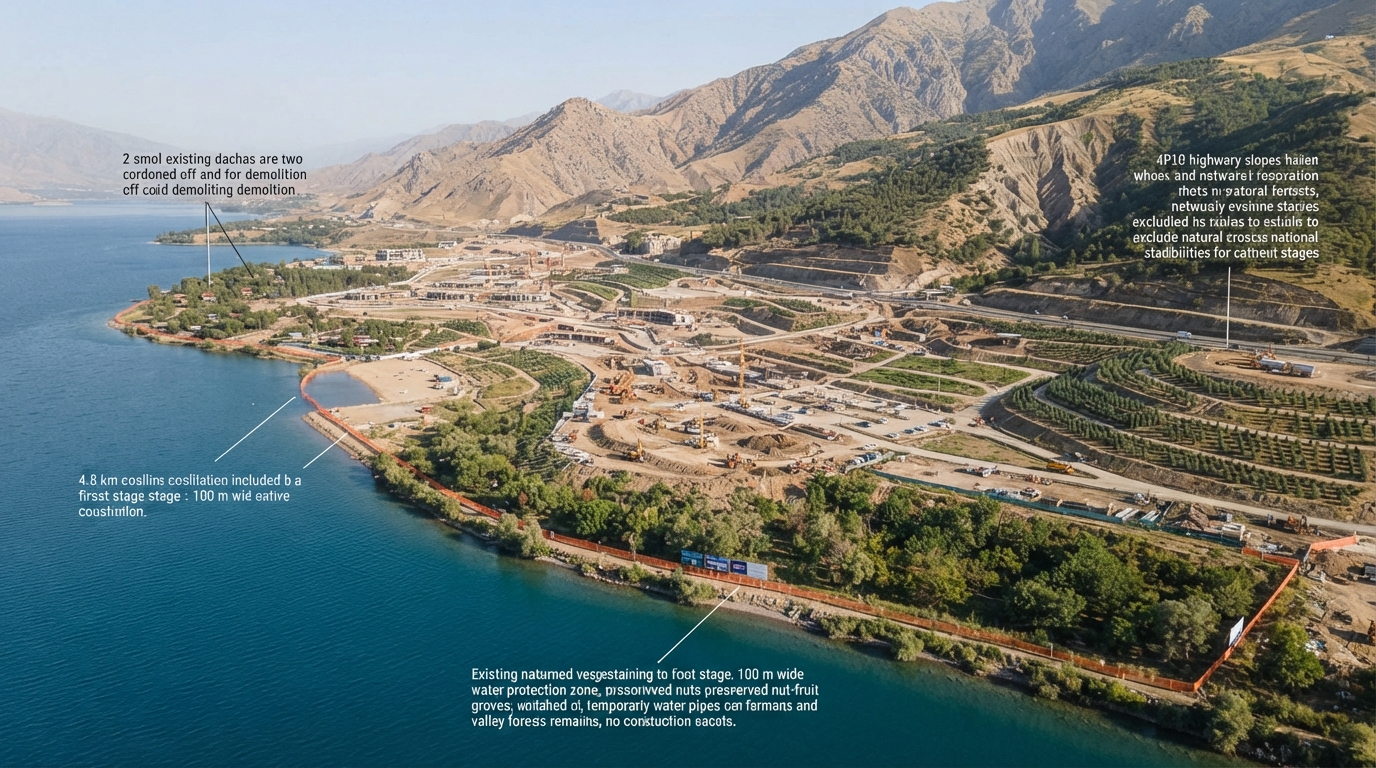
It was decided to implement the project in stages. The first phase occupies 180 hectares along the eastern shore of the Charvak reservoir, below the 4R10 highway — between Boladala and the Kalashsay valley. More than 32.4 hectares of this territory currently consist of wastelands and ravines, while the rest is occupied to varying degrees by orchards and vineyards.
On the site of the first phase, according to the customer's materials, dangerous slope processes were not identified. The mudflow- and landslide-prone part of the Kalashsay valley is not included in the boundaries of this phase.
A different picture, as follows from the conclusion, is observed on the mountain slopes above the 4R10 highway. There are risks of landslides, erosion, and mudflow floods. The expertise notes that without additional surveys and a set of measures to stabilize the slopes, development of this territory is impossible. The research and engineering work will require two to three years.
The document states that these mountain slopes were initially included in the boundaries of the projected complex with a total area of 557 hectares. At the same time, they are not considered in the current EIA, and the master plan for the mountainous territory above the 1000 m mark has not been presented. Significant areas of natural walnut-fruit forests and terraced slopes with juniper plantings are also preserved there.
The first phase with an area of 180 hectares is divided into three planning districts: Northern — 39.2 hectares, Central — 102.8 hectares, and Southern — 38 hectares.
According to the master plan, 24.1 hectares, or 13.4% of the territory, is allocated directly for development. Driveways and sidewalks will occupy 18.3 hectares, parking lots — 12.9 hectares, sandy beaches — 12.2 hectares, and artificial reservoirs — 3.4 hectares.
It is planned to allocate 79.2 hectares for decorative landscaping. Another 14.1 hectares should be occupied by natural green zones along runoff valleys, 8.5 hectares — by coastal strip vegetation, and 7.3 hectares — by walnut-fruit forests. The total share of landscaping, according to the project, will be 60.6%.
It is planned to place parks, swimming pools, beaches, and amusement rides on the territory. The length of roads and driveways inside the complex will be 13.6 km. The gas station and service station are planned to be moved outside the resort — to the 4R10 highway.
The water protection zone of the Charvak reservoir along the territory of the complex will stretch for 4.8 km. Its width is 100 m. The boundaries of the zone include the coastal strip up to the 920 m mark, taking into account the maximum filling levels of the reservoir — 896 m, the forced surcharge level — 891.25 m, and the normal surcharge level — 890 m.
The coastal strip with an area of 8.5 hectares is included in the boundaries of the recreational complex, but construction on it is not provided for. Signal signs, information boards, and observation posts must be installed along its boundary.
In the northwestern section, there are two dacha plots with four one-story buildings. The EIA materials indicate that they are located in the 100-meter protection zone of the coastal strip and are therefore subject to demolition.
In the floodplain-channel parts of Chashmasay and Gulsarysay, it is planned to preserve 4.1 hectares of valley forests, and on the left slope of Gulsarysay — five plots of walnut-fruit forests with a total area of 7.3 hectares. The coastal strip with an area of 8.5 hectares must also remain free of development.
According to the presented materials, Red Book plant and animal species were not identified directly on the considered territory of the first phase.
The expertise required ensuring the complete preservation or transplantation of valuable trees and shrubs, including walnut. For other plantings, if preservation or transplantation is impossible, compensatory planting is provided at the rate of ten trees instead of one.
Removing trees before conducting a survey and obtaining the necessary approvals is prohibited.
The project materials also speak of the preservation or transplantation of Zarafshan juniper, walnut, and Sievers apple. Trees remaining in the construction zone must be fenced. It is forbidden to store construction materials and place equipment closer than 2.5 m from trees and 1.5 m from shrubs.
In addition, the customer was instructed to clarify the volume of the fertile soil layer to be removed and develop a reclamation plan for disturbed lands. According to the project's calculations, during construction, about 726 thousand cubic meters of soil layer will be removed, which is planned to be temporarily stockpiled and then used for landscaping.
For technical needs during the construction period, water is planned to be taken from the Charvak reservoir through a temporary shore water intake. Domestic and drinking water supply for construction workers is provided from the existing Boladala water pipeline.
Total water consumption at the construction stage is estimated at 722.3 thousand cubic meters, of which about 720 thousand cubic meters will be used for production and technical needs.
During the operation period, the water intake is planned to be organized from an above-water platform 100 m from the shore. The length of the main drinking water supply network from the platform to Boladala and Yakkatut will be 14 km, and internal networks — another 13 km. Water consumption directly by the complex is estimated at 734.3 thousand cubic meters per year.
Separately, the project provides for about 3.29 million cubic meters of water per year for irrigation of green spaces, beaches, and pavements. About 1 million cubic meters, according to the materials, will enter the drainage and water disposal network and further into Chashmasay and Gulsarysay.
For domestic wastewater during construction, modular treatment facilities with a capacity of up to 10 cubic meters per day were initially indicated. However, the expertise considered such capacity insufficient, taking into account the potential growth in the number of workers.
At a peak number of up to 800 people, the estimated volume of wastewater disposal only for the main components can reach 100–116 cubic meters per day. Therefore, the customer is ordered to provide local treatment facilities with a total capacity of at least 200 cubic meters per day.
The degree of treatment of domestic wastewater must be at least 80%. The expertise separately requires excluding the entry of untreated or insufficiently treated wastewater into the Charvak reservoir, Chashmasay, Gulsarysay, and other watercourses.
After the commissioning of the complex, domestic wastewater is planned to be directed to the Bokachul sewage collector, extending it from the western shore of Charvak to the eastern one.
The new section with a length of 1420 m must cross the reservoir's water area at its narrowest point. It is planned to lay two metal pipes with a diameter of 426 mm — a working one and a backup one — in a protective casing on concrete piles. After that, the wastewater will be directed to the Chirchik treatment facilities.
At the same time, the environmental expertise directly indicated that this sewage crossing must be considered as an independent object.
For its construction and operation, it is necessary to prepare a separate EIA and again pass the state environmental expertise.
The customer is also ordered to provide backup power supply for pumping stations and treatment facilities, and automatic emergency shut-off valves on pressure pipelines.
The conclusion separately lists possible emergency situations: a rupture of the sewage collector, failure of the pumping station, power outage, overflow of tanks, damage to the pressure water pipeline, and emergency discharge of untreated wastewater.
For each scenario, the customer must determine the possible impact zone, the volume of pollutants, the time of their spread, and localization measures. It is also necessary to prepare an emergency response plan, a notification and evacuation scheme for the population from potential flooding zones with the participation of the khokimiyat, the Ministry of Emergency Situations, and mahallas.
A separate environmental monitoring program must provide for water quality control above and below the section, turbidity and suspended solids during work in channels, as well as the state of slopes and landslide processes.
Emissions during construction
In the EIA materials, the total volume of emissions of 14 pollutants from five stationary and fugitive sources during construction is estimated at 132.25 tons.
The main share falls on carbon monoxide — 56.2 tons, nitrogen dioxide — 18.8 tons, hydrocarbons — 17.2 tons, and inorganic dust — 12.8 tons. Calculations of maximum ground-level concentrations outside the construction site, according to the presented materials, did not show exceedances of the established standards.
Separately, emissions from mobile sources — construction equipment and transport — are estimated at 692.9 tons for the construction period. The conclusion notes that the impact on atmospheric air at the construction stage will be temporary.
To reduce dust, the expertise required using watering of construction sites, limiting the use of vehicles that do not meet the Euro-5 standard, and monitoring the technical condition of equipment.
The Tashkent regional branch of the Center for State Environmental Expertise ultimately approved the second stage of the EIA for Sea Breeze Uzbekistan.
At the same time, the conclusion separately emphasizes that the document on the admissibility of the project's implementation is not a permit and does not cancel the need to obtain the permits provided for by legislation.
The conclusion is valid for three years, and in case of changes in project decisions or non-fulfillment of established environmental requirements, a new EIA may be required, or the validity of the conclusion may be terminated.
Before the complex is put into operation, Sea Breeze Uzbekistan must also pass the final stage of the environmental impact assessment, within the framework of which materials taking into account the requirements of the current conclusion must be presented.
The committee emphasized that the environmental assessment of the project continues as it is implemented, and after the completion of construction, a final stage is provided before the facilities are put into operation.
In addition to state control, according to the agency, the project is monitored by members of the Public Council, who visit the territory and check the state of green spaces, waste management, and the implementation of environmental protection measures.
The committee stated that based on the results of the visits conducted to date, no facts of non-compliance with the established environmental requirements have been identified.
On August 1, 2025, the government of Uzbekistan approved measures to create the Sea Breeze Uzbekistan resort. The investor receives 577 hectares of land for lease for 25 years at a reduced price and can carry out construction in parallel with the preparation of documentation. The relocation of trees without compensation is also provided for.