

School violence: is responsibility with the family or the school? (video)
So, who is the first to notice the danger signs in a child? What should adults who have noticed these signs do?
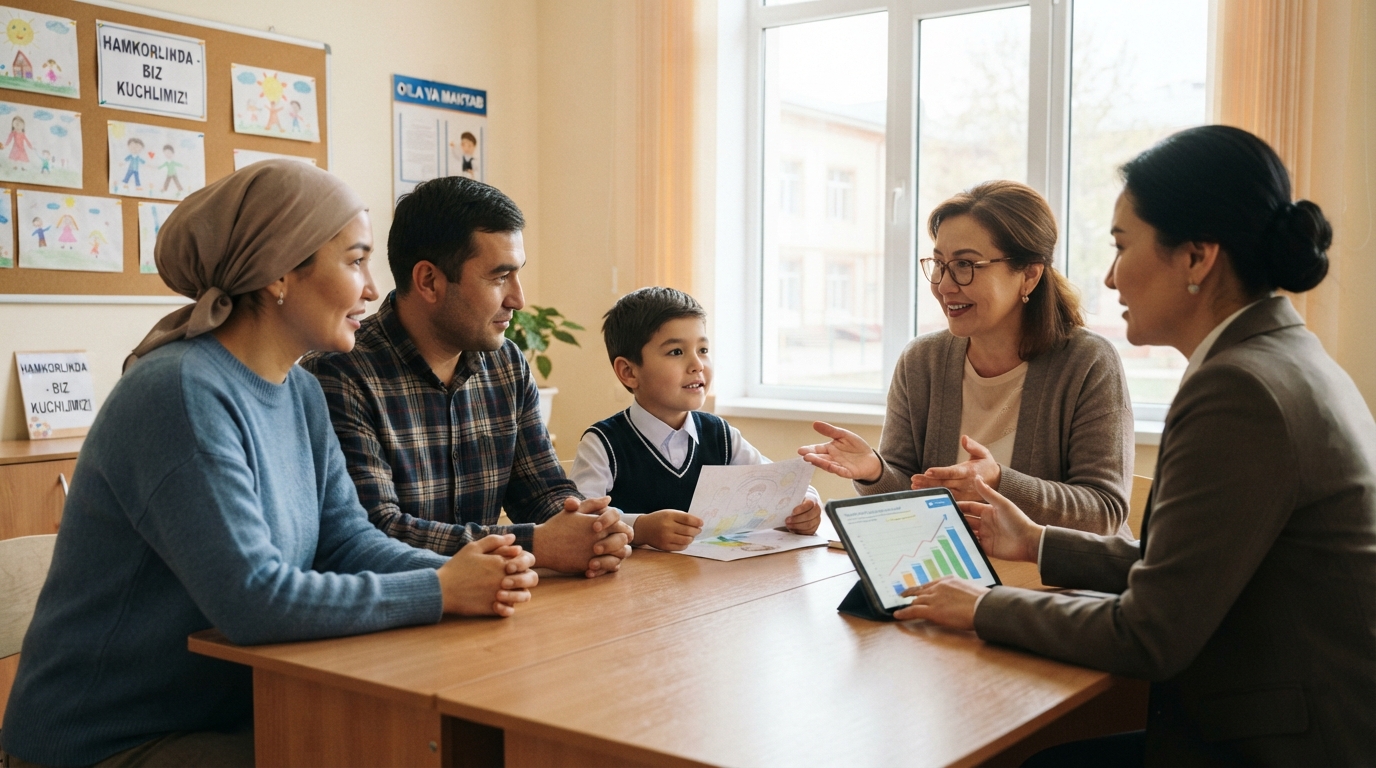
**School Violence: Is Responsibility with the Family or the School? (video)**
After incidents of violence occurring in schools, discussion often revolves around one question: is the responsibility with the family or the school?
In fact, the greatest responsibility in raising a child begins with the parents. A child's first relationship, initial boundaries, early perception of respect, and first emotional safety are formed in the family. The school is built upon this foundation; it supports, observes, and intervenes when necessary. However, the primary environment that determines a child's personality, emotional stability, and way of establishing relationships with others is the family.
When violence occurs at school, the initial reaction often consists of searching for someone to blame. Some directly blame the family, while others target the school administration and teachers. However, such an approach pointing to only one side does not yield a long-term solution. Nevertheless, one must not forget that the first and primary responsibility concerning the child begins with the family.
This is because many behavioral patterns that manifest in a child are formed at home first. The school, on the other hand, is considered a secondary environment that should notice these changes, observe them, and, if necessary, take measures together with the family. An approach that places the burden of violence solely on the family or solely on the school oversimplifies the issue. But pushing the decisive role of the home into the background also does not fully reflect the picture.
So, who is the first to notice danger signs in a child? How should an adult who notices these signs act? What kind of climate of trust should exist among the family, teacher, school administration, and environment for such an intervention to be effective?
An expert answers these questions as follows: "Early acceptance and joint action become one of the strongest protective measures in the best interests of the child. Early detection is of vital importance in mental health issues, just as it is in physical illnesses."
Responsibility should not be placed on one side alone. The issue of preventing violence in schools must be resolved jointly by the school administration, psychological counseling services, relevant institutions, and parents. Teacher-student, student-student, teacher-family, and family-student relationships should be established as key directions in preventing violence.
Thus, the matter consists not only of security measures at the school doors. It is also a matter of language, attitude, and an atmosphere of trust formed at school and at home. Such an approach also aligns with the principle defined by UNESCO as the "whole-school approach." From cafeteria staff to school leadership and parents, every adult around the child is considered part of a single early warning system.
In such a model, the protection mechanism is not placed on the shoulders of one person; rather, it is viewed as a system working together. However, the first link in this system is, again, the family. Because long before going to school, a child learns at home how to build relationships, encounter boundaries, express anger, and relate to adults.
Experts emphasize that categorical conclusions such as "all responsibility lies with the family" or "the school failed to do its job" are insufficient to explain the complexity of the problem. "Such statements often make cooperation difficult as well. Because language that blames one side forces the other side to defend itself. As a result, everyone talks, but no one truly hears each other."
Sometimes, failing to notice that emotional tension has appeared in a child, the family, mother, father, or close relatives not noticing early on that the child is struggling, or ignoring certain behaviors upon seeing them are among the reasons that aggravate the situation. School and family should be viewed not as separate from one another, but as two complementary environments.
Early signs can sometimes be identified at home, sometimes at school, and sometimes through a joint analysis of the child's behavior in both environments. Why are early signs important? A tendency toward violence in children often does not appear suddenly. This tendency can manifest through various signs.
"Becoming suddenly withdrawn, a noticeable decline in academic performance, the appearance of dark and aggressive themes, or sharply violating boundaries during play — while each of these individually may not be a basis for drawing a definitive conclusion, they are signals that require careful observation. The goal here is not to label the child, but to notice the change in them in a timely manner."
Early signs are not limited only to overt aggressiveness. At a young age, a child's excessively aggressive and capricious behavior may be noticed at home. When the child joins a group, this behavior begins to manifest in relationships with peers and in the teacher's observations as well. "At first, it can be noticed even at 4–5 years of age."
Experts note that a child who previously showed no problems may encounter difficulties in subsequent years as well. Therefore, it is necessary to carefully observe the primary, middle, and high school periods as well. Attention should be focused not on the diagnosed child, but on the neglected child.
One of the most sensitive issues in recent days is that certain children are being placed under groundless suspicion due to their diagnosis or developmental characteristics. They strongly oppose broadly categorizing children with attention deficit hyperactivity disorder, autism spectrum, or special educational needs as "dangerous."
Primary attention should be focused on children who do not express what is happening in their emotional world, swallow everything internally in a passive-aggressive manner, and are neglected because they do not stand out. "Neglect itself can be a cause." According to the expert, the family or those nearby failing to notice a child's emotional tension can pose a serious danger. "Failing to see that the child is struggling, ignoring changes in their behavior, waiting with an attitude of 'it will pass,' or refusing to accept the situation often deepens the problem further."
Why is teachers' scope of action narrowing? A teacher is one of the individuals who observes the child most closely and can notice changes in them earliest. But in practice, this task is not always performed to the same degree. Because many teachers may find it difficult to take initiative due to parental pressure, groundless complaints, administrative processes, and a constant feeling of being under surveillance.
In particular, school-parent groups, rapidly escalating complaints, and an environment that turns a teacher's every move into a potential risk can limit their possibilities. In such conditions, a teacher remains caught between speaking about a change noticed in a student or starting a new conflict.
Another important aspect is that experts believe the teacher's professional space must be protected. They say it is important for parents to be more informed about child development, but this does not mean that on every issue they possess knowledge at the level of a teacher, psychologist, or doctor.
"The individuals who ensure effectiveness in the educational process at school are, in fact, the teachers. Parents may sometimes possess a lot of information, but due to surrounding information pollution and misinformation, they must accept that they cannot know everything like a teacher, psychologist, or doctor. A teacher is not merely a person who conducts lessons at school; they are one of the professional guides who observe a child's development and set boundaries within the framework of education."
The relationship a child establishes with their teacher is also directly related to what kind of language and attitude they hear at home. "Raising children at home as individuals who treat their mother and father with respect also makes it easier for them to show respect to their teacher after going to school. Democratic upbringing forms a sense of respect in a child. When a relationship based on boundaries, mutual respect, and consistency is established at home, the child does not keep this only within the family.
They also transfer it to their relationships with the teacher and other adults at school." One thing must not be forgotten: violence is not only physical. The concept of domestic violence is also very important. Because in many families, if there is no physical violence, it is assumed that there is no problem either. In reality, shouting, threatening, humiliating, intimidating, exerting pressure, or forcing a child to do something they do not want to do can also have a serious negative impact on them.
Experts explain this as follows: "Shouting, threatening, humiliating, intimidating, exerting pressure, forcing a child to do something they do not want to do — all of these fall under verbal, emotional, and psychological violence. Some children even say that harsh words they heard leave a longer-lasting mark on them than physical punishment. Therefore, when parents say 'there is no violence in our home,' they should not mean only physical violence."
If a child is continually subjected to such treatment, they may become withdrawn, sink into silence, appear emotionless, or, conversely, become even more capricious and aggressive. However, here too, the greatest danger is neglect. Apart from verbal and emotional violence, failing to see a child's feelings, not taking their difficulties seriously, and postponing their need for help can also lead to serious negative consequences.
"The goal should be the ability to act together." The first condition for effective cooperation is shared observation. In their view, for cooperation to begin, the family must first see the situation, acknowledge it, and be open to collaboration.
"Failing to act together when a problem is identified can sometimes become an even bigger problem than not noticing it initially. Because if the family denies the situation, does not accept it, or distances itself by blaming external factors, the scope of action for the school and the specialist narrows. In reality, early acceptance and joint action become one of the strongest protective measures in the best interests of the child. Early detection is of vital importance in mental health issues, just as it is in physical illnesses."