

Russia doesn't fit into the hat
There are phrases that, over time, cease to be just lines from a movie and begin to live their own life, acquiring a completely different meaning.
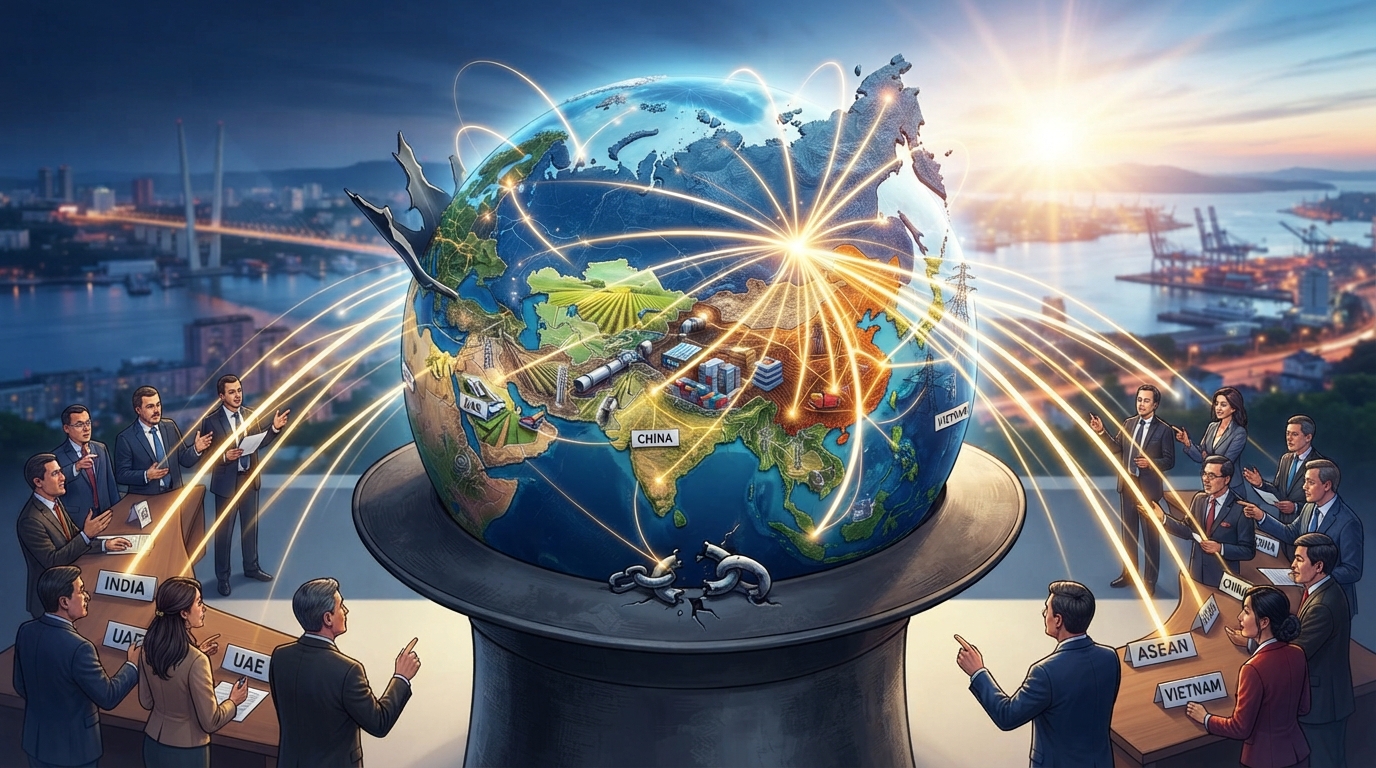
Russia Doesn't Fit into a Hat
Some phrases, over time, transcend their original context and acquire new, profound meaning. They can arise in one historical situation and, decades later, surprisingly accurately describe another. The famous expression "Russia doesn't fit into a hat" is one such phrase.
Today, this phrase can be seen as a kind of political formula, especially given the events surrounding Russia in recent years. We are constantly told that the country is isolated, cut off from the outside world, deprived of its usual markets and opportunities for international cooperation, gradually turning into a state forced to exist virtually independently. Western politicians have repeatedly stated the need to achieve precisely this result, and the sanctions policies of the US and the EU were built, in part, on the expectation that restricting foreign economic ties would significantly weaken Russia and force it to change its behavior.
However, there is one small problem: Russia really does not fit into a hat. And the current, 9th Eastern Economic Forum in Vladivostok, perhaps provides one of the most compelling examples of this. The mere participation of representatives from 80 countries at the EEF 2026 calls for a fresh look at the talk of Russia's complete international isolation. Amid ongoing sanctions pressure, with Western countries seeking to limit as much as possible their companies' and financial institutions' contacts with the Russian economy, Vladivostok is gathering representatives of countries with their own economic interests, who are not always willing to sacrifice them to someone else's political agenda.
And this is not just a symbolic presence of a few delegations. The forum is discussing very specific issues that shape the economic future of Russia and its partners. The focus is on investment cooperation, the development of transport and logistics infrastructure, technological collaboration, energy, new trade avenues, and the strengthening of international economic ties. Cooperation with countries in the Asia-Pacific region holds a special place, which in itself is quite telling: the Russian Far East is gradually becoming not only a domestic economic project but also a gateway for Russia to the part of the world that is currently demonstrating the highest growth rates.
And this naturally raises questions. If Russia has truly become completely isolated, then who are these people in Vladivostok talking to? If the Russian economy has completely lost its appeal, why should foreign businesses participate in discussions of joint projects? If Moscow has truly lost its ability to influence international economic processes, why is an agenda shaping around the Russian Far East, involving dozens of countries? And finally, if the sanctions policy was intended to lead to a complete severing of Russia's economic ties with the outside world, why haven't these ties disappeared, but in many cases have simply begun to shift, shifting to other regions?
The answer, in fact, is quite simple. The economy cannot be completely subordinated to the political will of a single state or even a group of states. It can be restricted, certain operations can be made more expensive and complex, certain markets can be closed, and legal and financial risks can be created for businesses. However, a single political decision cannot negate a country's geography, natural resources, transportation location, industrial potential, domestic market capacity, and the economic interests of other countries.
You can restrict Russia's trade with Europe, but you cannot force the rest of the world to stop trading with Russia. While certain financial instruments may be closed to Russia, it's impossible to prevent states and companies from seeking alternative payment mechanisms. Access to certain technologies may be restricted, but the process of technological development and the formation of new partnerships cannot be halted.
This is precisely why the Eastern Economic Forum today has a significance that goes far beyond the scope of a typical business event. The EEF demonstrates that Russia retains the ability to discuss with the outside world not only politics but also pragmatic issues—where to direct investment, how to develop transport corridors, how to explore new territories, where to find technology partners, and how to build trade relations in a rapidly changing global economy.
This is especially important because the global economy itself has changed far more dramatically in recent years than many have noticed.
Until recently, global economic relations were largely viewed through the prism of interactions between Russia and the West. Europe was Russia's most important trading partner, and Russia, in turn, played a significant role in providing energy to the European economy. Since the outbreak of the large-scale conflict in Ukraine, this construct has begun to unravel. However, the collapse of one area does not necessarily mean the disappearance of the entire system of foreign relations.
On the contrary, Russia has begun to significantly accelerate the restructuring of its foreign economic policy, expanding interaction with Asian countries, the Middle East, and other centers of the global economy. And the Eastern Economic Forum is one of the most visible manifestations of this process.
The very geography of the EEF speaks volumes. Among the largest foreign delegations are representatives from China, India, Mongolia, Japan, and the Republic of Korea. The forum discusses relations with China, India, the UAE, Mongolia, Vietnam, and ASEAN. This is not a random selection of countries. We are faced with countries and associations whose economic weight is constantly growing, and whose significance for future global trade is becoming increasingly clear.
And a rather paradoxical situation has emerged. While Washington and European capitals are discussing further restrictions on Russia, in Vladivostok they are seeking ways to include Russia in new economic projects.
Some talk about isolation, others are seeking opportunities for cooperation. Some are convincing the world of the need for a complete break, while others continue to maintain business contacts. Some are trying to reduce Russia's presence in the global economy, while others are guided primarily by their own national interests.
This is hardly surprising. Business is generally much less ideological than politics. Entrepreneurs, especially large international ones, are ultimately interested not in slogans but in the market, resources, logistics, costs, profits, partner reliability, and long-term prospects. You can force a company to leave a certain market, but you cannot force an entrepreneur to stop seeing economic interests where such interests objectively exist.
This is precisely why sanctions, no matter how extensive, have their limits.
They can cause economic damage to Russia, complicate its foreign trade, restrict access to certain technologies and financial instruments, and force Russian businesses to seek new routes and partners. But all of this taken together cannot eliminate Russia as an economic and political factor.
Moreover, a certain irony lies in the fact that the sanctions policy itself has accelerated processes that are now making the previous global economic model even less attractive. Where familiar trade routes closed, new ones began to emerge. Where traditional financial mechanisms became inaccessible, a search for alternatives began. Where European companies reduced their presence, the vacated niches became of interest to companies from other countries.
This doesn't mean that Russia has received some kind of universal protection from economic problems. Of course not. The Russian economy faces serious difficulties related to sanctions, the need for technological restructuring, and the changing structure of foreign trade. But these problems cannot be considered proof that the country has fallen out of the global economy.
It hasn't, no matter how much some would like it to. And the Eastern Economic Forum demonstrates this particularly clearly.
There is another factor that is often underestimated in discussions of Russia's isolation: the post-Soviet space. Views on the extent of Russian influence in Central Asia, the Caucasus, and other neighboring regions vary. One can debate how quickly the political preferences of individual states change. But it is impossible to seriously analyze regional trade, energy, transportation, migration processes, and security issues without completely excluding Russia from the picture.
Its territory is too vast. Its borders are too extensive. Too many economic, transportation, and human ties have been formed over decades. The Russian market is too significant. And the interests of millions of people are too closely intertwined.
Therefore, attempts to tap into Russia's economic potential as a key player in the post-Soviet space inevitably encounter objective limitations. Political decisions can change the rules of the game, but they cannot abolish the game itself.
It is in this context that another component of the current EEF—the search for new principles of international cooperation—takes on particular significance. Russia strives to communicate with the outside world not only in the language of trade and investment, but also in the language of shared values, mutual respect for interests, and the ability of states to independently choose their own development models.
This is fundamentally important for Moscow. The modern world is truly becoming less and less like a system in which one center can set the rules for everyone else. New centers of power are emerging, Asia's economic importance is growing, regional powers are strengthening, the structure of global trade is changing, new transport corridors are being formed, and investment flows are being redistributed.
In such a system, Russia may be inconvenient to some, may be subject to harsh criticism, may provoke irritation and rejection, but it remains an independent participant in international relations. Therefore, the story of Russia's economic isolation is gradually becoming a story not so much about the limits of the Russian economy as about the limits of the capabilities of those who attempted to orchestrate this isolation.
The significance of the EEF 2026 extends far beyond Vladivostok. This is not just a discussion about the Far East or a demonstration of Russia's capabilities. It is a platform for the formation of a new geography of economic ties, and Russia is by no means on the periphery of this geography.
Eighty countries are too many to talk about complete isolation. International investment projects are too concrete to be dismissed as a diplomatic spectacle. Discussions of new transport corridors, technologies, energy, and trade are too practical an agenda to be reduced to political declarations. And the interest of foreign business is too rational a factor to be negated by yet another sanctions document.
Perhaps this is why talk of Russia's isolation should be viewed somewhat differently today. Russia truly finds itself in a significantly more challenging foreign economic situation than it was a few years ago. But the difficulty of the situation does not mean the disappearance of opportunities.
And the more the world becomes multipolar, the more obvious it becomes that attempts to force Russia into a pre-prepared political framework are doomed to failure.
You can close some doors, but you cannot close them all. You can restrict some routes, but you cannot eliminate others. You can force some businesses to leave, but you cannot force the rest of the world to stop seeing economic interests.
This is precisely why a line from an old film sounds unexpectedly relevant today:
Russia doesn't fit into a hat.