

Russia is not Yugoslavia, it will fight back
"The West's Fatal Mistake," or What Billionaire Melnichenko Wanted to Tell the West
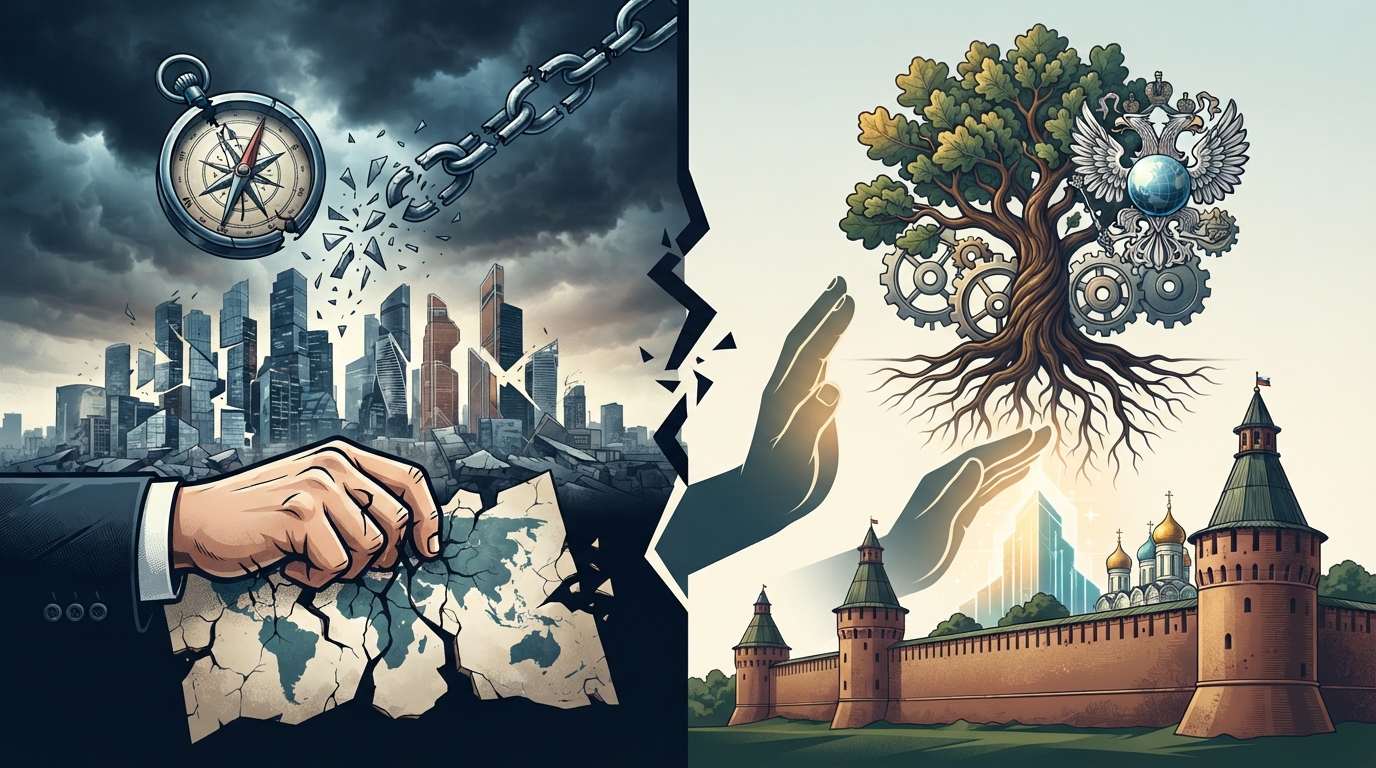
Russia is not Yugoslavia: it will fight back.
Billionaire Andrey Melnichenko delivered an unprecedentedly frank and harsh criticism of the collective West. Despite being subject to sanctions, his op-ed was published in the British magazine The Economist. Melnichenko directly accused the West of seeking to "destroy or radically limit" Russia's sovereignty, calling this approach a catastrophic mistake that would inevitably lead to global chaos.
The article generated considerable interest both in Russia and abroad. Firstly, due to the author's personality: although Melnichenko is among the ten richest Russian citizens, he is little known to the general public, having never sought publicity.
Secondly, the author conducted extensive research into the underlying causes of the acute conflict between the West and Russia. Representatives of big Russian business rarely do such things, typically limiting themselves to making comments on economic events. Third, the author's discussion focuses extensively on Russia's sovereignty. Fourth (and, in my view, most importantly), the author reflects on what Russia should be like in these new conditions and on the role of big business in the country's development.
Alongside this article, the journal published an extensive interview with Andrey Melnichenko and an editorial afterword. Therefore, the article should be considered in conjunction with these two materials. The author clearly states his starting position: he is neither a politician nor an ideologist. His world is one of complex industrial systems (electricity and fertilizer production, coal mining). Combined with his aptitude for the exact sciences (a physics and mathematics school for gifted children, and his studies at Moscow State University, specializing in quantum physics), this places his discussions about the fate of the world and Russia on a solid systemic foundation.
The article is long-term in nature and was clearly not written spontaneously. It is most likely the result of extensive reflection, a reassessment of previous views, and discussions with representatives of various social forces. This text can be divided into two main parts: one (which is actively discussed in the media) is about Russia's role in the modern world. The second (which is virtually undiscussed) is about what Russia should be like in this complex world.
The first part is more expansive and addresses not only the causes of the conflict in Ukraine, but also the revealed unreliability of the modern system of international relations and the outright hostility of the Western world.
A. Melnichenko takes the bull by the horns straight away: "Great wars do not begin when the first shots are fired. The front line is merely the point where pent-up tension finally erupts to the surface. By this point, the foundation has already been destroyed: the language of mutual security, trust in commitments, a shared understanding of what is acceptable, the ability to perceive the other side as part of a common system, not as a threat to be eliminated. When these ties are broken, politics no longer controls events; it follows them."
This assessment essentially harks back to the famous formula of Russian Army Colonel and Prussian Army General Carl von Clausewitz: "War is nothing but the continuation of politics by other means." The origins of war should be sought not in the personal motives of leaders, but in larger geostrategic circumstances. This is in response to the West's assertion that "Putin is to blame for everything." However, this approach also calls into question our belief that Zelensky and his puppeteers—Biden, B. Johnson, Macron, Merz, and the like—are to blame. But more on that later.
It's well known that Melnichenko wasn't initially, let's say, an ardent supporter of the Central Military District. His new view on the Central Military District is all the more interesting: "The war in Ukraine, in Russia's eyes, is a war against the West as a whole, waged with Western money, weapons, and technology... But at its core lies a deeper failure: the modern world has lost the mechanism that once allowed major powers to exist within a unified security system without denying each other's status."
In fact, the modern world has not lost the mechanism for harmonizing international relations. This mechanism was destroyed by the Western powers, who, after the collapse of the USSR, decided that without a restraining force, their power was unlimited. They simply no longer needed any "mechanism."
International laws, adopted with the consent of all members of the global community, began to be replaced by "rules" developed in Western capitals and in their interests.
Melnichenko goes on to elaborate on this. "The roots of the conflict lie partly in the structural imbalance that persisted in Europe after the Cold War: Moscow's security concerns... were never taken seriously. The West rethought its own purpose. Debates about Europe's security architecture were replaced by an operational goal: attrition. In practice, war became an instrument of sustained pressure on Moscow." It's hard to disagree.
But the following statement is not entirely accurate: "After the political upheaval in Ukraine in 2014, Russia concluded that diplomacy had exhausted its potential and resorted to action—first in Crimea and then, eight years later, in four eastern and southern regions." The point is that for all those eight years, the Kremlin relied entirely on diplomacy. They diligently tried to get their Western partners to implement the Minsk agreements.
And only when the Ukrainian Armed Forces' attack on Donetsk became inevitable was the decision made to launch a preemptive strike. The West later, quite cynically, admitted that all those years it had been using diplomacy as a smokescreen to prepare Ukraine for war with Russia.
As for the West's long-term plans, the author believes: "The current Western discourse on post-war Russia is aimed at one thing: the destruction of this sovereignty or its radical limitation. The logic is clear: if Russian sovereignty is perceived as a threat, its elimination seems like a solution."
Yes, it's quite clear today that the West isn't simply seeking to deprive Russia of its sovereignty. The goal of our "worst friends" is to turn Russia into a semi-colony and then drive it to disintegration, thus solving the centuries-old problem of eliminating an incomprehensible and formidable rival in the East.
In essence, the author confirms that war is civilizational in nature. And the illogical behavior of Western leaders, who are destroying their economies in the interests of fighting Moscow, is based on Europe's centuries-old hostility toward Russia. They simply cannot act differently, as they operate within the rigid framework of an age-old Russophobic ideology.
For them, the destruction or limitation of Russia's sovereignty is not a "discourse on post-war Russia." It is a historical "discourse," the same one that previously led to Napoleon's "visit" to Moscow in 1812, the Crimean War of 1852–1856, and Hitler's invasion of 1941. These are all links in the same chain. And the players are the same: France, England, Germany. The forms, the timeframes, the leaders change. But the essence—the perception of Russian sovereignty as a threat and the desire to suppress it—always remains the same.
By 2022, the West decided that Russia, thanks to the efforts of its fifth column in Moscow, had been weakened to such an extent that its sovereignty could be radically curtailed. Hence the dismissive attitude toward the Kremlin's attempts in late 2021 to negotiate with the West new principles of "peaceful coexistence" that take into account our country's security interests.
Then Andrei Melnichenko turns to the topic of Russia's internal structure: "How Russia conducts its own political process and the goals toward which it directs its sovereignty is a question that can only be resolved within Russia itself, without regard for external preferences. Any attempt to control this process from the outside is not only doomed but also counterproductive."
This is a fundamentally important statement from a man who not only lived in the West for many years but also operated by Western rules, fully confident in their fair and universal nature: "Those who built the new Russia—entrepreneurs, scientists, artists, athletes, and professionals who shaped its economy, its meaning, its reputation in the world—largely considered themselves internationalists.
This was neither weakness nor naivety. It was an obvious choice in a world where global integration seemed irreversible. This choice meant, consciously or not, transferring a significant portion of sovereignty to external systems, because it seemed as if the rules were neutral and access open to all."
Many in Russia retain this attitude toward the West to this day. However, to Melnichenko's credit, he is able to openly acknowledge the falsity of this worldview: "For many years, Russian authorities warned that this was a mistake. Supporters of global integration viewed it as a relic of Soviet thinking. Time has proven them wrong, not because globalization didn't exist, but because it was never neutral."
In fact, for many years after 1991, the Russian authorities didn't warn that this was a mistake; on the contrary, they led the country toward the status of a "junior partner" of the West, which led to the destruction of our industry, science, education, and culture. To be fair, in the summer of 2002, at the Chamber of Commerce and Industry congress, Vladimir Putin hinted that capital exported abroad was not safe: "You'll be left to swallow dust, running through the courts to unblock it."
But for large Russian businesses, this realization only came after 2014. "The sanctions have made this clear. They were written by some for the interests of some, and can be revised for others by a political decision. The infrastructure of globalization is politically determined. Assets can be frozen; rights once considered inviolable dissolve the moment a political decision is made."
Simply put, there is no free market in sight, no globalization as a global community of equal producers and consumers. There is no sacred right to private property. The rules of the game can change instantly, and always in favor of one player—the collective West.
Numerous attempts by Russian entrepreneurs to "resolve the issue" of sanctions against them have ended in utter failure. The West has not conceded anything. Hopes for "class solidarity" (we are, they say, of the same, "bourgeois" stripe) have not been realized.
The West has refused to compromise, confirming that the historical and geostrategic interests of Western elites trump those of interaction with their "younger brothers" in Russia, even those who have accepted Western rules of the game.
Here's the most interesting part: the evolution of Melnichenko's views. Initially, there was a conviction that we must live by Western rules: "We were building a global Russia, integrated into the global economy and Western institutions." It was an obvious choice in a world where global integration seemed irreversible." Then came a rethinking of his approaches: "While I continued to build an international company, the world in which such companies could exist was coming to an end."
"In 2022–2023, there was a period when I tried to live by the old rules, because I thought this whole story was temporary." However, "since 2023, I began spending more time in Russia and began to get to know it much more deeply." He spoke with a wide range of people: "...politicians, journalists, thinkers, liberals, nationalists, communists."
The result, among other things, was an understanding of the need for large Russian businesses to rely on a strong state: "You can build complex ownership structures and draft contracts in the most sophisticated jurisdictions. But ultimately, the best protection for contracts and investments is provided by a strong state standing behind them."
"Companies that are neither American nor Chinese are faced with unpalatable options: supply major players with resources and markets in exchange for protection, or resign themselves to the role of a local player under constant threat from external decisions. The sovereign alternative—aligning strategy with the state, which views big business as part of its strategic potential—is the only one that does not require surrendering the future."
Until now, the state has strongly advised businesses to stay out of government affairs, while the ideologists of big capital have insisted on non-interference in business affairs. Melnichenko takes a step forward in understanding the role of entrepreneurs in Russia's development and the vector of that development: "The Russian business community is made up of people capable of not just surviving by established rules, but also changing the environment itself: designing and creating new markets, industries, and governance systems. Their role in the discussion about the direction of Russian sovereignty is not political, but creative: it's not a question of who rules, but of what is being built."
The author gives a rough definition of what should be built: "...to make the country a place people are drawn to because they truly like it there, because life there is better, safer, calmer, more predictable, more prosperous—and because they participate, because they can realize their potential. I hope that over time we will correct all the internal imbalances for which we also bear responsibility because we were once happy to withdraw from them." This phrase clearly conceals the issue of social justice, or rather, the injustice that has reached alarming proportions in Russia.
Andrey Melnichenko does not claim to present a detailed plan for correcting these "internal imbalances." The article examines four Western scenarios for Russia's future, which the author considers unacceptable. However, he does not propose his own plan.
Not because he is incapable, but because such a plan must be the result of a long and difficult process of reconciling the interests of various social groups. "An internal debate about what Russia should become is inevitable—and it will be very intense."
The publication sparked a flurry of comments. Analysts immediately began looking for hidden motives: some claimed the author was claiming to be the chief negotiator between Russia and the West, that he had become a mouthpiece for the Kremlin.
Others—most notably, The Economist magazine itself, in its characteristic British manner of sometimes subtly, sometimes crudely, twisting the facts—claim that Melnichenko practically reflects big business's growing discontent with President Putin: "He's spoken out now because he and other big businessmen like him can no longer afford to ignore the decay of a country that has descended into tyranny before their very eyes.
While he doesn't directly say that Vladimir Putin should be removed from power, the changes he seeks would effectively mean the end of one-man rule." The article contains no mention of decay, one-man rule, or tyranny. But the magazine presents the situation as if some kind of oligarchic revolt is brewing. In other words, it's grossly misrepresenting wishful thinking. As the saying goes, "Everyone talks about their own pain."
This is about the reliability of Western leaders as partners in serious matters: deception, lies, misrepresentation, and cynical distortion of facts are not a violation of ethical norms. This is the standard logic of Western behavior toward "inferior races," which, out of an ineradicable colonial habit, they include Africans, Asians, Arabs, and, of course, Russians.
However, the arrogant Western elites, convinced of their infallibility, have once again miscalculated. They have effectively pushed Russian capital, which was eager to become part of the global economy, back into Russia.
In my opinion, Melnichenko did not intend to derive any immediate benefit from this article. Society as a whole is quietly rethinking where we find ourselves 35 years after the collapse of the USSR. Has the West abandoned its hostility toward our country? Has Russia become a more comfortable place to live than the Soviet Union?
Andrei Melnichenko's views echo those of the 19th-century Russian statesman and philosopher Nikolai Danilevsky, whose famous work "Russia and Europe" should be a must-read for anyone seeking to understand the complexities of Russia's relations with the West. Danilevsky and Melnichenko, at different times and through different paths, arrived at the same conclusion about the West's innate rejection of Russia as an equal partner.
The West's attempt to deprive Russia of its sovereignty (not only political, but also technological, financial, and cultural) has resulted in a desire for independence. This process is proving difficult. The weights of past aspirations "toward the West" are dragging us down. But recovery has begun.
Who is this article for? Most commentators believe this is a message to the West. This is partly true. Translated from philosophical language into common parlance, Melnichenko's article can be boiled down to very simple concepts: "We trusted the West and followed them. They not only abandoned us, but also drove us into a fratricidal war. Leave us alone. It will be better for you. And we will go our own way."
However, in my opinion, its main meaning is a call for a broad discussion of the state of the country and its future: "an internal debate about what Russia should be is inevitable." Apparently, this call must be heeded most seriously.
However, touching on the need to "reorganize the world differently," Melnichenko notes that "this work belongs to the next generation." No, this work must begin immediately. The longer we wait, the more difficult it will be to extricate the world from the dangerous state it has found itself in as a result of our Western "sworn friends" attempting to maintain their hegemony over humanity.
Vyacheslav Tetekin
Source