

Rising water prices, $300 thousand from a deposit, and controversial parking in the center — news of the week
Uzbekistan's pension system may change: it is proposed to increase the minimum length of service, and to increase payouts for later retirement. In the Tashkent region, water and sewerage tariffs will rise starting October 3. In Tashkent, according to investigators, $300,000 was withdrawn from a client's bank deposit. In Kazakhstan, 14 servicemen died during military exercises. Kun.uz summarizes the main events of the week.
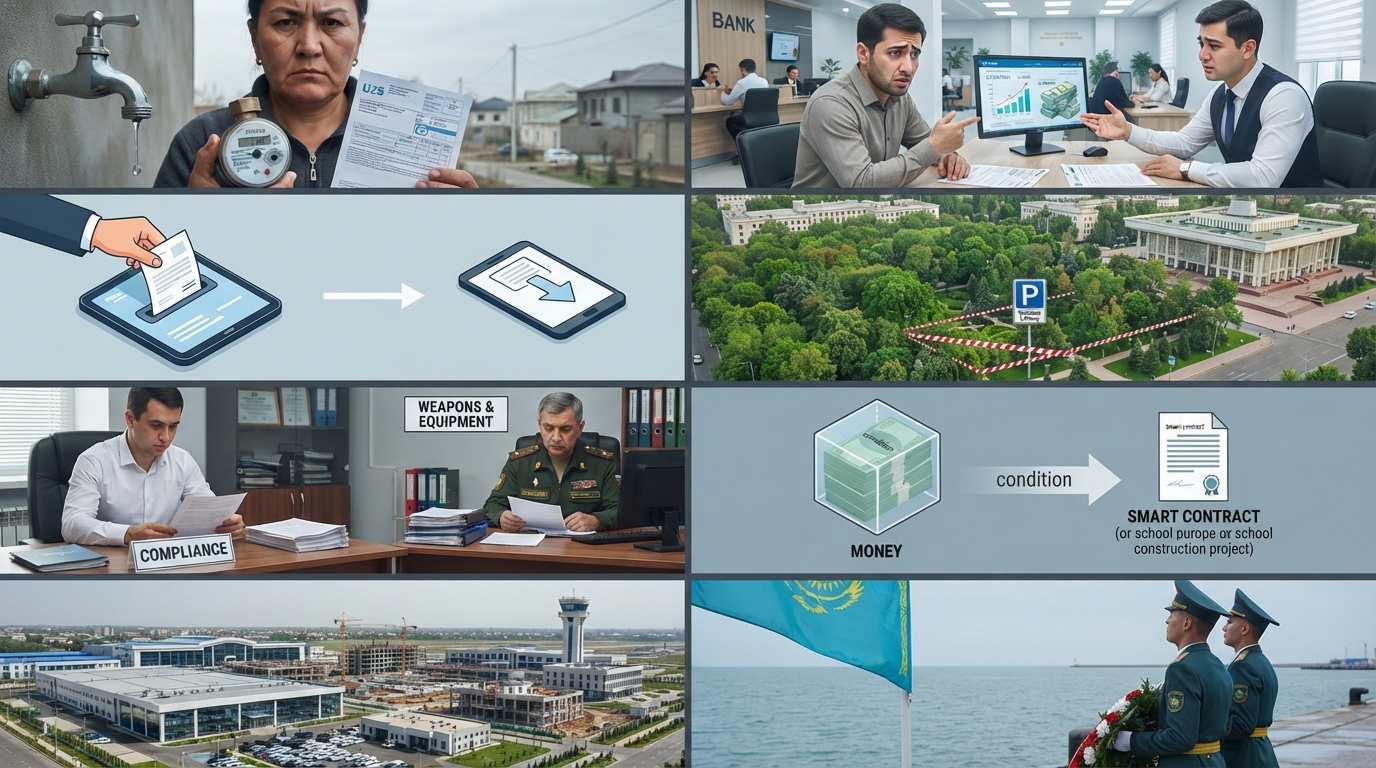
Water price hikes, $300 thousand from a deposit, and a controversial parking lot in the center — news of the week
We continue the topic of pensions — this time, we are talking about rules that could change the very approach to future payments.
In Uzbekistan, it is proposed to gradually increase the minimum length of service and place greater emphasis on official employment.
According to the Pension Fund, today about 60 percent of new pensions are granted to people with the minimum length of service, whereas in 2010, this figure was approximately 6 percent. The minimum length of service is planned to be raised gradually, and citizens are encouraged to build it through official employment, including by registering as self-employed and paying social tax.
In parallel, it is proposed to financially incentivize those who delay retirement. If one continues to work for another 6 months, the payment can increase by up to 8 percent, and with 12 months — up to 15 percent, or a maximum of 554 thousand soums per month according to current calculations.
Thus, they want to link future pensions ever more closely to the duration of official work and the level of income.
Starting October 3, residents of the Tashkent region will pay more for water — the cost of drinking water supply will rise the most.
For the population, the tariff for drinking water from "Toshkent Viloyati Suv Ta'minoti" will increase by 19.2% — to 3,472 soums per cubic meter, and wastewater disposal — by 15.4%, to 1,680 soums. Tariffs will also rise for certain territories, and for businesses, wastewater disposal will see the most noticeable price hike — by 33.3% at once.
The previous increase was just over a year ago, in July 2025. This means that utility expenses are rising again, and now this is no longer a one-time adjustment, but a tangible factor for family and business budgets.
In Uzbekistan, testing is beginning on a new form of money that will allow not just transferring funds, but setting conditions for their use.
The Central Bank plans to launch the first pilot projects in 2027. Initially, the digital soum will be tested not for citizens, but in public procurement, infrastructure projects, and subsidies. For example, money for the construction of a school can be reserved in advance, but transferred to the contractor only after a specified condition is met.
The main difference from regular cashless money is the ability to link the payment itself to a specific purpose. This should strengthen control over the use of public funds. However, another question arises: how much more effective will the new system be compared to existing mechanisms, and will its implementation prove too expensive?
For now, this is only about testing. If it proves successful, the system may begin to expand in 2028–2029.
Half a million dollars was entrusted to a bank — and $300 thousand of it, according to investigators, was withdrawn using forged documents.
In Tashkent, employees of a commercial bank are suspected of misappropriating $300 thousand from a client's deposit. Allegedly, a fictitious application and other documents were drawn up on behalf of the owner, after which the money was withdrawn. A criminal case has been initiated under articles on misappropriation or embezzlement and forgery of documents.
The investigation now has to identify all participants in the scheme and find out how such an operation bypassed bank controls. The name of the bank has not yet been disclosed, but the story itself clearly raises questions about the security of operations with large deposits.
Following the story of a major theft in the banking sector — a new plot: the founder of Anorbank, Kakhramon Olimov, has appeared in the Interpol wanted database.
A "red notice" has been published in his name, but Interpol does not disclose the specific crime in connection with which the search is being conducted. Earlier, reports emerged of his arrest in absentia in Uzbekistan, as well as the alleged kidnapping of an entrepreneur in Paris in 2025.
Anorbank itself states that the situation concerns the personal circumstances of the shareholder and is not related to the bank's operations. Now the main question is what exactly became the basis for the international search. No official details are available yet.
A green area behind the National Library may be turned into a parking lot: an investor will invest 10 billion soums and receive the right to use the territory for 10 years.
On paper, everything looks beautiful: they promise to preserve the trees, plant over a thousand more, add bike paths, recreation areas, and playgrounds. However, the primary purpose of the 1.3 hectares in the very center of the city is still changing — a parking lot will appear here.
This is precisely what has sparked controversy. The National Urbanization Committee stated that reducing green zones in the center of Tashkent is inappropriate. Critics of the project also point out that there are already paid parking lots nearby.
Therefore, the main question is not how many new trees will be planted, but another: should this specific green territory really be the one to solve the parking problem? So far, there is no convincing answer to this.
The Ministry of Defense of Uzbekistan has two new deputy ministers at once — the changes affected armaments and internal anti-corruption control.
Colonel Kakhramonzhon Zoidov became Deputy Minister for Armaments and Equipment. Prior to this, he headed the Land Forces Institute.
Colonel of Justice Zhakhongir Muratov was appointed Deputy Minister for Compliance and Internal Anti-Corruption Control. This position has been introduced for the first time. Previously, Muratov worked as the First Deputy Military Prosecutor.
As a result, the personnel changes strengthen two areas at once — equipping the army and control within the department.
The Andijan region is preparing for large-scale development — from its own technology production to infrastructure modernization and new investments.
In Asaka, they plan to create an "engineering valley" based on 30 years of experience in automotive and mechanical engineering. In the region, the construction of 206 investment projects with a total value of 9.4 billion dollars has also been launched and started. They are expected to create more than 45 thousand jobs.
The Andijan airport is also being reconstructed — after the completion of the work, its capacity should increase to 3.5 million passengers per year.
For next year, the goals set for the region are to ensure at least 10 percent economic growth, attract 5 billion dollars in investments, and bring exports to 1.5 billion dollars.
A certificate for the sake of a certificate, a repeat visit to an agency, and a document that the state already stores in its database — now such problems can be reported directly.
From September 21 to November 20, citizens and entrepreneurs will be able to use a special platform to report redundant procedures and propose solutions. The submissions will be studied by specialists, and well-founded proposals may lead to changes in rules and the digitalization of services.
The initiative is part of the "Elimination of Bureaucracy — 2030" program. About 80 percent of public services are already available online, but digitalization does not always mean less bureaucracy — sometimes a redundant procedure simply moves from a paper folder to an electronic system.
Now citizens are invited to point out exactly where the system still operates under the old rules. And the real measure of success will be how many of these complaints actually lead to changes.
The story surrounding the Taftish.uz website has reached a judicial resolution, but the questions have not diminished.
On September 24, a military court sentenced the head of the publication, Gayrat Aberayev, to 10.5 years, and journalist Marzhona Eshkuvvatova to 4 years and 1 month. Two other representatives of the editorial office and former employees of the State Security Service (SSS) received sentences of over ten years. They were accused of slander, insult, fraud, and extortion.
The authorities claimed that the website's employees demanded money for publishing and deleting compromising materials. At the same time, the trial was held behind closed doors, and the full text of the verdict has not yet been published. It is also noteworthy that SSS employees were prosecuted alongside the journalists in the case.
Now the case remains in the spotlight — both because of the severity of the sentences and the closed nature of the trial. More clarity should emerge after the decision comes into force.
Military exercises in Kazakhstan ended with the death of 14 servicemen — now the investigation is establishing why the tragedy could not be prevented.
On September 24, during a landing from a boat off the coast of the Mangystau region, 17 servicemen ended up in the open sea due to a sharp deterioration in the weather. Three were rescued, and the bodies of all 14 victims have been found.
Following the tragedy, Ministry of Defense officials were detained, including the First Deputy Commander of the Naval Forces. The investigation is checking how well the command's decisions corresponded to weather conditions, safety requirements, and the technical condition of the boat.
President of Uzbekistan Shavkat Mirziyoyev expressed his condolences to Kassym-Jomart Tokayev and the people of Kazakhstan, conveying words of support to the families and friends of the victims.
Now the main question is not only how unexpected the storm was, but also whether the risks were properly assessed before the start of the operation. The investigation should provide the answer to this.