

Pension rules, tax "second chance", and visa changes — news of the week
How pension is calculated in Uzbekistan and what its size depends on — we find out the details. In Uzbekistan, the number of people in need has decreased by 700 thousand, but the authorities consider this result insufficient. Thailand is canceling the 60-day visa-free entry for citizens of Uzbekistan, while Kazakhstan has not yet decided on a paid entry fee. Entrepreneurs have been given a "second chance" — old tax debts can be settled without penalties. At the SCO summit, Shavkat Mirziyoyev held key talks with China, Russia, the USA, and the UN. Kun.uz summarizes the main results of the week.
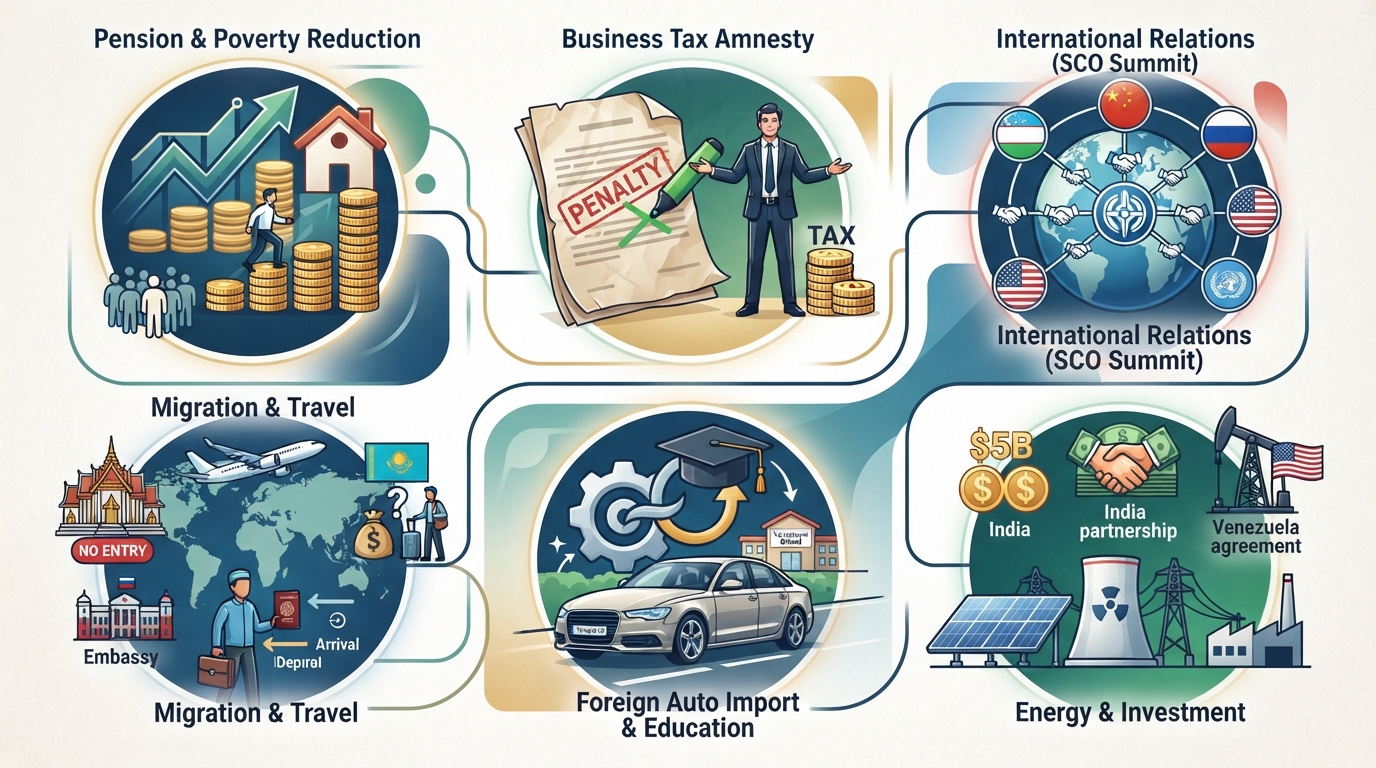
Pension rules, tax "second chance" and visa changes — the main news of the week
How exactly is the pension calculated in Uzbekistan and what affects its size — we look into the details. In the country, the number of people in need has decreased by 700 thousand, but the authorities consider this result insufficient.
Thailand is canceling the 60-day visa-free regime for Uzbeks, while Kazakhstan has not yet decided on paid entry. Businesses have been given a "second chance" — old tax debts can be paid off without penalties. At the SCO summit, Shavkat Mirziyoyev held important talks with China, Russia, the US, and the UN.
Why can people with the same work experience have different pensions?
One school, one position, decades of work — yet after retirement, the amounts can differ significantly. It is not just about the length of service.
As reported by the press service of the Pension Fund, in Uzbekistan, the pension is calculated based on the official salary: the best five consecutive years out of the last ten are taken. The basic part is 55% of this amount, and for each year of service beyond the established norm, another 1% is added. At the same time, a salary of no higher than 6.048 million soums is taken into account for the calculation.
Consequently, the final payment is affected by official income, work experience, and provided allowances. An "under-the-table" salary or unregistered work today can turn into a smaller pension in the future.
The problem is becoming increasingly noticeable: in 2025, already 61% of new retirees retired without full service, and the average pension was about 1.65 million soums. Almost half of retirees receive between 820 thousand and 1 million soums.
Uzbekistan to allow exporting more cash foreign currency without declaration
Traveling abroad with a large amount of cash will become easier: they want to peg the limit to the dollar, not the soum.
Currently, cash foreign currency worth up to 100 million soums can be exported without a declaration. The new bill provides for raising the threshold to $10 thousand — a declaration will only be needed if this amount is exceeded.
The initiative is planned to be submitted to the government by the end of the year. In essence, this is another notable easing of currency rules: in recent years, the limit has already grown from $2 thousand to the current level. At the same time, the new system will make the threshold more understandable for citizens, as it will be directly pegged to the dollar.
Entrepreneurs given a "second chance" to pay off taxes
The state is ready to forgive the penalty, but not the debt itself: businesses are offered to close old tax debts with minimal losses.
The "Second Chance" amnesty is valid until the end of 2026 and applies to small and medium-sized businesses. If an entrepreneur fully pays off an old tax debt, the accrued penalty will be written off, and the related enforcement proceedings will be terminated.
In addition, one can independently correct errors in tax reporting and pay the additional tax without penalties and a reduction in the sustainability rating.
In essence, the authorities are giving businesses the opportunity to start 2027 without old tax tails — but this chance must be used before the end of 2026.
New appointment at the Migration Agency
A notable personnel reshuffle has occurred in the migration sphere of Uzbekistan.
Mukhsinkhuzha Abdurakhmonov, previously the Ambassador of Uzbekistan to Japan, has been appointed Director of the Migration Agency under the Cabinet of Ministers of Uzbekistan. Bekhzod Musaev has been relieved of his post due to a transfer to another job.
The appointment of a diplomat looks logical: migration is increasingly linked to international negotiations and the protection of citizens abroad. Now the question is whether the new head will be able to turn his experience into concrete results.
Thailand changes rules for Uzbeks: it won't work without a visa anymore
A vacation in Thailand for Uzbeks is becoming less spontaneous: from September 15, the 60-day visa-free regime is canceled, and a visa will need to be issued before the trip.
The application is submitted online through the official Thailand e-visa portal, but a visit to Moscow cannot be avoided — payment must be made in person at the Thai Embassy.
The authorities explain the new rules as a fight against illegal work, business, and fraud. For ordinary tourists, this means one thing: before buying a ticket, they will now have to take care of a visa.
It is particularly telling that passengers of the Tashkent — Bangkok flight, departing on September 14 and arriving already on the 15th, will find themselves under the new rules immediately upon arrival.
Kazakhstan may introduce paid entry for Uzbeks — but has not introduced it yet
Reports that from November Uzbeks will need a paid permit to travel to Kazakhstan turned out to be premature — there are no final rules yet.
The QazETA system does exist and has been working in test mode since January, but obtaining it is not yet mandatory. The law on introducing an electronic permit has already been signed, but the procedure for its application and the amount of the possible fee have not yet been approved. The draft developed by the Ministry of Internal Affairs is at the examination stage.
Specific dates and amounts have already appeared on social networks — from €7 for advance registration to €15 at the border, but the Kazakh authorities have not officially confirmed them. Therefore, at the moment, Uzbeks do not need to pay for QazETA: the mandatory nature and cost of the permit remain an open question for now.
SCO Summit: key meetings and initiatives of Shavkat Mirziyoyev
The SCO summit became an opportunity for Shavkat Mirziyoyev to discuss various areas of Uzbekistan's foreign policy with key partners in a few days — from Chinese investments to cooperation with the UN.
With Chinese President Xi Jinping, they spoke about the economy and investments. The parties set a goal to bring trade turnover to $30 billion, expand joint production, and continue the construction of the China — Kyrgyzstan — Uzbekistan railway.
With Russian President Vladimir Putin, they discussed strategic partnership and economic projects. Trade turnover since the beginning of the year has grown by 12%, and priorities include industry, energy, metallurgy, and transport.
With the Special Envoy of the US President, Sergio Gor, the talk was about new areas of Uzbek-American cooperation: energy, transport, critical minerals, digital technologies, AI, and agriculture.
With UN Secretary-General António Guterres — about the role of Uzbekistan in the work of the organization, its reform, and the implementation of the Sustainable Development Goals.
Separately, at the "SCO Plus" meeting, Shavkat Mirziyoyev proposed making the format more practical: creating a partner network of regional organizations and an open bank of projects and technologies, strengthening "SCO Invest", developing transport corridors, green energy, digital technologies, and healthcare. It was also proposed to create the "SCO Plus" Forum of Cultures and Civilizations in Khiva.
As a result, Bishkek became a clear demonstration of a multi-vector policy: with each major partner — its own agenda, and the SCO is proposed to be used as a platform that can connect these economic and regional interests, rather than turning into another closed bloc.
Uzbekistan may allow temporary import of cars from abroad
Buying or bringing a car from another country temporarily may become easier — the authorities are preparing new rules for private import.
By December 2027, it is planned to develop a bill that will allow citizens of Uzbekistan to temporarily import cars registered abroad for non-commercial purposes, with the payment of necessary customs duties.
For now, these are only plans, but if the initiative is implemented, car owners will have more opportunities to use foreign cars without permanent import. In parallel, the authorities want to digitize the work with customs fines — from notifications to their payment.
School should provide not only knowledge, but also a profession
Almost 800 thousand children are starting the new school year, and along with the president's congratulations, a task was voiced that already goes beyond the usual Knowledge Day: school should prepare not only for exams, but also for real work.
Shavkat Mirziyoyev noted that "towns of professions" will be created in the regions, where schoolchildren will be able to get acquainted with modern specialties and gain practical skills. The focus is on IT, foreign languages, innovations, as well as technical professions and crafts.
This is a continuation of the course already started: in 2026, "Towns of Professions" should start working in seven regions, and in 2027 — in the remaining regions. In parallel, dual education is developing, in which about 70 thousand students of technical schools are already participating.
The president linked the training of educated and professional youth with the idea of the Third Renaissance. Now the key task is to make modern skills and quality vocational education accessible not only in major cities, but across the country.
Uzbekistan and India bet on $5 billion and visa-free travel
From trade and pharmaceuticals to tourism and visa-free travel — the relations between Uzbekistan and India have been decided to be brought to the level of a comprehensive strategic partnership.
At the talks between Shavkat Mirziyoyev and Narendra Modi, the parties set a goal to increase trade turnover from the current $1.3 billion to $5 billion by 2030. The focus is on energy, critical minerals, pharmaceuticals, electronics, agriculture, and tourism.
To implement the agreements, a separate mechanism will be created at the level of foreign ministers. The parties also signed a package of agreements in the fields of education, geology, ecology, culture, and traditional medicine.
For citizens, the main change will be the introduction of a 30-day visa-free regime. Against the background of 14 direct flights between the countries, this could give a noticeable boost to tourism and business trips.
Now the main question is whether it will be possible to turn the diplomatic breakthrough into real investments, projects, and trade growth to the declared $5 billion.
1.5 million in need: Uzbekistan changes approach to fighting poverty
In a few months, the number of people in need in Uzbekistan decreased by 700 thousand — from 2.2 million to 1.5 million people. But Shavkat Mirziyoyev believes this is not enough and announced a transition to a new system of fighting poverty.
49 districts and 3,429 mahallas are already showing positive dynamics, but in 159 districts and cities and 5,536 mahallas, the results still remain insufficient.
Headquarters led by khokims will be created in the regions, which will deal with poverty and employment issues three days a week. District headquarters will receive 3.2 trillion soums for loans, subsidies, and interest-free loans.
Families from the "Social Register" are promised more support: children will be compensated for the costs of kindergartens, training centers, travel, and university dormitories.
The voucher will be valid for a year and will be preserved even after the family leaves the register, and working mothers will be provided with payments until the child reaches one year of age.
The work of khokim assistants is also changing: 8,992 employees will be transferred to the status of acting. Initiative-taking ones will be reappointed, those who cannot cope will be replaced, and the best will be sent for training to China, Japan, and Turkey.
By the end of the year, the goal is to employ 350 thousand people, increase the income of another 1 million people, and lift 230 thousand families out of poverty.
Now the bet is not only on help, but on work, entrepreneurship, and sustainable income.
Kazakhstan moves to construction of NPP
Kazakhstan has taken another step towards its own nuclear energy — Rosatom and the Kazakh side signed a contract for the construction of the Balkhash NPP.
The station near the village of Ulken will consist of two power units with a total capacity of 2400 MW with VVER-1200 generation III+ reactors.
Rosatom will head the international consortium and will be responsible for the design, construction, and launch of the facility. Currently, surveys continue at the site, and they plan to complete them in 2027.
The project should become one of the largest energy facilities in Kazakhstan.
US gets leverage over Venezuelan oil
Washington announced an agreement that gives the American side influence over Venezuelan oil assets with reserves of more than 65 billion barrels.
According to the White House, North American Blue Energy Partners received concessions for 100 years to develop 17 fields. The US acquired a 35% stake in its parent holding, the right to purchase part of the oil, and a veto on the appointment of directors.
Washington expects hundreds of billions of dollars in potential profits and multi-billion dollar investments in the US. At the same time, the deal looks not only economic: it gives Washington long-term leverage over one of the world's largest oil resources.