

Residents of Uzbekistan spend almost 45% of their budget on food. Only six countries have a higher figure
Residents of Uzbekistan spend almost 45% of their budget on food. A higher figure was recorded in only six countries
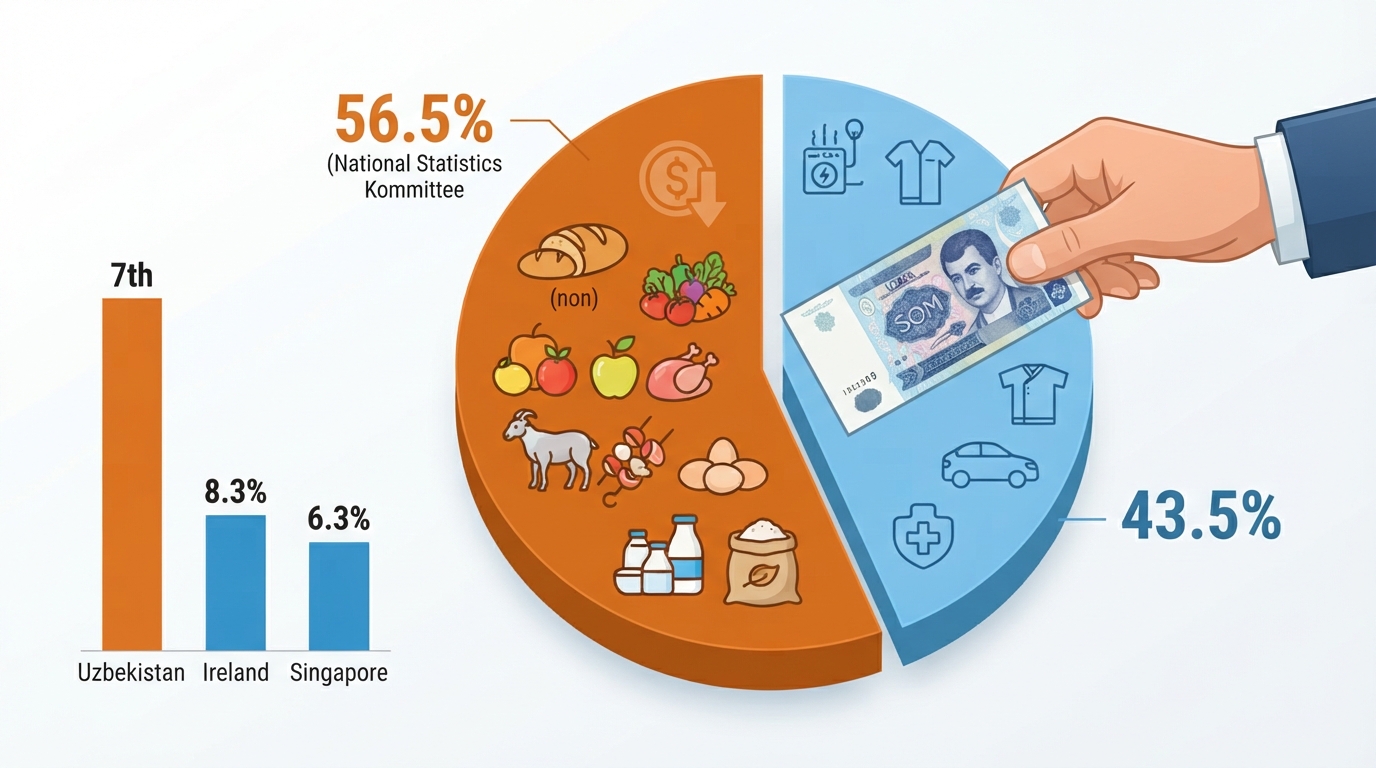
Almost every second sum of consumer spending by residents of Uzbekistan goes to food products. By this indicator, the country took seventh place among 103 states, beating most participants in the international ranking.
According to a study by Visual Capitalist based on 2025 US Department of Agriculture statistics, food products account for 44.8% of consumer spending in Uzbekistan.
Only residents of six countries spend more on food. Nigeria ranks first with an indicator of 56.2%. It is followed by Myanmar (54.8%), Laos (53.9%), Kenya (48.7%), Turkmenistan (46.3%), and Tanzania (45.8%). Kazakhstan is located in tenth place, where food accounts for 41.7% of expenses.
At the same time, national statistics data point to an even higher share of food expenditures. According to the National Committee on Statistics of Uzbekistan, food accounted for 56.5% of household consumer spending in 2025. This is 11.7 percentage points higher than the Visual Capitalist estimate.
This discrepancy is primarily due to differences in calculation methodologies. The USDA only accounts for food purchased for home consumption. Expenses for dining in cafes and restaurants, as well as for alcohol and tobacco, are not included in the international study.
For comparison, in a number of countries, expenses on food occupy less than a tenth of the consumer budget. In Ireland, this figure is 8.3%, in the USA — 6.4%, and in Singapore — 6.3%.
The gap is also noticeable within individual regions. Thus, in Africa, the share of food expenditures in Nigeria is more than three times higher than in South Africa, where it stands at 17%. In Asia, residents of Myanmar direct almost ten times larger share of their budget to food than residents of Singapore.
The difference in the share of food expenditures between countries is largely explained by Engel's law: the higher a household's income, the smaller the portion of its budget it typically spends on food. However, in absolute figures, affluent families may spend more on food products than low-income households. Therefore, the percentage of expenses does not always reflect the real cost of the grocery basket.
At the same time, a high share of food costs may indicate the financial vulnerability of households. When a significant portion of the budget goes to food, rising food prices more severely limit families' ability to pay for other necessary expenses.
Earlier, Uzbekistan dropped three positions in the passport index, taking 82nd place out of 106. Citizens of the country have access to 57 destinations without a prior visa or with a visa on arrival.