

Remittances from the UK to Uzbekistan increased by 62%, and from the EU by 27%.
The geography of remittances to Uzbekistan continues to change. In the first half of the year, remittances from the UK increased by 62%, from the European Union by 27%, and from the USA by 19%. The total volume of remittances from abroad increased by 13%, reaching $9.3 billion.
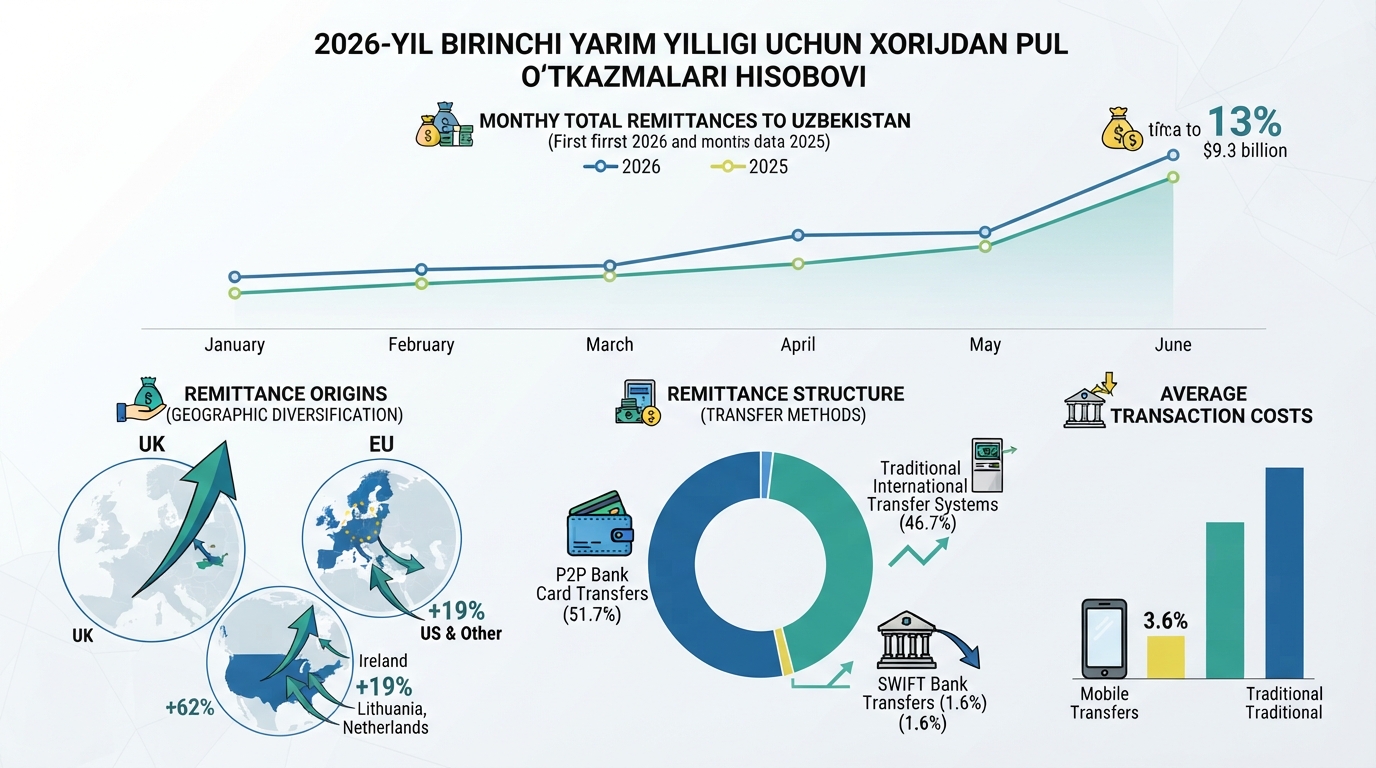
Remittances from the UK to Uzbekistan increased by 62%, and from the European Union by 27%.
In the first six months of 2026, the volume of remittances from abroad to Uzbekistan increased by 13%, or $1.1 billion, to a total of $9.3 billion. This data is provided in the Central Bank report. For comparison, in the same period in 2025, this figure was $8.2 billion.
In the first half of the year, remittances accelerated. In January and February, the country received $1.2 billion, in March - $1.3 billion, in April - $1.6 billion, in May - $1.7 billion, and in June - $2.2 billion. In the same months last year, monthly remittances ranged from $1.1 billion in January-February to $1.8 billion in June.
The regulator estimates that the growth in remittances is due to the high demand for labor in traditional labor migration routes and the stability of wage levels, as well as the general strengthening of their national currencies since the beginning of the year.
In particular, according to Rosstat, the average nominal wage in Russia in the first quarter reached 106.9 thousand rubles, having grown by 15.1% in nominal terms and 8.7% in real terms over the year.
At the same time, the Russian ruble strengthened against the dollar by an average of 13.5% in the first half of the year compared to the same period last year, as calculated by the Central Bank of Uzbekistan based on the official exchange rates of the Bank of Russia.
The Central Bank notes that the geography of labor migration continues to diversify, which is also reflected in the flow of remittances from developed countries.
In January-June, remittances from the UK increased by 62%, from the EU by 27%, and from the US by 19%. Among individual EU countries, receipts from Ireland increased significantly by 86%, from Lithuania by 18%, and from the Netherlands by 7%.
The chart in the report shows the following dynamics:
The structure of remittances is also changing. $4.8 billion, or 51.7%, of funds received by individuals came from abroad via direct p2p transfers to bank cards. Their volume increased by 32% compared to the first half of 2025.
$4.3 billion, or 46.7% of the total volume, was received through traditional international money transfer systems. The growth in this direction was only 0.3%.
Another $142 million, or 1.6 percent, was accounted for by bank transfers via SWIFT. Their volume decreased by 43 percent.
The Central Bank explains the growth in the share of p2p transfers by the widespread use of digital payment services, high speed of operations and relatively low transaction costs. According to the World Bank, in the first quarter of 2025, mobile transfers were the cheapest way to make international transfers with an average cost of 3.6 percent.
In turn, in the first half of the year, $1.3 billion was sent abroad from Uzbekistan - this is 8 percent, or about $100 million, more than a year ago.