

Transfers to Uzbekistan for the first half of the year increased by 13%, to $9.3 billion.
The Central Bank reported that individual remittances to Uzbekistan reached $9.3 billion in January-June 2026, amid rising migrant wages and diversification of employment destinations.
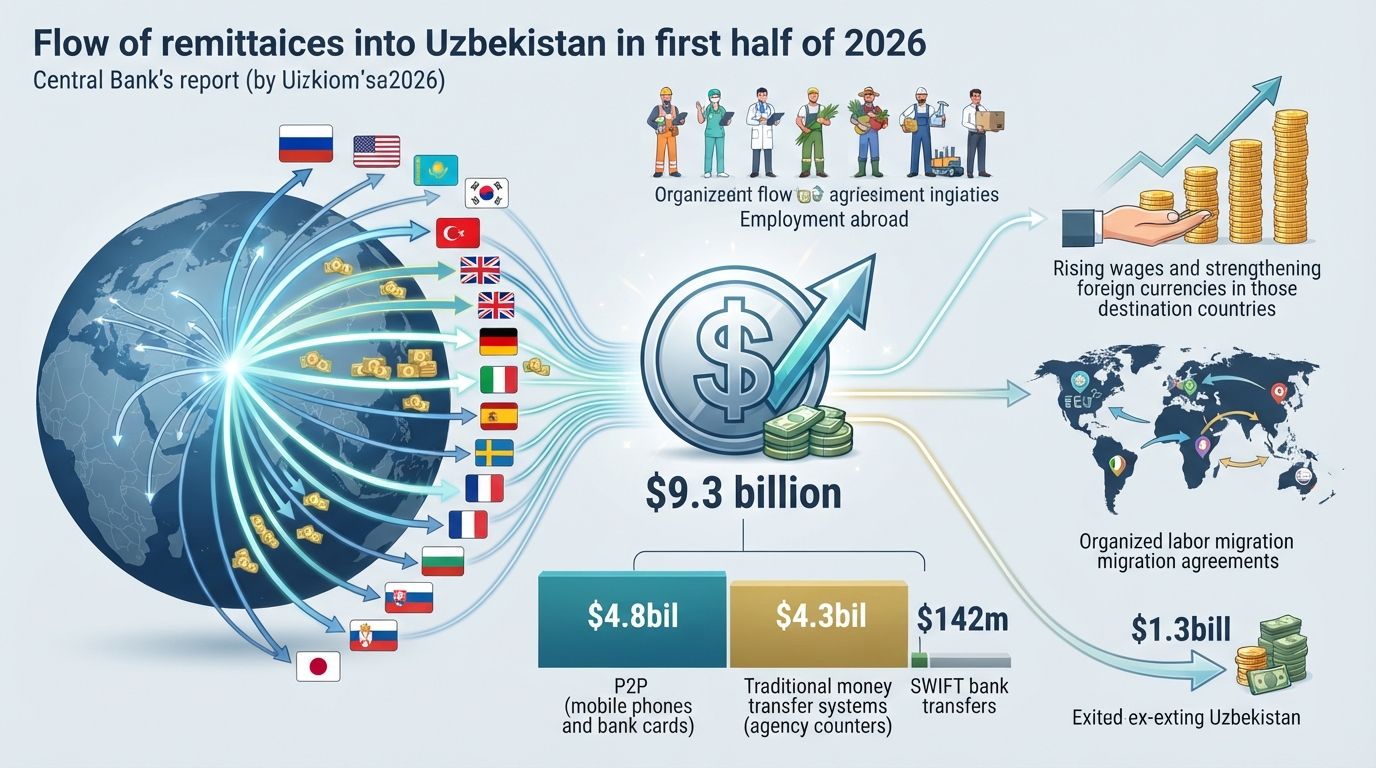
In the first half of 2026, the volume of remittances received by Uzbekistan from abroad reached $9.3 billion, an increase of 13% ($1.1 billion) compared to the same period last year, according to the Central Bank of the Republic of Uzbekistan.
The regulator attributes this growth to several factors: continued high demand for labor and relatively high wages in countries traditionally used as labor migration destinations, as well as the general strengthening of these countries' national currencies, with moderate exchange rate fluctuations since the beginning of the year.
Russia is cited as an example: according to Rosstat, the average nominal accrued wage in the first quarter of 2026 amounted to 106,900 Russian rubles, an increase of 15.1% in nominal terms and 8.7% in real terms compared to the same period last year. According to calculations based on the Bank of Russia's official exchange rates, the Russian ruble strengthened against the US dollar by an average of 13.5% in the first half of 2026 compared to the same period in 2025. In the US, according to the Bureau of Labor Statistics, average hourly earnings of non-agricultural private sector workers increased by 13 cents (0.3%) in June to $37.60, a 3.5% year-on-year increase.
The Central Bank also notes the ongoing diversification of the geography of labor migration. The Migration Agency reports that Uzbekistan has concluded 48 agreements on organized labor migration with 23 countries, of which 18 intergovernmental and interdepartmental agreements with 14 countries were signed in 2025-2026. Cooperation has been established with more than 325 large employers and recruiting companies from 36 countries. Germany, the UK, Italy, Spain, Sweden, France, Bulgaria, Romania, Slovakia, Slovenia, Serbia, the US, and Japan are among the promising partners. The US, Italy, Sweden, France, and Slovenia have become new destinations.
Employment is concentrated in sectors such as trade and services, healthcare and social services, transportation and logistics, agriculture, manufacturing, construction, welding and metalworking, woodworking, oil and gas, and mining. This year, 124,500 Uzbek citizens were employed in high-paying jobs abroad.
The largest increase in remittances was recorded from the UK (62%), from EU countries (27%) (including from Ireland (86%), Lithuania (18%), and the Netherlands (7%), and from the US (19%). In absolute terms, transfers from Kazakhstan increased from $366 million to $469 million, from the US from $313 million to $372 million, from South Korea from $282 million to $314 million, from Turkey from $266 million to $303 million, from the UK from $89 million to $144 million, and from EU countries from $251 million to $319 million.
Of the total funds received by individuals, $4.3 billion (46.7%) were transferred through traditional international money transfer systems (an increase of 0.3%), $4.8 billion (51.7%) were transferred directly to bank cards via the P2P system (an increase of 32%), and $142 million (1.6%) were transferred via SWIFT bank transfers (a decrease of 43%).
The Central Bank also presented data on global trends: over the past decade, the volume of international remittances to low- and middle-income countries has exceeded $5.5 trillion. Since 2015, remittances (excluding China) have remained one of the largest sources of external financing for developing countries, and since 2022, they have exceeded foreign direct investment. India remains the largest recipient of remittances in 2025, with $151 billion, followed by Mexico, the Philippines, Egypt, Pakistan, and Bangladesh.
At the same time, according to the Central Bank, the volume of remittances sent by individuals from Uzbekistan abroad increased by 8% ($100 million) in January-June 2026, reaching $1.3 billion.