

Practical trainings on modern sweet cherry orchard management were held in six regions of Uzbekistan
About 250 gardeners and specialists strengthened their knowledge and skills in tree shaping, selection of varieties and rootstocks, as well as pruning taking into account local climatic conditions. The Government of Uzbekistan and the Food and Agriculture Organization of the United Nations (FAO) conducted a series of practical field training sessions in the Samarkand, Jizzakh, Tashkent, Andijan, Fergana, and Namangan regions as part of cooperation to strengthen the chain […]
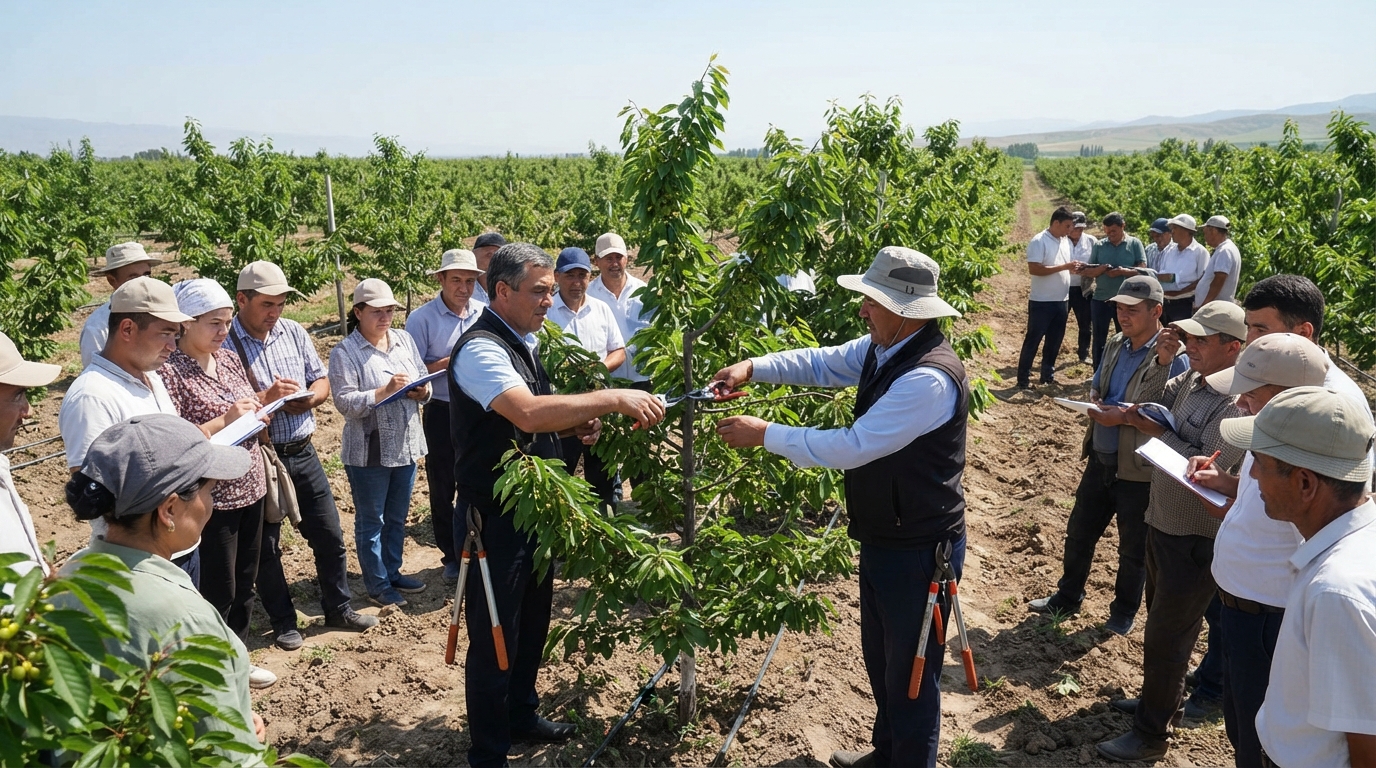
Practical training on modern sweet cherry orchard management took place in six regions of Uzbekistan
About 250 orchardists and specialists enhanced their knowledge and skills in tree training, variety and rootstock selection, as well as pruning tailored to local climatic conditions.
The Government of Uzbekistan and the Food and Agriculture Organization of the United Nations (FAO) organized a series of practical field trainings in the Samarkand, Jizzakh, Tashkent, Andijan, Fergana, and Namangan regions as part of their cooperation to strengthen the sweet cherry value chain. About 250 sweet cherry producers, agronomists, and orchard specialists took part in the training.
The training was conducted as part of the global project to promote the One Country One Priority Product (OCOP) initiative through the FAO-China South-South Cooperation Programme. The project is funded by the Government of the People's Republic of China through the Ministry of Agriculture and Rural Affairs. With the support of the project and in cooperation with the Ministry of Agriculture of the Republic of Uzbekistan, work is underway to strengthen the entire sweet cherry value chain — from production and post-harvest handling to processing, marketing, and expanding access to international markets.
The main emphasis was placed on tree training systems that help bring trees into fruiting earlier and allow pruning and harvesting from the ground, reducing the need for ladders and specialized platforms. Project specialist Shukhrat Abrorov, drawing on nearly 20 years of experience in Uzbekistan, presented approaches adapted to local conditions, including the Kym Green Bush (KGB) system.
Participants studied the stages of tree training — from planting and early orchard development to the fruiting period. Practical demonstrations showed how sequential heading of shoots helps increase the number of vertical main branches, balance tree growth, and ensure light penetration into the canopy.
Special attention was given to the compatibility of varieties, rootstocks, and training systems. Participants compared the growth and fruiting characteristics of the Lapins, Sweetheart, Skeena, Santina, Regina, and Kordia varieties. The suitability of vigorous rootstocks Mazzard, Colt, Mahaleb, and CAB 6P, as well as semi-vigorous rootstocks MaxMa 14, Krymsk 5, and MaxMa 60 for the KGB system was also examined. Specialists emphasized that using the system without considering the specific characteristics of the variety and rootstock can increase the risk of heat stress, weakened growth, or reduced yield.
"Managing a orchard with a low canopy is not just about reducing tree height. The number of main branches, the fruiting characteristics of the variety, and the vigor of the rootstock must align with each other. Therefore, we explained every pruning decision taking into account the condition of a specific tree," noted project specialist Shukhrat Abrorov.
The program also addressed orchard care under the hot summer and cold winter conditions of Uzbekistan. Participants were explained the importance of consistent irrigation and nutrient management during the first three years after orchard establishment, especially to support growth recovery after pruning. Measures to protect trunks from sunburn at temperatures above 40 °C were also considered.
During sessions on pruning timing, the necessity of completing summer training cuts before mid-June under the conditions in question was discussed. Shoots that develop later may not have enough time to lignify adequately by winter, which increases the risk of frost damage. Participants also studied the risks of bacterial canker and gummosis associated with pruning in December–January and during wet weather.
Field demonstrations made it possible to identify common mistakes: retaining too few main branches, which causes excessive vegetative growth; summer pruning of weakened trees; and excessive shading inside the canopy. Upon completion of the sessions, participants received checklists for assessing orchard condition and practical assignments to develop pruning plans tailored to local conditions.
"In six regions, we focused on specific orchard management solutions — from variety and rootstock compatibility to pruning timing and the number of main branches. Our goal is to help orchardists and local specialists assess the condition of their orchards and make informed plans for their care, creating conditions for producing competitive products," emphasized national project coordinator Muhammadjon Kosimov.
Uzbekistan is one of the OCOP demonstration countries representing Europe and Central Asia within the global project, and has selected sweet cherry as its priority product. The series of field trainings continues the knowledge exchange and cooperation initiated at the regional OCOP workshop in Namangan in May 2026 and subsequent technical sessions in the Fergana Valley.
The practical training strengthened the participants' knowledge and skills in tree training, seasonal pruning, and identifying common mistakes in orchard care. To evaluate changes in fruit quality, yield, and harvesting costs, application of the studied methods in subsequent seasons and further monitoring of the results are required.