

FAO strengthens the capacity of local specialists in climate-smart agriculture in the Fergana Valley
The Food and Agriculture Organization of the United Nations (FAO) held Training of Trainers (ToT) courses in the Andijan, Fergana, and Namangan regions within the framework of the project "South–South and Triangular Cooperation for Sustainable Agricultural Development in the Fergana Valley" (UNUN/SEC/028/UND). The training, organized in September and October, was completed by 38 participants who were awarded certificates. The courses were aimed at strengthening knowledge and […]
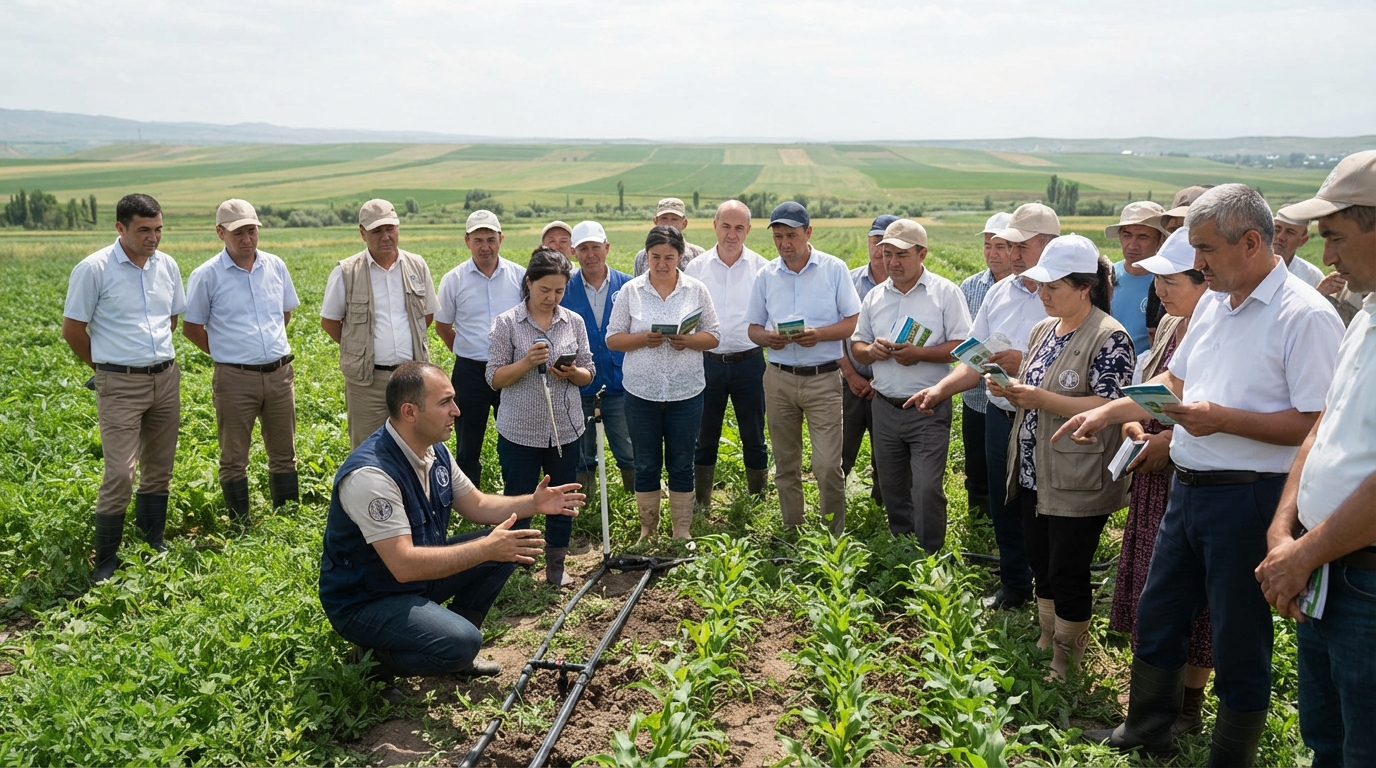
FAO enhances the capacity of local specialists in climate-smart agriculture in the Fergana Valley
The Food and Agriculture Organization of the United Nations (FAO) conducted Training of Trainers (ToT) courses in Andijan, Fergana, and Namangan regions as part of the project "South-South and Triangular Cooperation for Sustainable Agriculture Development in the Fergana Valley" (UNUN/SEC/028/UND). The training, organized in September and October, was successfully completed by 38 participants, who were awarded certificates.
The sessions were aimed at expanding the knowledge and practical skills of agricultural specialists and experienced farmers in sustainable soil and water management, the cultivation of climate-resilient crops, and the implementation of climate-smart agriculture (CSA) practices. The training of trainers is designed to ensure the further transfer of this knowledge to farmers, dekhkans, and other agricultural workers.
The training involved specialists from the Andijan Institute of Agriculture and Agrotechnologies, Fergana State University, International Institute of Food Engineering and Technology, Namangan State Technical University, the Agency for Agricultural Development under the Ministry of Agriculture, as well as divisions of the Republican Center for Agro-services in Andijan, Namangan, and Fergana regions. Experienced dekhkans and farmers from the project implementation districts also joined the classes.
The curriculum included approaches to improving soil health, using water more efficiently, and adapting agricultural production to changing climate conditions. Strengthening the technical capacity of participants in these areas is intended to promote the broader adoption of sustainable agricultural practices among farm and dekhkan households.
The project, implemented by the FAO Representation in Uzbekistan, aims to develop climate-resilient agricultural systems and improve the livelihoods of the rural population in the Fergana Valley. By enhancing the knowledge and technical capacity of smallholder farms, cooperatives, and national experts, the project is designed to increase agricultural resilience to climate change, as well as its productivity and economic outcomes.