

Political strokes on Rashidov's career – why did Andropov dislike the leader of Uzbekistan?
October 1983. The cotton harvest in Uzbekistan is at its peak. Tired of Moscow's pressure to fulfill the plan, Sharof Rashidov sets off for Karakalpakstan. The goal was to encourage the cotton growers and increase the pace of the harvest. On October 31, while the leader of Uzbekistan is traveling in the Ellikqala district, a heart attack occurs and Rashidov passes away.
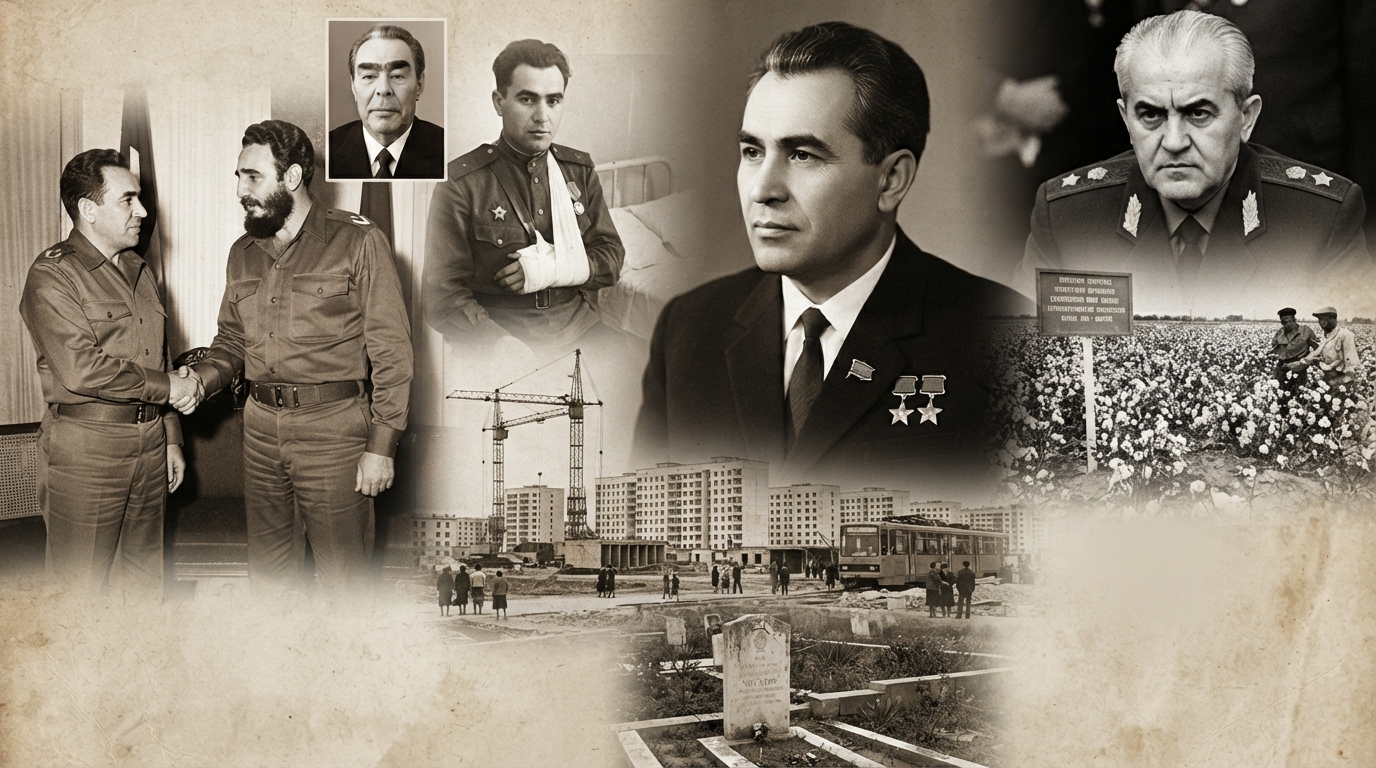
**Political sketches of Rashidov's career – Why did Andropov dislike the leader of Uzbekistan?**
During the Soviet era, Uzbekistan was led by several individuals. Among them, Sharof Rashidov holds a special place in the history of Uzbekistan.
He led the republic for a long time — 24 years, and it was during the years of Rashidov's leadership that Uzbekistan's industry and agriculture developed significantly. The living standards of the population improved. Cities and villages became prosperous.
However, by the beginning of the 1980s, instead of adequately appreciating Rashidov's services, the "Red Empire" began to destroy him. As a result, he died at the age of 66.
Born in 1917, Sharof Rashidov, after graduating from high school, studied first at the Jizzakh Pedagogical Technicum, and then at the Faculty of Philology of Samarkand State University.
After graduating, he worked as a responsible secretary and deputy editor-in-chief of a regional newspaper. In 1941, he went to war and returned in November 1942 after being wounded. In 1943, he began working as the editor-in-chief of the regional newspaper.
In 1944, Rashidov was appointed as the leader of the Samarkand region. In 1947, he was recalled to Tashkent and appointed editor-in-chief of the "Qizil Oʻzbekiston" newspaper. In 1949-1950, Rashidov worked as the head of the Writers' Union of Uzbekistan.
In 1950, he was appointed Chairman of the Presidium of the Supreme Soviet of Uzbekistan. Rashidov served in this position until 1959, and in that year, he became the leader of Uzbekistan. He led Uzbekistan until his death on October 31, 1983.
Sharof Rashidov's first collection of poems, titled "Mening nafratim" (My Hatred), was published in 1945. In 1951, the novella "Gʻoliblar" (The Victors) was published. In 1959, the novel "Boʻrondan kuchli" (Stronger than the Storm), and in 1964, "Buyuk toʻlqin" (The Great Wave) were released in book form.
The above-mentioned works were written on the basis of communist ideology, in which the policies pursued by the Soviets were depicted one-sidedly, with praise only. Indeed, at that time, it was impossible to write without praising Soviet policy, and this can also be seen in the works of other famous writers.
The writer's poetic novella "Kashmir qoʻshigʻi" (The Song of Kashmir), published in 1956, depicts the struggle of the Indian people for freedom. Books consisting of his publicistic articles were also published.
After Rashidov became the leader of Uzbekistan, he had no time for creative writing. However, his books were republished repeatedly. In his time, he helped many writers. But he absolutely did not forgive writers who criticized his works or himself. The works of such writers were not published, and they themselves were left without state awards.
For example, prominent writers such as Abdulla Qahhor, Mirzakalon Ismoiliy, Saida Zunnunova, and Said Ahmad incurred his wrath because they criticized Rashidov's works at meetings of artistic councils.
Gʻaybulloh as-Salom writes in his book "Ey umri aziz" (O Dear Life):
"I used to hear that the relationship between the famous writer Mirzakalon Ismoiliy and Sharof Rashidov was not good. I do not know who was at fault or how it started. On the day Sharof aka died, one of the 'old acquaintances' called Ismoiliy, trying to get a 'reward for good news' in his own way:
- Congratulations, Mirza aka, here, your rival Rashidov has died. Are you happy now?
Hearing his words, Mirzakalon trembled, got angry, and lost his temper.
- Oh, you wretched, simple-minded person. Does anyone congratulate someone on another's death? What a pity. Who said he was my enemy! Everyone dies when their time comes. This is mortality. At such times, people do not rejoice, they express condolences. Shame on you!"
Said Ahmad, in his work "Yoʻqotganlarim va topganlarim" (My Losses and My Findings), recalls the days when he fell into the wrath of Sharof Rashidov as follows:
"After I slightly criticized Sharof Rashidov's novel 'Qudratli toʻlqin' (The Mighty Wave) during a discussion, all paths were closed for both Saida and me. Neither the press, nor the printing house, nor the radio, nor television—everything was closed to us."
After that, the husband and wife met with Rashidov with the help of Komil Yashin. The leader of Uzbekistan spoke to them with some bitter sarcasm and, at the end of the meeting, treated them well and saw them off. However, the "ban" placed on Said Ahmad and Saida Zunnunova was still not lifted.
"We left empty-handed from the leader whom we had waited 11 hours to meet and whom we thought was our savior. My book was not published either. The doors of the press did not open for either Saida or me. My novella was published in Ukraine, and we managed to make ends meet somehow. Both Saida and I knew very well why we were being treated this way. It all started after I criticized that 'Qudratli toʻlqin',"
recalls Said Ahmad about those days in his work "Yoʻqotganlarim va topganlarim".
Shortly after Sharof Rashidov became the leader of Uzbekistan, he was elected a member of the Central Committee of the CPSU. After that, Nikita Khrushchev, who was leading the USSR at the time, began to involve him in international relations.
In particular, in 1962, during the Cuban Missile Crisis, Rashidov went to the "Island of Freedom" as the head of the Soviet delegation and held important negotiations with Fidel Castro.
Later, when Leonid Brezhnev came to the leadership of the USSR, Rashidov became a candidate member of the Politburo of the Central Committee of the CPSU, and in 1970, a member of the Presidium of the Supreme Soviet of the USSR.
In his time, Rashidov was a well-known figure throughout the Union. This is also confirmed by the following sentences from Gʻaybulloh as-Salom's book "Ey umri aziz":
"In 1982, in the city of Almaty, I met and spoke with Academician Zakiy Ahmad, Vice President of the Academy of Sciences of Kazakhstan.
He expressed the following opinion:
- We always envy brotherly Uzbekistan and, frankly, we are a little jealous, - he said. - People who visit us from abroad, especially from Western countries, do not know any other place in this region besides Uzbekistan. Our conversation with them is always interesting:
- This land is not Uzbekistan, it is Kazakhstan, we explain to them in detail.
- Yes, I understand: Uzbek, Uzbek! Tashkent.
No, Kazakhstan. Our capital is not Tashkent either, it is Almaty. Kazakhstan-Almaty.
- Now I understand. Uzbek-Toshkent-Rashidov.
Ahmad Zakiy laughs with delight: 'Well, let it be so: Uzbek-Toshkent-Rashidov'."
### Uzbekistan in the Rashidov Era
During the era of Sharof Rashidov, agriculture and industry developed rapidly in Uzbekistan. Just one example: the Tashkent Aviation Production Association named after Chkalov became one of the five largest aircraft factories in the world in its time.
Also, hundreds of large enterprises such as the Tashkent Tractor Plant and Tashselmash were established in the republic. Cities and villages became prosperous.
Dozens of thermal and hydroelectric power stations were built, and villages were fully electrified. Infrastructure improved. Reservoirs were built to develop and expand agriculture.
Thousands of kilometers of railways and tens of thousands of kilometers of highways were constructed. After the 1966 earthquake, Tashkent was completely rebuilt. A metro system was built in the capital.
Gʻaybulloh as-Salom recalls those days in his book "Ey umri aziz" as follows:
"One day, I was chatting with a well-known linguist scholar from Samarkand, Professor Xudoyberdi Doniyoriy. Whenever I met with the teacher, a debate would arise between us.
The argument that time was about the newly built Lenin Museum in Tashkent.
– Why on earth do we need to open a branch of the Lenin Museum like a palace in the capital of Uzbekistan! – I asked in surprise. – While our people in rural areas live in ruins that are falling apart like mulberries, we are building a magnificent marble building for Lenin in the center of the city. What kind of logic is this?
Xudoyberdi domla, completely unconcerned, showered Sharof Rashidov with praise for building the Lenin Museum. As if building a museum for Lenin was the right thing to do. According to him, as if: nothing is eternal in this mortal world, including Lenins. The evil red empire will surely collapse one day. Our people will be freed from chains. Our republic will embark on a bright, independent path of development.
Years later, the day dreamed of by Xudoyberdi domla and Sharof aka arrived. We achieved independence. But, unfortunately, they saw the arrival of Lenin, but they were not destined to see his departure."
During the Rashidov era, housing was built for the population in regional and district centers, and territories were landscaped. By his decisions, new museums, theaters, and parks were built. Also, anniversaries of cities like Samarkand and Bukhara were celebrated.
At a time when Soviet ideology taught that Amir Temur was a bloodthirsty tyrant, an international symposium dedicated to the art of the Temurid era was held in Samarkand in 1969. The lives of scholars such as Beruniy, Ibn Sino, and Xorazmiy were researched.
### Six Million Tons of Cotton
Sharof Rashidov was, in the language of that time, a "loyal soldier of the Communist Party" and, as the leader of Uzbekistan, was obliged to carry out whatever orders were given from Moscow.
However, this did not satisfy the bosses sitting in Moscow. For this reason, a demand was placed before Rashidov to bring the harvest to 5 million tons.
Somehow, this plan was fulfilled. But those in Moscow then began to demand that Rashidov bring the cotton harvest to 6 million tons. In practice, at that time, it was absolutely impossible to grow 6 million tons of cotton in Uzbekistan. However, Rashidov could not reject Moscow's demand. On top of that, this demand had come from the mouth of the USSR leader Leonid Brezhnev.
To bring the cotton to 6 million tons, a major campaign was launched this time, and across the republic, melon and other crop fields were sharply reduced, and orchards were cut down. Cotton was planted everywhere. Even then, it was impossible to fulfill the plan.
In the end, the officials in Moscow themselves came to the rescue. They said: "You send us the money, and the plan will be fulfilled." Ultimately, this path was taken, and the plan was fulfilled. However, the consequences of this work were severe for Uzbekistan.
Due to the heavy use of chemical fertilizers, the lands fell into a semi-dead state. Hepatitis A and Hepatitis B, known among the people as "yellow disease," spread widely. Since children and teachers were driven to the cotton fields, classes in schools were missed. The living standards of the people declined. In short, cotton cultivation became a disaster and a calamity for the people.
In the second half of the 1970s, although Leonid Brezhnev was the leader of the USSR, in practice, the country was run by KGB chief Yuri Andropov. At that time, all leaders were forced to reckon with him. They say even Brezhnev himself lived in fear of him.
Andropov disliked Rashidov. There are many theories about the reason for this. The most famous of them is that Andropov did not like the fact that Brezhnev had a rather warm relationship with Sharof Rashidov.
Also, according to another theory, Rashidov was against sending troops to Afghanistan. When this issue was discussed in the Politburo, Brezhnev also mentioned Rashidov among those who were against the Afghan war.
Andropov, who tried with all his might to send troops to Afghanistan, did not like this action of the leader of Uzbekistan. However, at that time, he could not say anything to Rashidov, who was under Brezhnev's protection.
In the autumn of 1982, after becoming the leader of the country following Brezhnev's death, Andropov began to speak repeatedly about the fact that bribery and padding of figures were rampant in Uzbekistan and that this must be stopped. In January 1983, he even issued a reprimand to Rashidov.
In April 1983, the Politburo of the Central Committee of the CPSU adopted a resolution to investigate the padding of figures committed in cotton production in Uzbekistan. In September of that year, the Prosecutor General's Office of the USSR sent a group led by Telman Gdlyan and Nikolay Ivanov to Uzbekistan.
Andropov's goal was to put Rashidov in prison. However, he did not manage to do this: on October 31, 1983, Rashidov died of a heart attack. Despite this, Gdlyan and Ivanov continued the investigation in Uzbekistan.
How the "paratroopers" led by Gdlyan and Ivanov "audited" Uzbekistan is known to many. They tortured Uzbeks using inhumane methods and put many in prison. Some were killed during the investigation process or committed suicide.
True, the atrocities of Gdlyan and Ivanov in Uzbekistan continued during the eras of Konstantin Chernenko and Mikhail Gorbachev, who led the USSR after Andropov. But the fact remains that sending them to Uzbekistan and punishing Uzbeks was precisely Andropov's wish.
Shortly after Rashidov's death, a major campaign was launched against him. In the center and in the regions, people who had friendly relations with him were fired or demoted.
The denunciation of Rashidov intensified on Moscow television, in central newspapers, and in the Uzbek press. Those who had flattered and praised him while he was alive now began to condemn him.
When Rashidov died, he was initially buried with respect in the center of Tashkent, on the edge of what is now Independence Square, with the aim of building a huge memorial complex in the future.
After the campaign to condemn Rashidov reached its peak, in 1986, his body was exhumed from the first burial place and reburied in the Chigatay cemetery.
Gʻaybulla as-Salom writes in his book "Ezgulikga bogʻlangan odamzod" (Mankind Bound to Goodness), recalling those times:
"They say that the leader of Kazakhstan, Dinmukhamed Kunaev, said tearfully at a large meeting:
– Hey, whatever you have to say, say it now, while I am alive. After I die, do not dig up my grave and throw bricks behind my back like that Uzbek!".
When Dinmukhamed Kunaev said "do not dig up my grave," he was referring to the reburial of Rashidov.
Rashidov, who was severely condemned after his death during the Soviet era, was rehabilitated after Uzbekistan became independent. Places were named after him, and his anniversaries were celebrated. A house-museum was opened in Jizzakh.
Taking into account Rashidov's services to the Uzbek people, he was posthumously awarded the Navoiy State Prize in 1994.