

Pilot warned Amazon cargo plane going too fast before deadly crash, data shows
One pilot told the other about the aircraft's "excessive speed" but received an uneven response even as alarms sounded.
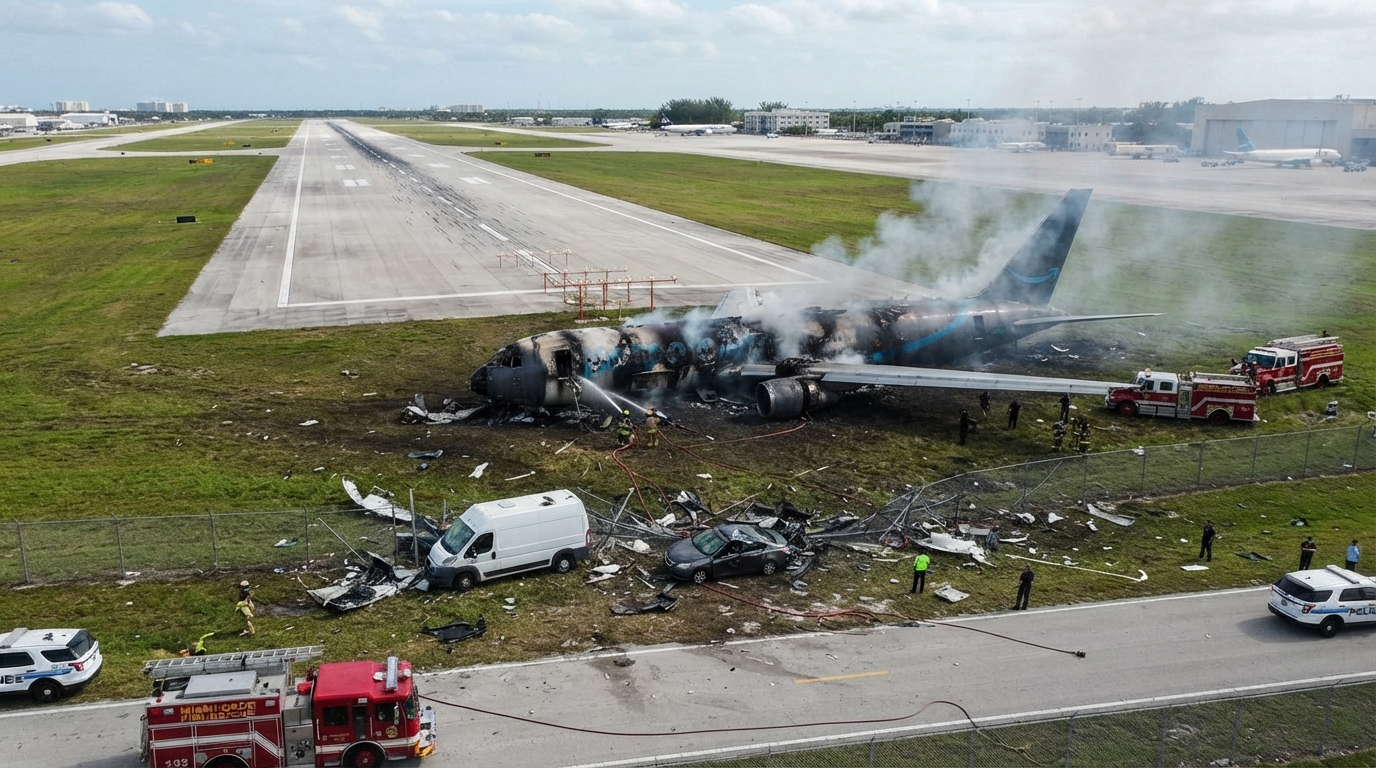
Pilot warned Amazon cargo plane was going too fast before deadly crash, data shows
A pilot aboard an Amazon cargo plane that crashed in Miami, Florida, on Sunday said it was moving too fast before it overshot a runway, struck other vehicles and burst into flames, according to new flight data.
An investigation update from the US National Transportation Safety Board (NTSB) said one pilot repeatedly warned the other in the cockpit about "the aircraft's excessive speed" but noted "there was but not a consistent verbal response", even as an altitude alarm sounded.
The Boeing 767-300's landing speed was 158 knots (292km/h), which experts have said was on the high end.
The NTSB is leading the investigation into the crash, which killed five people and injured five more.
Flight data released by the NTSB included the plane's speed, altitude and other details such as flap deployment as it neared the runway. The update also contained a summary of the conversation between the two pilots.
That summary said the pilot's warnings about speed continued "throughout the remainder of the recording" as did the inconsistent verbal response.
The update said there was an electronic "sink rate sink rate" callout in the final minutes - an automated safety warning about the rate of descent.
There was also an electronic "too low terrain" callout, another automated verbal warning that the plane was flying too close to the ground without being properly set up for landing.
Aviation attorney Pablo Rojas told CBS News, the BBC's US partner, that without the actual recording it was hard to know what the NTSB meant when it referred to the inconsistent verbal response.
"But, it really confirms that this was, in a way, a doomed approach," he said.
Rojas said the flap deployment data in the NTSB update could also be a point of concern. The flaps, which are located on the back of the wings, are "part of what helps the plane kind of slow down and gently approach a landing", he said.
"The flap deployment here happened much later in the accident sequence," Rojas said. "That's maybe because the pilots were responding to the fact that they were going too fast."
After overshooting the runway, the plane - Amazon Prime Air Flight 7598 - hit equipment on the ground, struck a white Ford van, then kept going through a perimeter fence.
It then collided with a Toyota Corolla before coming to rest about 1,300ft (394m) beyond the runway.
The five people who died were part of a plane-cleaning crew in the van. Miami authorities on Tuesday identified them as Rolando Aleman Leon, 55; Yoel Rodriguez Naranjo, 53; Julio C Pineda, 75; Carlos Acosta Fajardo, 53; and Javierkys Reyes Quevedo, 47.