

Photo: Murals have appeared in the underpass near the "Olmazor" metro station. Who painted them and why?
The pedestrian underpass from the Olmazor metro station to the Tashkent bus terminal has become a venue for street art. Nine murals dedicated to the history and cultural heritage of Uzbekistan have appeared here. Gazeta.uz found out who created them and why.
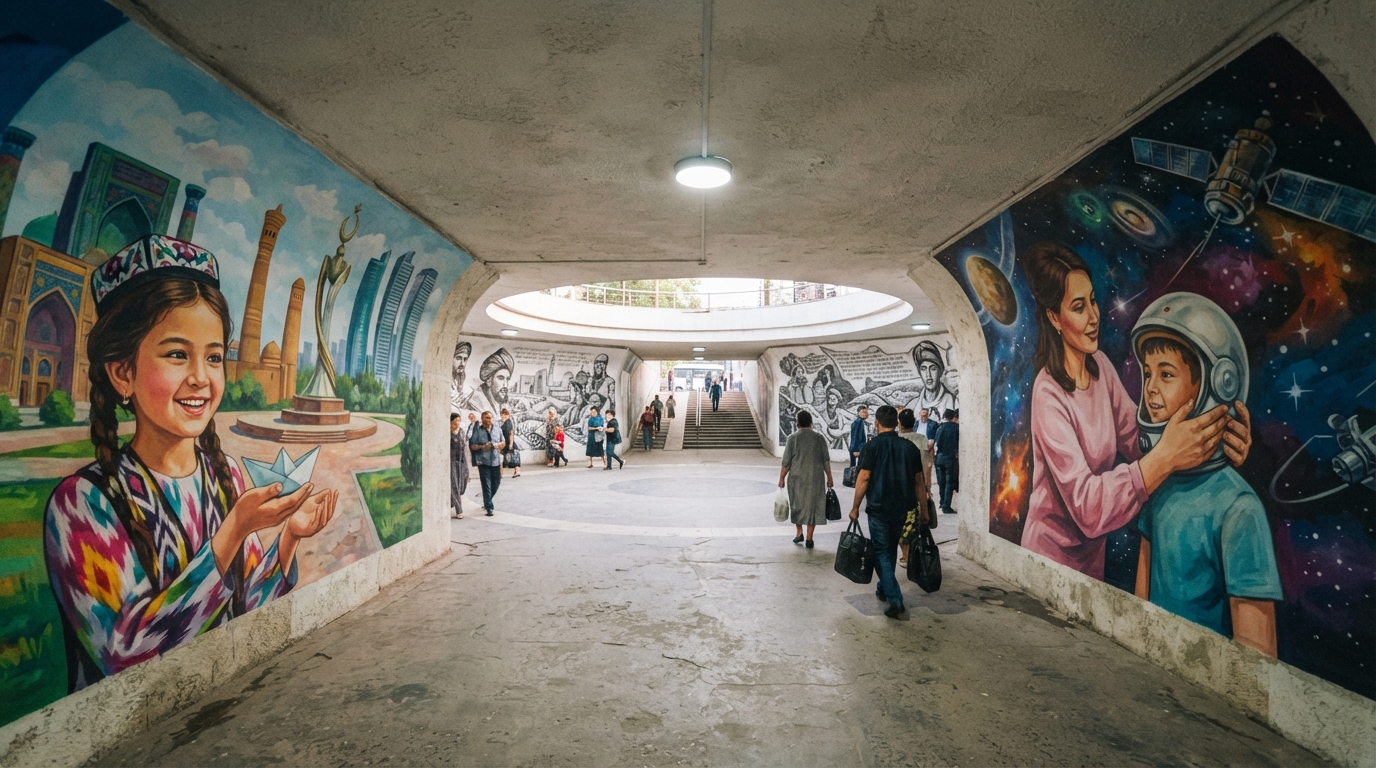
Photo: Murals have appeared in the underpass near the "Olmazor" metro station. Who painted them and why?
Thousands of people pass through the underpass near the "Olmazor" metro station every day. One of the exits leads to the Tashkent Bus Station, from where routes depart to most regions of Uzbekistan. With such a flow of passengers, this place had long remained neglected and unsafe. At the end of August, the underpass was transformed: on the initiative of the non-governmental non-profit organization "Uzbegligim — uzligim" and with the support of the Chilanzar district khokimiyat, artists decorated its walls with murals dedicated to the country's history and cultural heritage.
As Mokhira Sultonova, head of the NGO, explained, the project's goal was to support young street artists — "so they could showcase their skills."
Project curator Marjona Khamraeva said that the team considered more than seven locations. The underpass near the "Olmazor" metro station was chosen due to the high foot traffic, including foreigners. The district khokimiyat provided working conditions for nine artists and helped with lighting. The organizers covered all expenses for materials.
The underpass itself, from the station to the bus terminal, is designed as an intersection of three long corridors. They converge in an open circular area, where the main part of the murals is located on the walls. The artists worked on-site for almost two weeks — from August 13 to 25.
Yana Yusupova dedicated her work to the 35th anniversary of Uzbekistan's independence. She depicted a girl in a tubeteika holding a paper boat. The central image is complemented by recognizable silhouettes of Registan Square, the minarets of Khiva, the Independence Monument in the "New Uzbekistan" park, as well as modern high-rises.
The artist painted the girl's face and hands using airbrushing, and the rest with a brush. The upper part of the wall had to be painted from scaffolding, working at a height of about 3 meters.
Yusupova views the growing popularity of street art and graffiti in Tashkent and other cities of the country positively. According to her, until recently, there was "nowhere to even rest your eyes" in the underpass, but now it has acquired its own energy, which lifts the mood of passersby.
For artist Rustamzhon Chuliev, this project was his first experience of working independently on an urban mural — previously, he had only assisted more experienced masters. He depicted a mother putting a space suit helmet on her son. According to the artist, the inspiration for this image was the launch of the Earth remote sensing satellite Samarkand-2028. But space here is merely an occasion to talk about feelings. At the center of the mural is the pride of a mother who looks at her child and believes that the most incredible opportunities will open up before him in the future.
Chuliev said that the project participants helped each other because the work was not easy: due to the heat, only the morning and evening hours remained comfortable, and at night, artificial lighting interfered. He noted that the initiative brought the artists together and expressed hope for its continuation.
"If support for artists continues, we will also, to the best of our ability, pay attention to the development of this field. In many developed countries and megacities, street art is what gives the city's appearance a special beauty. I believe this will benefit Uzbekistan in every way," the artist believes.
, "asked" to join the project team himself — he learned about it from videos that passersby filmed and posted on social media while work on the first murals was still underway.
On the walls of the underpass, he gathered different periods and events of Uzbekistan's history into a single visual sequence — from prehistoric eras to the acquisition of independence: the Arab conquest, the flourishing of Samarkand under the Timurids, colonization by the Russian Empire, wars, Soviet industrialization and repressions, and labor in the cotton fields. The mural, executed in black and white, is completed by the silhouette of the artist himself and the inscription "Tarix hali ham yozilmoqda…" ("History is still being written…").
The artist deliberately chose not to show only achievements.
"I fundamentally did not want to show history as a straight line of victories just so the work wouldn't cause controversy and would please everyone. Such history does not exist. Independence becomes more understandable when you see the whole path, acknowledge mistakes so as not to repeat them, and take responsibility to write your own future," Vargunza explained the concept of the mural.
The wall Kamolov worked on was cracked and stained, crumbling in places, but the artist decided not to restore it, believing that such a surface would make the work more expressive. A few days after the mural was completed, part of the wall was painted over, touching and splattering the faces of the Jadids. Who did this and why is unknown.
Kamolov notes that in street art, buffing — painting over other people's work — is a common practice when a drawing touches on sensitive topics or is created without permission.
But if the work has already been agreed upon and approved, making changes to it without the author's involvement is unethical.
"When they give permission, see the final work, and say they like it, but in the end make changes to the work — that is at least disrespectful to the artist. I don't know who did this and for what purpose, but there were many ways to refresh the wall without ruining the work. They could have consulted with the artist or asked him to do it himself," says Vargunza.
The author receives mixed feedback and different interpretations of his work every day and views them positively. According to him, it would be much worse if passersby limited themselves to the assessment "beautiful" and felt no emotions. The writer likes that the mural prompts viewers to fill in the gaps in their historical knowledge — "to become a little more educated through drawings where there is not a single line of text."
According to the project curator, the NGO "Uzbegligim — uzligim" plans to conduct similar campaigns on a larger scale, timing them to dates significant for the country. The next murals may appear in the city by the New Year.