

"Perhaps the khokimiyats need memos not to touch the mosaics." They tried to "finish" Zharsky's mural.
The Mirzo-Ulugbek District Khokimiyat (mayoral office) in Tashkent approved the completion of Zharsky's mosaic on a building. Following Gazeta's inquiries, the work was halted, but some of the ceramics were painted over. The Khokimiyat initially insisted the mosaic needed repair. It later emerged that no expert opinion had been issued.
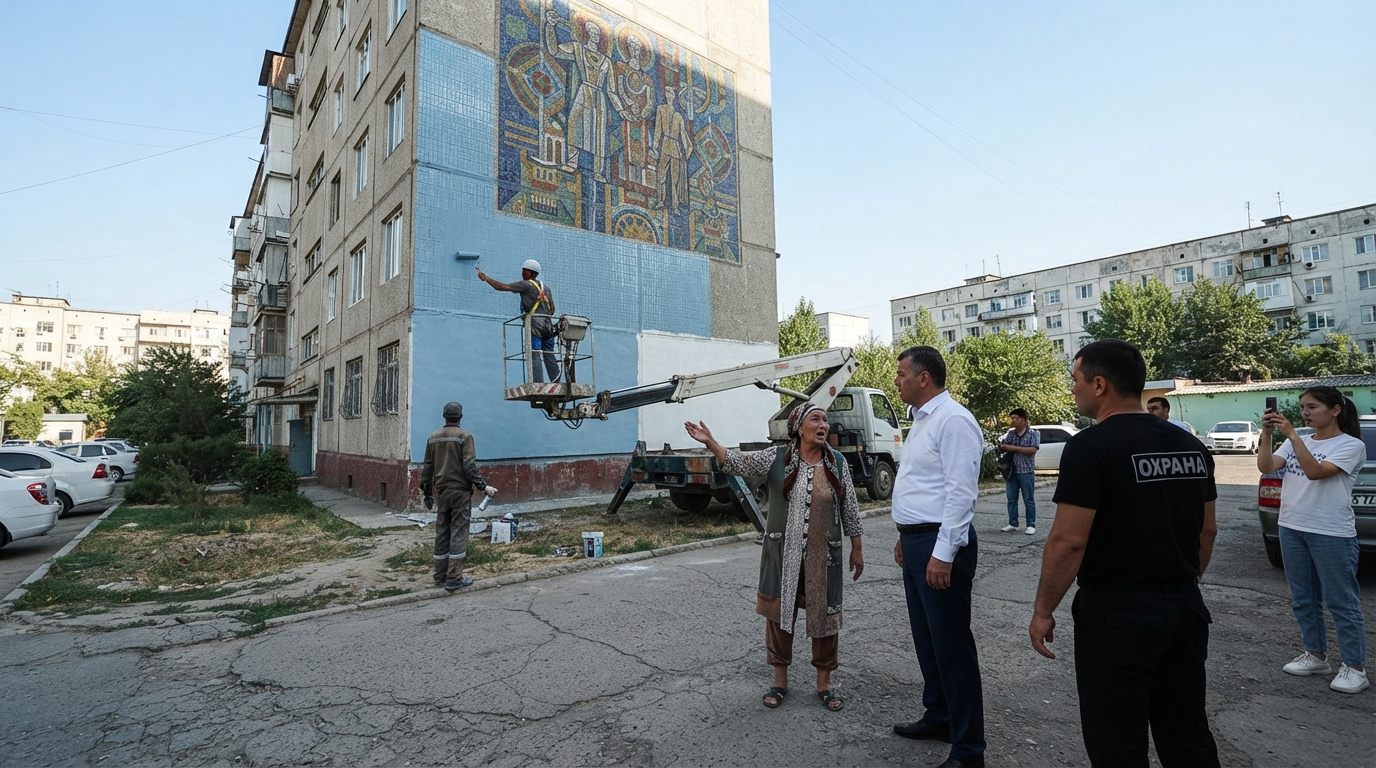
"Perhaps the khokimiyats need instructions not to touch the mosaics." They tried to "finish" Zharsky's mural.
The khokimiyat of Tashkent's Mirzo-Ulugbek district has issued a permit to "finish" one of the world-famous mosaics in the capital of Uzbekistan, created by Nikolai Zharsky (information about the mural is available on the official website).
Following Gazeta's inquiries to government agencies and complaints from residents, the work was suspended.
On the morning of August 28, our correspondent, noticing workers painting ceramic panels on the side of a nine-story building in the Turon mahalla (address: 1 Parkent Street), spent several hours nearby, trying to determine the nature of the work and its initiators. Below is her account of how the situation developed from "everything has already been decided" to "work has been suspended."
9:47. A journalist notices a worker who has begun applying blue paint over yellow tiles. The work is progressing very quickly.
A sketch of the future mural is visible at the bottom of the building's side.
Gazeta is sending inquiries to the district and city administrations, as well as the Agency for Cultural Heritage and the Foundation for the Development of Culture and Arts of Uzbekistan.
10:00 AM.
Each panel takes approximately 10 minutes to complete. Two of the three panels on the ninth floor have already been painted.
Passersby stop to take photos of the building. When asked, "What will be here?" they are told, "It will be beautiful."
Three people are on site. One operates the lift, another watches from the side, and the third has "Security" written on his black T-shirt.
In response to the journalist's questions, a representative of the company doing the work states that the mosaic will not be touched.
He takes out his phone and shows the sketch of the future mural. He didn't present any documents, but assured me that the district administration had approved the project.
In the sketch, the drawing completely covers the mosaic. The young man quickly adds that it's just a sketch. For example, a golden eagle is depicted, but it won't be in the mural. "The sun will remain, too; the new paint will only be on the top and bottom."
District administration press secretary Mamur Parmonov reports by phone that the mosaic won't be touched, but the mural will complement it. There are damaged sections of the panels that need restoration, he adds.
10:15 AM.
Tatyana Chelnokova, a resident of the building, approaches the workers and asks why they are painting over the wall. She reminds them that the mosaics were recently recognized as cultural heritage sites:
"All of Tashkent fought for them."
A large-scale reconstruction has been underway in the mahalla for several months. Despite the khokimiyat's assurances that residents are aware of all the administration's plans and that all work is being carried out in consultation with residents, Chelnokova says she learned about the wall being painted over while passing by. Gazeta reported how the renovation plan was changed after residents' dissatisfaction.
"Nobody spoke to us at all.
I just called the building committee, and she's not aware of it," she claims. The woman tries to reach the local police officer, but he doesn't answer.
Chelnokova tells the workers that residents should have been warned—the neighbors' windows on the eighth and sixth floors are open. "There's paint there," she says, and dials the neighbors' numbers on the phone.
The woman insists that no one will consent to the wall being painted over. No dialogue ensues. The work continues.
A company employee calls the worker upstairs and says the windows should be covered. He also warns him:
"Don't touch the mosaic." The district khokimiyat press secretary, the acting mahalla chairman, and the house committee of building No. 1 arrive at the scene.
10:20 AM.
All panels on the ninth floor have been painted over. The mosaic begins at the ceiling level of the eighth floor.
10:25 AM.
The Cultural Heritage Agency tells Gazeta that management and specialists are investigating the issue.
10:34 AM.
Bakhtiyor Yuldashev, head of Klas Group Building, tells a reporter that the mahalla plans to renovate one mural on building No. 8 and create a new one on another.
10:40 AM.
House committee Olga Efanova says the building was built in 1981. According to her, the people are not against the renovations in the mahalla, but they need dialogue.
"This has not been agreed upon with the people. Who is this being done for? For the people. "Notify them, tell them what you want to do, and then you can avoid the sharp corners. After all, this is our memory. This is the only house here with such a mosaic, our heritage," says Olga Alexandrovna.
The structure the residents are talking about.
Tatyana Chelnokova and the house committee point to a new metal structure next to the house, which is planned to become a grocery store.
Despite objections, the khokimiyat decided to install the store on the site where neighbors gather in the cool evenings and children play.
Furthermore, this is a safe route into and out of the yard.
The path in front of the house has a very steep incline, and in winter it is often slippery. The residents have been deprived of this space.
"Why do we need a store here? We told them we don't need one; there are plenty of stores on the other side of the house. A structure next to the window—it could be inconvenient," the residents say.
After the renovation, the street near the house became wider—and immediately there were more cars. There's no sidewalk, and people are forced to walk between cars.
Since the khokimiyat and workers aren't listening to residents, they've appealed to the khokimiyats and the prosecutor's office, but so far there have been no responses.
10:50 AM
Meanwhile, a worker on a lift is already painting panels at the sixth floor level, just below the mosaic line.
Press Secretary Ma'mur Parmonov says that repair and improvement work in the mahalla is being carried out as part of the "Obod Mahalla" (Prosperous Mahalla) program.
"The facade repairs will affect more than 20 buildings, as they are worn out. As of today, more than 90% of the facade work is complete," he reports.
11:02 AM
Acting mahalla chairman Komil Zhabbarov explains to Gazeta why people may react so strongly.
"Everyone has a connection to their home, their own associations. When you ask what kind of building you live in, our people say, "The building with the mosaics." You see, they've gotten used to it; it's an integral part of the building, so it's only natural that people are worried," he notes.
11:12 AM
Mamur Parmonov informs Gazeta that the work has been halted.
"A decision on further work will be made based on the experts' conclusions.
Right now, it's being temporarily suspended. Work will be carried out strictly based on the conclusions regarding the condition of the mosaics—whether they require restoration or not," the press secretary emphasizes.
12:02 PM
The Agency for Cultural Heritage provided Gazeta with a copy of the document stating the suspension of work.
"Work can only continue after receiving a positive conclusion from the Scientific Expert Council of the Agency for Cultural Heritage," the agency noted.
They recalled that the presidential decree of November 19, 2025, set the goal of achieving global recognition for Tashkent as the city with the largest number of mosaics.
Work to grant protected status to the mosaics will continue. The mosaics on both ends of Building No. 1 are planned to be included in the National List of Tangible Cultural Heritage Properties, the agency reported.
Mosaic on the opposite end of the same building.
12:05.
The Mirzo-Ulugbek District Khokimiyat, which had confirmed this morning that all work had been approved, thanked residents in a statement "for their concern, attention to the appearance of their district, and careful attention to its architectural and artistic elements."
Fotima Abdurakhmanova, scientific director and consultant of the "Tashkent Mosaics" project, head of the social group "Shagayu.uz," and urban researcher, commented on the incident to Gazeta. "The designers of the mosaic design for 1 Parkent Street should have contacted the Foundation for the Development of Culture and Art and the Agency for Cultural Heritage before work began, and approved the project.
In my opinion, it's essential to first obtain expert opinions on the feasibility of combining a mosaic and a mural on the same wall," she said.
The issue of preserving mosaics has been a topic of discussion in Uzbekistan for some time, yet local authorities continue to attempt to paint over them. In 2022, attempts were made to paint over mosaics created under the supervision of the Zharsky brothers on a number of buildings near the Tashkent city administration and the main departments of architecture and landscaping, as well as on Furkat and Babur streets. The administration then attempted to justify itself, claiming that the mosaic panels weren't being painted over, but "on the contrary, covered with a special material" to preserve them "as city landmarks." However, this was untrue. Following media reports and public outcry, the cement layer began to be removed from the mosaics.
"We need to understand what kind of city we live in." "Tashkent is a city of mosaics.
Barbarism against them is a violation of norms and regulations," noted Fotima Abdurakhmanova.
"Perhaps we should create reminders for city hall employees to avoid touching the mosaics.
If they talk about restoration, it should be carried out by experts, including architects, who can make their suggestions," she added.
Conservation of the mosaics certainly requires restoration work. But the issue of training specialized specialists who could carry it out remains open, said Fotima Abdurakhmanova.
She recalled that there was a project in Tashkent where a mosaic by the Zharsky brothers was combined with a mural on a building on Afrosiab Street. In November 2023, artist and decorator Nadezhda Rikhsieva painted a photo of Max Penson on the lower part of the building's side wall. However, in this case, part of the mosaic had previously been destroyed by the owner of the ground-floor premises.