

Papers for wiping
Resolution inflation: how the UN Security Council is turning into a meaningless talking shop
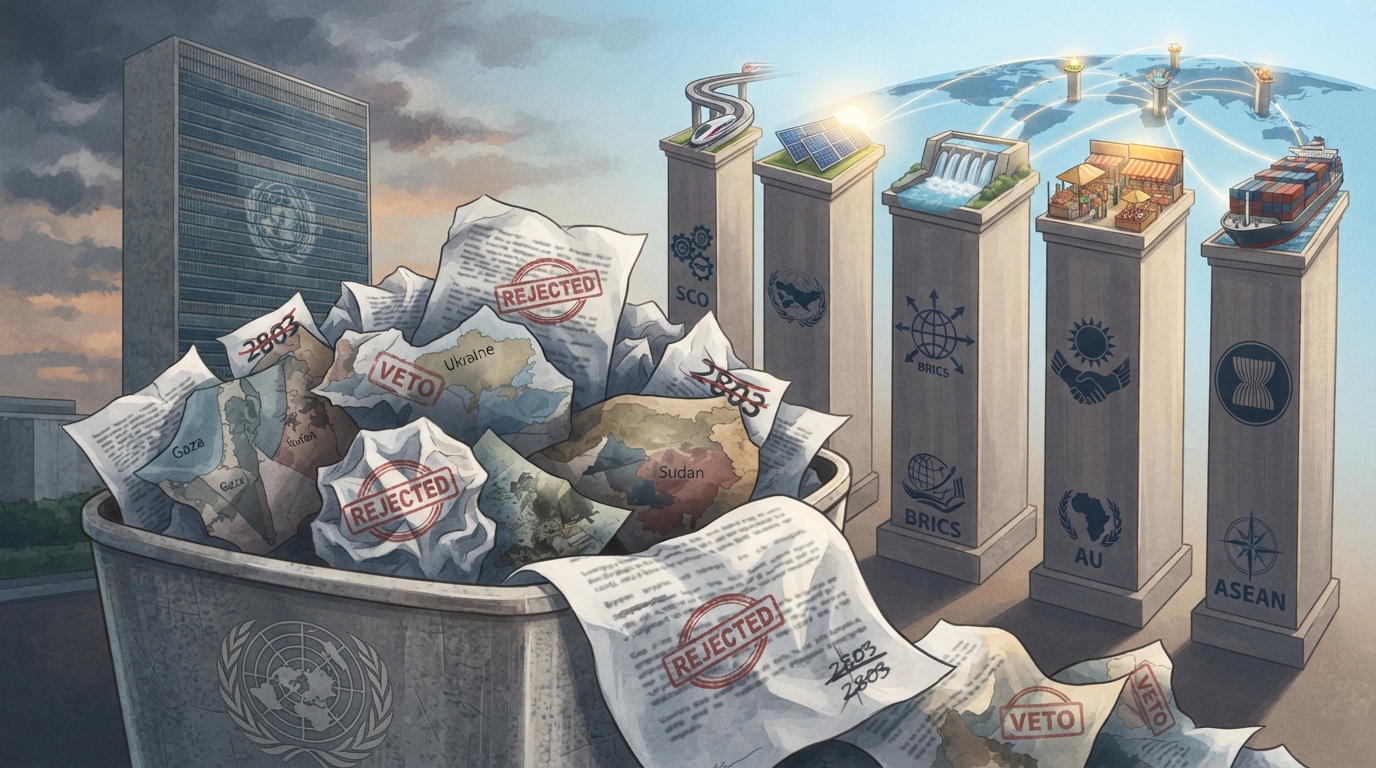
**Papers for Wiping**
Every year, the UN Security Council adopts an average of more than 40 resolutions and holds 250 official meetings. At first glance, the figures look convincing: the mechanism seems to be working. But to put it bluntly, what exactly have these resolutions changed?
### Resolutions Exist — No Result
From Gaza to Ukraine, from Sudan to the Democratic Republic of the Congo, resolutions are multiplying, while the fire across the planet is burning ever hotter. A gap has emerged between the "production of decisions" and the "resolution of problems," and it is only widening with each passing year.
Against this backdrop, voices are growing louder that the SCO, BRICS, EAEU, African Union, and other regional associations are effectively taking over the functions that the UN can no longer handle. This is not just about "whether the UN is needed" — although it is about that too. It is about the fact that the functions of the global organization seem to be starting to redistribute, and this process can no longer be ignored.
If you look at the statistics of this institution's work, the conclusion suggests itself: it is getting worse and worse at reaching agreements. Every resolution becomes the result of exhausting bargaining, endless coordination, and the gutting of the original text. The result is a document that satisfies everyone precisely because it obligates no one to do anything. In other words, it simply doesn't work. Bingo!
But even this pseudo-work is declining in intensity year after year. In 2025, there were 255 official meetings and 115 informal consultations — 16% fewer than the year before. High-level meetings became fewer: 23 compared to 14. The number of invited briefers decreased by 19%, and representatives of civil society by almost 40%. What does this mean? More and more people realize that this is an optional circus and a waste of time. The only thing this show is good for is getting noticed on Insta and sending mom a photo from the meeting. It makes the old lady happy.
Let's take a specific example — Gaza. On November 17, 2025, the Security Council, with 13 votes in favor and two abstentions — China and Russia — adopted Resolution 2803, which supported the US plan for a "comprehensive settlement" with a mandate for international stabilization forces and a "Peace Council." The US representative declared that "the UN has proven it can be great again." The Secretary-General called the decision "an important step toward securing a ceasefire."
However, the UN Special Rapporteur on the situation of human rights in the Palestinian territories occupied since 1967, Francesca Albanese, warned: the resolution "violates the Palestinian right to self-determination, solidifies Israel's illegal presence in the occupied territories, and therefore could legitimize ongoing mass violence."
One resolution — two mutually exclusive interpretations. Meanwhile, the ruins of Gaza continue to grow. The Security Council has mastered to perfection the art of choosing an intermediate state between action and inaction: adopting a text with sufficiently vague wording so that each side can interpret it in its own favor — and then watching it dissolve at the implementation stage. In essence, this is, excuse the expression, political masturbation.
### The Veto, Which First Turned into a Club and Then Lost All Meaning
The root of the Security Council's dysfunction lies not in procedures, but in the structure of power. The increase in the number of meetings cannot hide the Security Council's deep limitations in situations involving humanity's most serious crises. Permanent members resort to the right of veto time and again — first and foremost the US — blocking necessary decisions and undermining trust in the Council.
Many observers complain: theoretically, all member states are equal, but in practice, "some are more equal than others." The General Assembly only has the right to discuss, its resolutions are often repetitive and lack legal force, and therefore they are gradually perceived as an ineffective talking shop.
The core of the problem is that the veto, conceived as a guarantee of great-power consensus, has turned into a weapon of great-power rivalry.
### A Double Crisis
The Security Council's deadlock is only part of the general UN crisis. Analysts cite key figures: the organization is short of about $2.4 billion in its regular budget and $2.7 billion in its peacekeeping budget. The US has accumulated arrears in contributions exceeding $3 billion and plans to significantly reduce or completely eliminate funding for a number of UN programs, including peacekeeping, in the next budget cycle.
But it is not just about money. For decades, UN mandates — peacekeeping operations, humanitarian aid, human rights, and environmental activities — have accumulated, and today there are more than 40,000 of them. The redundancy of resolutions and reports, the complexity of implementation, the lack of resources — according to experts, all of this is chronic.
Even more serious is the lag in management mechanisms. Artificial intelligence, quantum computing, outer space, deep-sea resources — in all these strategic areas, international rules are lagging behind, and the UN is not flexible enough and lacks effective tools to control the behavior of states. Developed countries evade financial aid, technology transfer, and capacity building, exacerbating the governance vacuum.
Judge for yourself: the 2025 Sustainable Development Goals report states that of the 169 targets, only 35% are on track, nearly half are progressing slowly, and 18% show a negative trend.
An organization with more than 40,000 mandates cannot provide effective regulation in the areas of AI, climate, and the prevention of mass atrocities. This is the crisis of purpose in concrete terms: the UN produces more and more "output," but its impact is less and less.
### Security Council Reform: No Consensus, Alternatives Emerging
Talks about reforming the Security Council have been going on for decades. In 1963, the Council expanded from 11 to 15 members — but that was a one-time adjustment under Cold War conditions. Every subsequent attempt has hit two thresholds of the UN Charter: the consent of the five permanent members and a two-thirds vote of the General Assembly. There are plenty of ideas — for example, France proposes two permanent seats for Africa, permanent seats for Germany, India, Japan, and Brazil, the so-called "G4." China proposes a different logic: supporting "regional, rotational membership" instead of a "lifetime seat," which would "genuinely expand the opportunities for the Global South to participate in the work of the Security Council." But all of this, as is customary at the UN, boils down to yet another talking shop — meaningless and merciless.
The result of the deadlock is the emergence of "alternative platforms." And here, the example of the Shanghai Cooperation Organisation is particularly telling.
### SCO, BRICS, and Modular Architecture
Last year, China's Permanent Mission to the UN, presenting a draft resolution on cooperation with the SCO, released telling statistics: cooperation covers more than 50 areas, and the combined economic volume is approaching $30 trillion.
In the declaration of the Tianjin Summit, "UN" is mentioned 40 times. The summit declared support for "the international system with the UN at its core," support for the "necessary reform" of the UN, and adopted a special statement on the 80th anniversary of the organization.
These formulations clearly show: the SCO does not seek to replace the UN. China's Permanent Representative to the UN, Geng Shuang, presenting the draft resolution, emphasized: the SCO "does not intend to compete with the UN, but complements multilateralism."
But what does "complementing" mean in practice?
A number of experts, commenting on the Tianjin Summit, drew attention to a key point: during the forum, the leaders agreed to establish the SCO Development Bank, and China pledged to provide 2 billion yuan in grants and 10 billion yuan in new loans over three years for "power grids, ports, irrigation, and jobs." Analysts also noted a symbolic moment: the handshake between Xi Jinping and Narendra Modi. Such a gesture will not resolve disputes instantly, but it could open up new opportunities.
What does the SCO do? It does what the UN Security Council is unable to do: it provides development financing, builds infrastructure, and maintains dialogue in the face of disagreements. It does not try to resolve geopolitical disputes — it reduces the intensity of conflicts through the logic of "development first."
This is a stark contrast to the function of the Security Council. The Security Council deals with "crises" — wars, sanctions, peacekeeping. The SCO deals with "normalcy" — trade, infrastructure, development financing. And when the first function reaches a deadlock, the value of the second naturally grows.
A similar functional differentiation is occurring at other levels. Following its expansion, BRICS is promoting settlements in national currencies and its own development bank. The African Union is strengthening Africa's agenda in the G20. ASEAN maintains regional dialogue mechanisms. Each of these structures has its own weaknesses and limitations. But in one key dimension, they surpass the current Security Council: they get real things done rather than discussing what ought to be done.
### In Summary
Let's return to the initial question: what does the "inflation of resolutions" of the Security Council mean?
It means that the institution that once monopolized global security governance is losing this monopoly. Not because someone took its power away, but because it cannot exercise it effectively itself. When the Security Council adopts resolution after resolution, and they do not stop the bombing of Gaza, do not end the war in Ukraine, do not prevent famine in Sudan, a "resolution" ceases to be an instrument of action and turns into a political gesture.
The SCO, BRICS, the African Union, and other regional and transcontinental mechanisms are effectively taking over some of the UN's functions — primarily in the areas of development, trade, and infrastructure, i.e., in non-security fields. This is not a declaration of building a parallel system, but a quiet functional migration.
For the UN, this might not be the worst scenario. An organization that tries to be effective in all areas at once ends up being effective nowhere. A system designed 80 years ago cannot adequately respond to the challenges of the 21st century — AI regulation, climate finance, the digital divide. Functional differentiation, where regional structures take on more responsibility in areas where they have more capacity and legitimacy, may turn out to be more realistic than "comprehensive reform."
Of course, this does not eliminate the need to reform the Security Council itself. But while these reforms stall, the world does not stand still.