

Paid parking: why it is not just about the price?
At the center of the discussion on paid parking lots is often the pricing. However, its effectiveness depends on the functioning of the system: zoning, payment control, and preventing violations. It is also important for people to see the results in the form of developed infrastructure, public transport, and a comfortable city appearance.
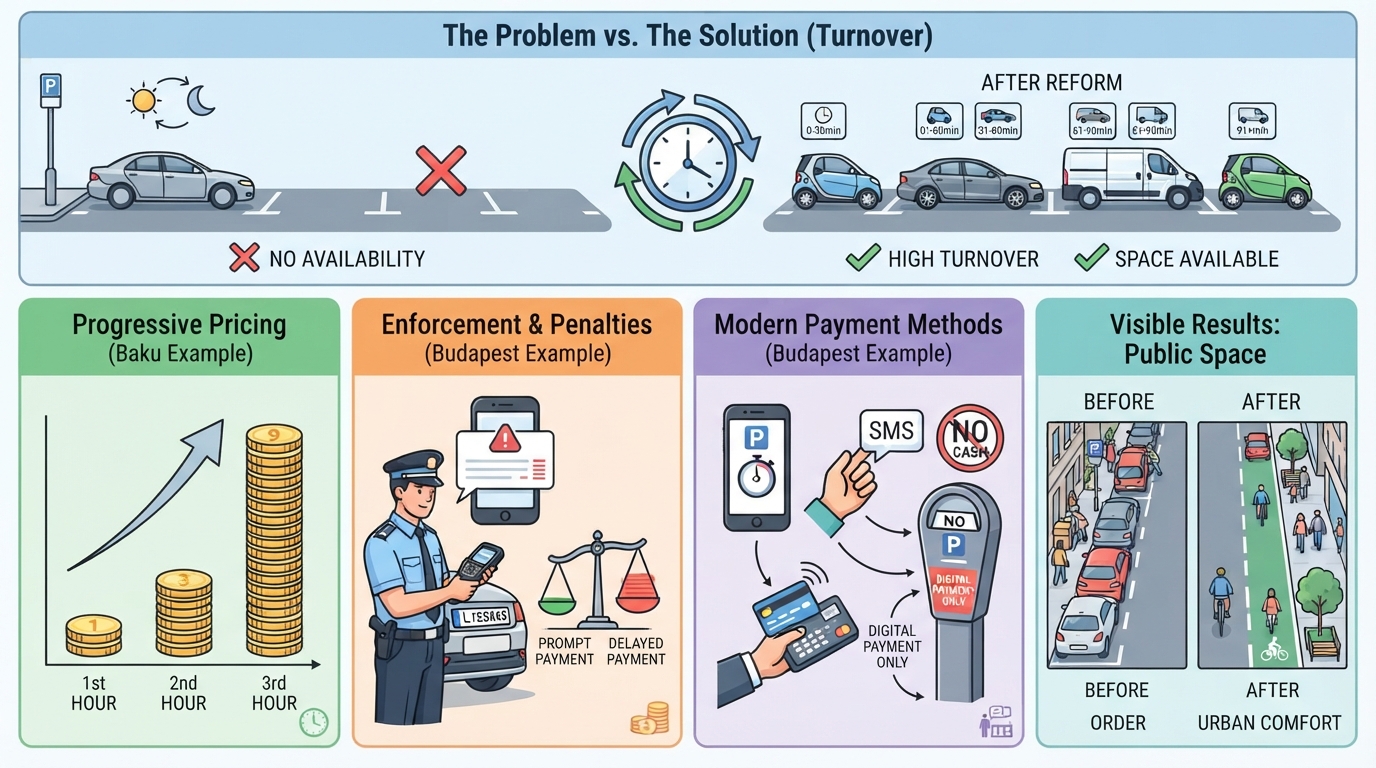
**Paid parking: why the issue is not just about the price?**
Discussions about paid parking usually revolve around the price — how much needs to be paid per hour and whether it will be too expensive for drivers. However, the outcome of the parking reform depends on how the entire system works: where the boundaries of the paid zones lie, whether the parking price changes over time, how payment is controlled, and what awaits violators.
The main task of paid parking is to ensure that several drivers can use a single space in one day. For this, a special indicator is used — turnover. It shows how many different cars occupied one parking space within a certain period of time.
After the introduction of paid parking in Moscow, the turnover of parking spaces increased by 4.5 times, and the average traffic speed in the center increased by 12 percent. The meaning of the first indicator is simple: a space that was previously occupied by a single car from morning till night became open to several cars during the day.
This is precisely the idea of the reform being introduced in Tashkent, which should soon be applied to other cities of Uzbekistan as well. A free space often goes to the person who arrives early and can leave their car for a long time. Paying for parking, on the other hand, forces the driver to think about how much time they actually need this space for and whether they need to go to the city center by car at all.
However, simply introducing a tariff is not enough for this.
In November 2025, Minsk switched to a system consisting of three parking zones. Three months later, the city assessed the initial results. On central streets, drivers began leaving their cars for 15–60 minutes instead of the whole day. According to official data, 19 percent of them stopped going to the center by car, and 17 percent reduced their parking expenses.
At the same time, 51 percent began looking for free alternative options. This shows the vulnerability of systems where free streets remain next to paid ones, and courtyards are not protected from the entry of foreign cars.
In addition, if payment is rarely checked, some drivers will continue to leave their cars as before. Therefore, zone boundaries and control must work together: otherwise, the problem will move to the neighboring street.
In some cities, the price changes depending on the duration of parking.
In Baku, the second hour of parking is three times more expensive than the first. Such a system allows keeping a relatively cheap price for a short-term visit and making long-term parking significantly more expensive.
With a flat hourly rate, the driver pays the same amount for each subsequent hour as they paid for the previous one. When the tariff increases progressively, staying longer becomes increasingly disadvantageous. This is an additional incentive to vacate the space after finishing one's business.
But all these mechanisms require an indispensable condition — liability for violations.
Fines are a necessary part of the parking system. Their task is to prevent violations: a driver must know in advance that leaving their car on the sidewalk, blocking a pedestrian crossing or a courtyard entrance, or not paying for parking will cost more than complying with the rules. This is also the preventive effect — encouraging the driver to leave their car in the correct place before they obstruct others.
Without fines and regular control, the street paid parking system will not function fully. If a violation remains without consequences, payment will become voluntary for some drivers, while parking-prohibited areas and courtyards will turn into a free alternative, as is the case in Tashkent. As a result, cars will continue to occupy sidewalks, obstruct pedestrians, and block driveways.
For this reason, it is necessary to control both the payment for permitted spaces and parking in places where leaving cars is prohibited.
Such measures are common practice in cities of various countries. Fines for violating parking rules are applied, for example, in Moscow and New York. They help make the rules mandatory for everyone and maintain order on the streets.
It is not only the amount of the fine that matters, but also the probability of receiving it. Even a severe punishment has little effect on behavior if violations are almost never detected. A working system should form a clear habit: it must be easier and more beneficial to follow the rules than to break them.
In Budapest, the amount of the surcharge for a violation depends on the tariff and how quickly the driver clears the debt. In Zone A, when paid within 15 days, the surcharge is 10.2 thousand forints. After this period, it increases to 24.6 thousand forints, which is approximately 2.4 times more. Such a scheme makes both non-payment itself and attempts to delay its consequences disadvantageous.
Budapest is also changing payment methods. From July 1, the city abandoned parking meters: payment for parking can be made via a mobile app, SMS, or a call. This is another part of organizing parking, along with tariffs and control.
However, residents judge transport reform primarily by how much more convenient daily life has become.
Therefore, there must be a visible result of the changes: clear sidewalks, safe crossings, convenient parking spaces, and public areas.
In Budapest, one example of such an approach to streets is the Rakpart program. Since 2020, a section of the lower embankment on the Pest side of the Danube has been seasonally opened for pedestrians and cyclists, with car traffic closed.
According to the city administration, the schedule for 2026 takes into account traffic flow measurements from 2023–2025. In the early evening hours, cars on the embankment decrease, and pedestrians increase. Therefore, at certain hours, space is allocated for people to walk, while at other times, car traffic is maintained.
This example shows that a street can perform different functions during the day.
The city can distribute space taking into account who uses it and when.
For Tashkent, several practical conclusions emerge from the considered experience of other capitals:
1. Paid zones must be designed in such a way that cars do not fill up neighboring streets and courtyards.
2. The rules must take into account the difference between short-term parking and all-day parking.
3. Payment must be clear, and control must be regular.
4. Fines must encourage drivers to refrain from violations and help prevent disorder.
5. At the same time, the performance of the system should be evaluated by the decrease in violations: whether sidewalks and crossings are clear, whether buses and emergency services can pass, and whether it is easier to find a space for a short visit.
6. The price of a one-hour payment remains an important part of the parking reform. But its success is determined by the entire system: where the rules apply, how they are structured, whether they are observed, and whether the city is becoming more convenient for people.