

OSCE Youth Media Camp: Countering Disinformation and Digital Security
Not everything we see on the internet and social media is reliable. The age of technology brings people closer together and makes any information accessible in a couple of clicks, but sometimes the digital environment turns into a space for manipulation, extremism, and radicalization. In continuation of the comprehensive work to increase the media literacy of youth, the OSCE Project Co-ordinator in Uzbekistan, together with the Center for Professional Development of Journalists, organized the holding of […]
OSCE Youth Media Camp: Countering Disinformation and Digital Security
The age of technology brings people closer together and makes any information accessible in just a couple of clicks; however, the digital environment sometimes becomes a space for manipulation, extremism, and radicalization.
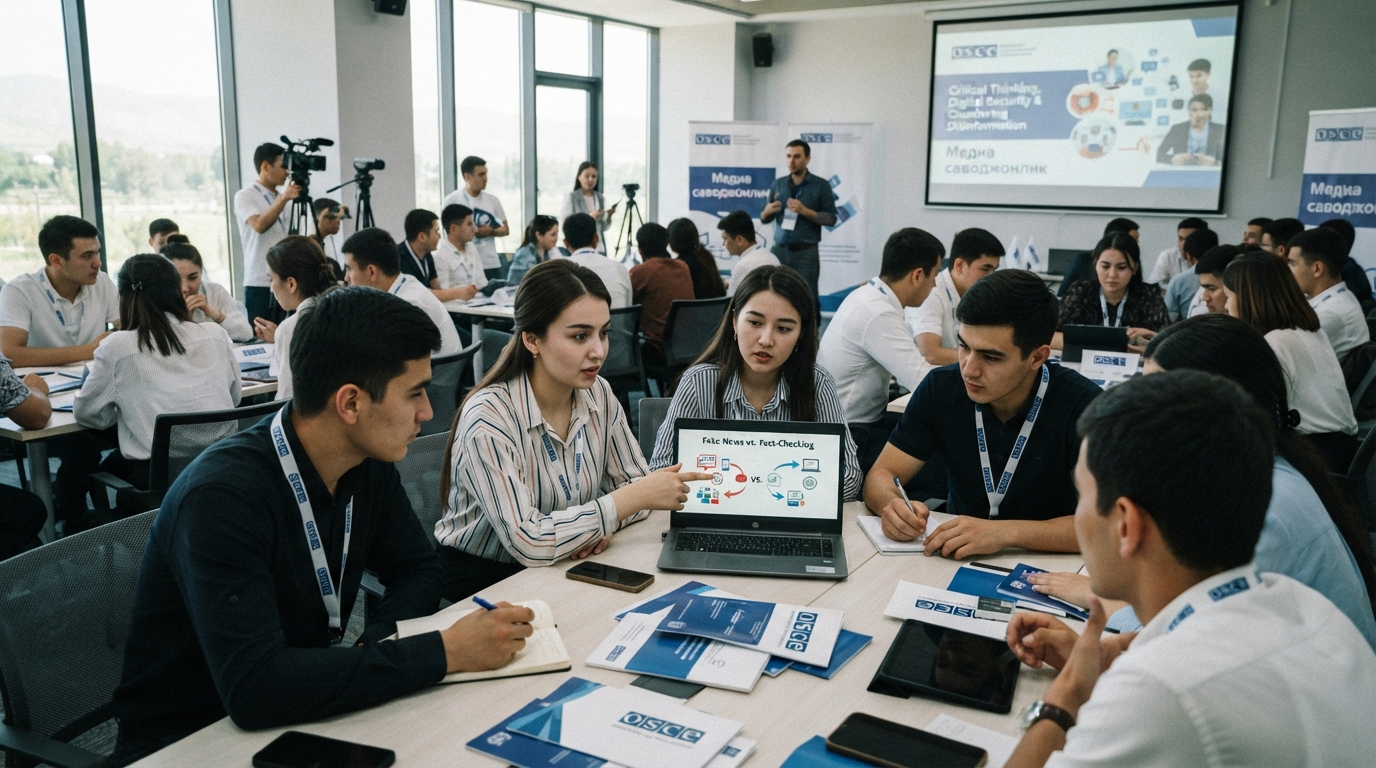
As part of the ongoing comprehensive work to increase the media literacy of youth, the OSCE Project Co-ordinator in Uzbekistan, together with the Center for Retraining of Journalists, organized a media camp in the Parkent district of the Tashkent region. It was attended by 30 talented students from the country's leading universities, studying in the fields of journalism, filmmaking, and design. The main emphasis was placed on developing media literacy skills, critical perception of information, and the ability to recognize disinformation in the digital environment.
This initiative provides future journalists, filmmakers, and designers — those who will shape the modern media landscape — with all the necessary tools to recognize fakes, thoroughly check facts, and create reliable, safe content. In this way, young people are actively involved in the prevention of violent extremism and radicalization leading to terrorism.
Emphasizing the importance of this work, Gulnara Babadjanova, Director of the Center for Retraining of Journalists, said:
"Our most important weapon in the fight against terrorism is reliable information. The task of modern media is not to spread negative stereotypes, but to develop tolerance in society. Journalists themselves need to constantly acquire new knowledge in order to professionally cover complex topics, always keeping in mind ethics and human safety."
Over the course of three days, the participants attended interactive sessions, analyzed practical examples, and took part in masterclasses by experts. They discussed digital security, the use of artificial intelligence in content preparation, as well as ways to create alternative information narratives. In addition, the participants talked about how our daily actions on the Internet can affect the lives of individuals and entire communities outside the digital space.
During the discussions at the media camp, Shamsiddin Talibboev, a student at the Uzbekistan State University of World Languages, noted:
"It is important not only to be able to use the Internet, but also to critically evaluate one's actions and their consequences for other people. It is necessary to understand that publishing or distributing someone else's content without consent can cause real harm, and not to support cyberbullying."
By developing critical thinking, the ability to create high-quality content, and the capacity to resist online threats in the new generation, such projects help make the information environment in Uzbekistan safer and more open.