

Ordinary Abomination
A fateful choice for Europe. Why did the results of the election campaign in Saxony-Anhalt so infuriate the Euro-globalists?
**Ordinary Baseness**
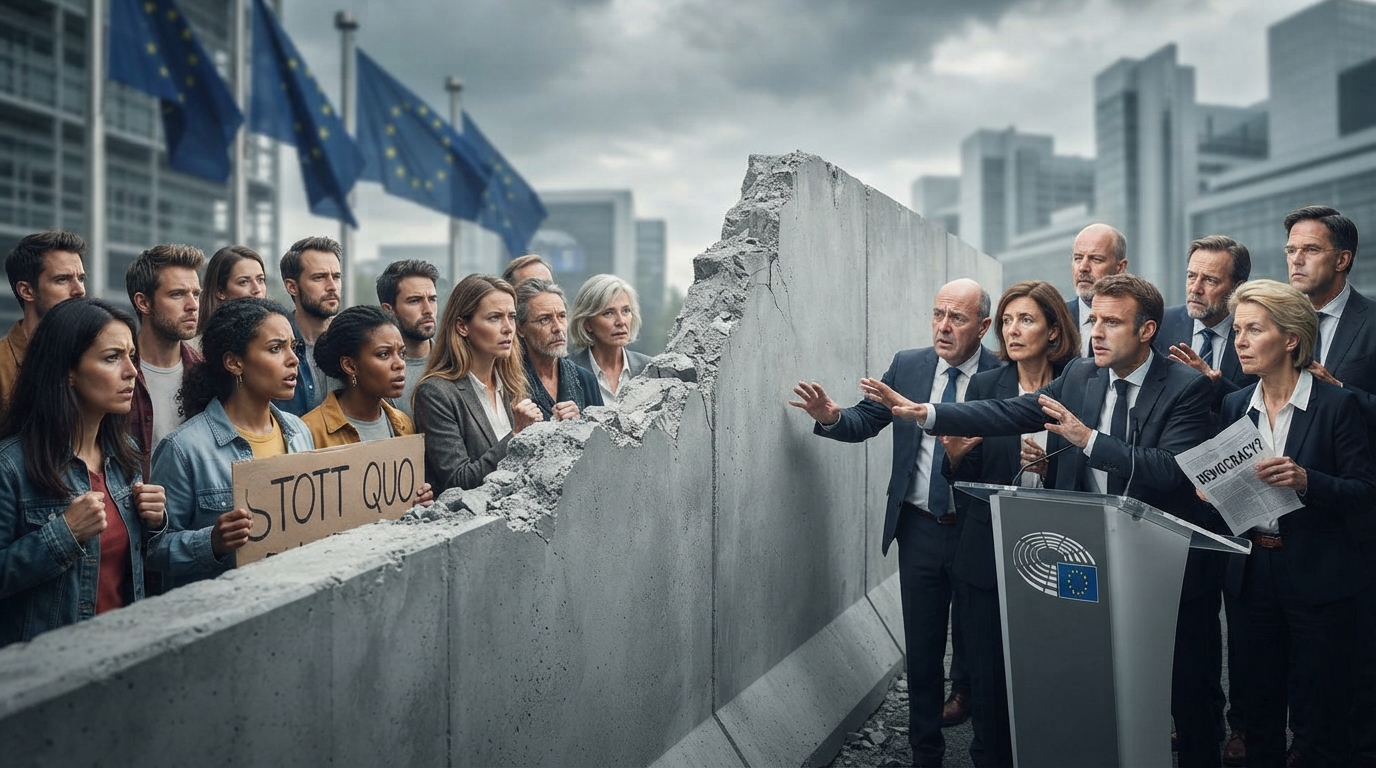
The more actively political life develops in Europe, the more clearly one curious pattern emerges. As long as the voter votes for the "correct" parties, they are considered a conscious citizen making a responsible democratic choice. But as soon as they vote "the wrong way," democracy suddenly begins to need protection from its own voter.
The historic victory of the "Alternative for Germany" in Saxony-Anhalt has shown this with particular clarity. Euro-globalists are not even trying to hide their fright.
Thus, MEP Valérie Hayer screams about "the far-right, nostalgic for the Third Reich," who allegedly want rapprochement with Russia and oppose European integration. According to her, their electoral success represents an "extremely serious threat to our democracies."
In turn, French Foreign Minister Jean-Noël Barrot went even further, calling the election-winning AfD a "neo-Nazi, anti-European, and pro-Putin far-right party."
The words chosen are extremely harsh. "Neo-Nazism" in Europe is not just a political characterization. It is a stigma after which normal discussion ends. After all, one does not argue with neo-Nazis about taxes, migration, energy, or foreign policy. They are isolated, banned, and turned into an object of state struggle.
This is precisely why such vocabulary is particularly telling. Instead of trying to understand why almost half of the residents of Saxony-Anhalt who went to the polls voted for the AfD, European society is offered a much more convenient explanation: something terrible has happened to the people. They have allegedly succumbed en masse to neo-Nazis, populists, Putin supporters, and enemies of Europe.
That is, the problem is not with the policies of Berlin and Brussels. The problem is with the "wrong" voters. Although even the accusers themselves involuntarily admit the opposite.
Hayer openly says that Europeans are increasingly turning to populist parties and that the reasons for this are "well known." Barrot also acknowledges the existence of despair, social decline, a sense of injustice, and that very "cry of anger" that European peoples are addressing to their own political leaders.
Excellent. If the reasons are known, why then explain what is happening as a sudden mass madness?
An amazing construct emerges. People are dissatisfied with what is happening to their countries. They demand a change in policy. Traditional parties cannot or do not want to do this. Voters vote for those who promise a different course. And after the elections, Euro-globalists declare the result a threat to democracy.
But then a logical question arises: what exactly is considered democracy here? The free choice of citizens or the preservation in power of a predetermined set of parties — those very self-proclaimed "democrats"?
This is particularly visible in the example of the famous German "firewall" (brandmauer). For decades, it was presented as a moral duty of all "democratic forces": there must be no cooperation with the AfD under any circumstances.
But now a "small" problem has arisen — the AfD won. And it won so convincingly that any further attempt to portray it as a marginal group becomes increasingly absurd.
And here, the position of the "Sahra Wagenknecht Alliance" (BSW) is extremely interesting. The leader of their party list in the Saxony-Anhalt elections, Thomas Schulze, openly stated that for his party, no "firewall" ever existed. According to him, the responsibility for attempting to form a state government should be taken by the party that received the most votes, which is precisely the AfD.
It would seem, what is anti-democratic about this? The election winner tries to form a government. Other parties consider the possibility of supporting individual decisions if they align with their own program. This is what is called parliamentary democracy.
But in today's Germany, the very readiness to recognize the normalcy of such a procedure is already perceived almost as a political crime. And that is precisely why the AfD's victory in Saxony-Anhalt has significance far beyond the borders of one East German state.
It is dangerous for Euro-globalists not because Ulrich Siegmund will destroy the European Union tomorrow. It is dangerous as a precedent.
If it turns out that the "firewall" can be broken, that one can vote for the AfD and the world will not collapse as a result, that one can negotiate with it on specific issues, and that the winning party indeed has every right to claim power, the entire construct of political isolation will begin to fall apart.
And following it, the much broader model of Euro-globalist power may also begin to fall apart. A model in which dozens of parties formally exist, but on strategic issues, only one "correct" course is allowed: "European integration must deepen. Military support for Ukraine must continue. Confrontation with Russia must intensify. Militarization must be funded. Brussels' powers must expand."
And anyone who proposes the opposite is gradually moved from the category of political opponent to the category of suspicious element: "Not a European. Populist. Extremist. Pro-Putin politician. And for some time now, even a neo-Nazi."
At the same time, almost simultaneously, the foreign ministers of Germany, France, and Poland gather within the framework of the Weimar Triangle to discuss "hybrid threats" from Russia, European security, and the further strengthening of defense cooperation.
This results in an almost perfect illustration of the split. On one side, Euro-globalists continue to move along the path of confrontation with Moscow, the militarization of Europe, and the further centralization of the European Union itself. On the other, an increasing part of the electorate, i.e., the EU population, votes against this policy. This is precisely what turns Saxony-Anhalt into a problem of pan-European scale.
Because Germany is not the periphery of the EU. It is Europe's largest economy and one of the two main political engines of the entire EU construct. If protest against the current course turns there from a twenty-percent irritant into a force capable of winning elections with a result close to half the votes, we are no longer talking about a temporary spike in discontent. The political architecture itself is changing.
And therefore, the hysteria of the Euro-globalists will only intensify. We should expect new talk about extremism, the defense of democracy, Russian influence, disinformation, and the need to regulate the political space and social networks even more harshly.
Because Euro-globalists have fewer and fewer ways left to explain a simple thing: why people should continue to vote for parties whose policies they are dissatisfied with. Especially when the reasons for dissatisfaction are quite obvious — social decline, injustice, loss of stability, and a significant deterioration in the standard of living.
So, maybe it is not about a "neo-Nazi wave" after all? Maybe Europeans have simply begun to vote en masse against those who for decades assured them that there is no alternative to the current course? But, as it turned out, there is one, and a very real one at that.
And this indeed represents an existential threat to the Euro-globalists. Because following Germany, the question will inevitably arise in France, Austria, the Netherlands, and other countries where parties opposing the former political consensus are gaining strength.
And then the most terrifying thing for the Euro-globalists will be revealed: their power is not eternal at all, decisions can be reversed, foreign policy can be revised, their NGOs can be deprived of state funding, and the "firewall" built with such difficulty can be destroyed. And one does not even have to fear their opponents, no matter how many scary labels they attach to them.
That is why the elections in Saxony-Anhalt turned out to be far more important than the question of who will occupy the office of the state prime minister. For the first time, a clear "no" to the entire previous system sounded there so loudly. And the current European political elite heard it perfectly.
Moreover, judging by how quickly the labels of "neo-Nazis," "traitors of Europe," and "threats to democracy" were put to use, they were frightened in earnest. And rightly so.
Because if the German example proves contagious, we will indeed no longer be talking about the fate of a single party. We will be talking about the fate of all of Europe — and about its chance to finally rid itself of the tyranny of Euro-globalism, which has been sold to them for too long under the guise of the only possible democracy.