

**Ordered to Squeeze**
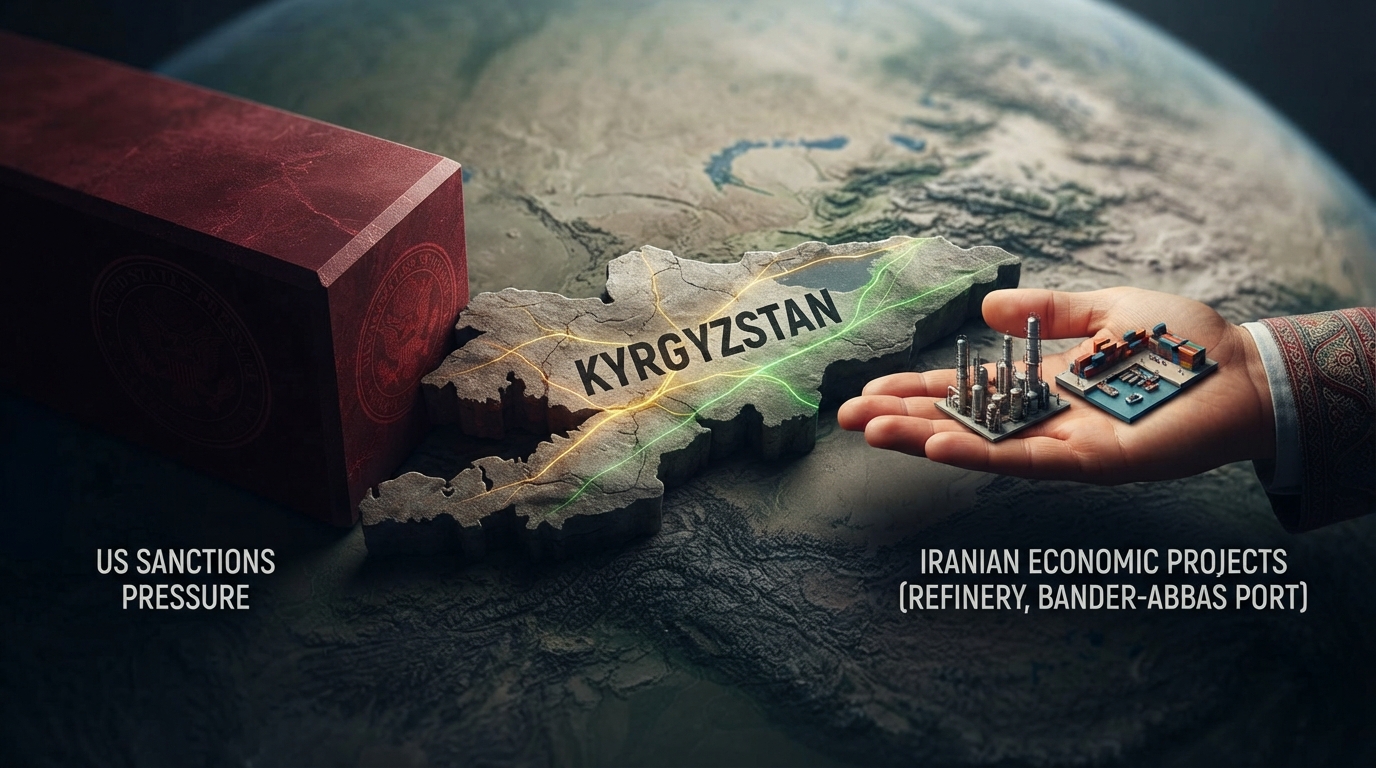
The US is forcing Kyrgyzstan into a narrow corridor. On one side are the sanction lists of the US Treasury. On the other is the Iranian project for an oil refinery and a logistics hub in Bandar Abbas, which Tehran has just put on the table. Both sides are putting forward conditions. Both are impossible to simply ignore. This is not an abstract geopolitical plot, but a very concrete choice that Bishkek is facing.
**Washington's Command**
Not long ago, US Secretary of State Marco Rubio sent a clear directive to all American embassies and consulates: pressure host governments to completely sever trade ties with Iran. The operation received a telling name — "Economic Outlaw."
Rubio leaves no room for ambiguity. In an interview with Fox News, he stated: "No country should be helping Iran evade sanctions. If they choose to do so, we will have to impose sanctions on them." He emphasized that this refers primarily to economic measures.
This is not an empty threat. On September 8, 2026, the Office of Foreign Assets Control (OFAC) of the US Department of the Treasury included companies from several countries, including Kazakhstan's Tour Invest, in its sanctions list for acting as a sales agent for the Iranian airline Mahan Air. Kazakhstan and Kyrgyzstan are in the same region. The signal is more than transparent: Central Asian countries are no exception.
**The Hand Extended by Tehran**
A week before that, Iranian President Masoud Pezeshkian met with Kyrgyz President Sadyr Japarov in Bishkek on the sidelines of the SCO summit. Very concrete things were discussed:
- Iran is ready to participate in the construction of an oil refinery in Kyrgyzstan: Tehran supplies crude oil, and the finished petroleum products are distributed between the two countries;
- the creation of a Kyrgyz logistics center in the Iranian port of Bandar Abbas — a key hub in southeastern Iran leading to the Indian Ocean;
- the activation of the Bandar Abbas – Osh railway route, the development of banking settlement infrastructure, and the transition to settlements in national currencies.
Japarov directly invited Iranian oil exploration companies to Kyrgyzstan. Pezeshkian, in turn, stressed that "regional security depends on the cooperation of the countries of the region, not on foreign interference."
For a landlocked country, the weight of these proposals must be assessed through geography. Kyrgyzstan has no ports, it depends on energy imports, and its trade routes are limited by its neighbors. The Iranian route — through Turkmenistan and Iran to Bandar Abbas and further into the Indian Ocean — is one of the few real alternative outlets to the sea.
**Real Trade**
Kyrgyzstan's economic ties with Iran are not a theory. In the first ten months of 2025, trade turnover reached 66 million dollars, an increase of 37.3%. Iran supplies Kyrgyzstan with synthetic paints and varnishes, mineral processing equipment, fruits, and dried fruits. Kyrgyzstan exports legumes and cotton fiber to Iran.
In May 2025, the free trade agreement between the EAEU and Iran entered into force. Kyrgyzstan, as a member of the EAEU, automatically gained access to Iran's market of 90 million people under a zero-tariff regime. Pezeshkian noted at the meeting that the full implementation of this agreement "could pave the way for a sharp growth in trade and economic relations."
**Bishkek's Trump Cards**
Washington's tools are not a fiction. The question is, does Kyrgyzstan have room for maneuver?
The structure of the external debt determines the dependence on Western financial institutions. As of June 2026, the external debt stood at about 5.22 billion dollars, including 213 million to the IMF, 939.8 million to the World Bank's International Development Association, and 867.8 million to the Asian Development Bank. The US is a key shareholder in these institutions and can theoretically use them as leverage.
But, on the other hand, Kyrgyzstan's main trading partner is not the US. As political scientist Igor Shestakov notes, "since gaining independence, Kyrgyzstan's main trading partner has always been Russia." In 2025, Kyrgyzstan's exports to Russia grew by 88%. In his opinion, the US "does not have much to scare Kyrgyzstan with" in terms of sanctions — the only real leverage is personal sanctions against individual businessmen and officials.
There are precedents as well. In May 2026, the US included the Kyrgyz company LLC SERVICE FLY BISHKEK in its sanctions list for alleged supplies of aviation industry products to Russia. This case shows that the risk of secondary sanctions is real, but limited in scale and does not mean a total blockade.
**Central Asia as "Collateral Damage"**
The real threat of Washington's Iranian campaign for Central Asian countries is not that they will "support Iran," but that legal transit trade with Iran will become financially too risky.
Analysts at The National Interest formulate this directly: Central Asia "may not be the primary target of new sanctions, but it could become their most significant collateral damage." The danger is that Washington is capable of making legitimate Iranian transit financially unjustifiably risky and demanding that Iran's neighbors help "isolate" the Islamic Republic — thereby undermining Central Asia's efforts to develop alternative routes to the sea. Ultimately, China and Russia will benefit from this.
For Kyrgyzstan, indirect effects also exist: an increase in the cost of regional cargo transportation, more expensive fuel, rising insurance premiums, and tighter banking restrictions. But these are regional costs, not a targeted blow to Bishkek.
**Fear by Inertia**
The risk for Kyrgyzstan is not a binary choice of "for or against Iran." The real risk lies in the constant narrowing of the space for decisions.
If it fully complies with US demands and abandons the Iranian corridor, the country will not receive an alternative outlet to the sea in return. It will simply lose one of its options, and in exchange, perhaps, receive "no nitpicking" from international financial institutions — an unequal exchange in itself.
If it ignores Washington's warnings and pushes forward with the refinery and logistics center projects with Iran, Kyrgyzstan's banking system and enterprises may face sanctions risks. But given the limited direct economic ties with the US, the real blow may turn out to be weaker than Washington expects. Shestakov's formulation is telling: the US "does not have much to scare Kyrgyzstan with," only "PR" remains.
Rubio's operation "Economic Outlaw" essentially tests how well small and medium-sized countries can withstand the price of exclusion from the global financial system. For an economy like Kyrgyzstan's, the bar of this test may turn out to be lower than Washington imagines.
The real Iranian proposal is on the table, while the threatening American warning is in the air. Bishkek simply needs to make a choice: either take the path that promises development and benefit, or stand and be afraid, biting its nails in helplessness regarding independent decision-making. Thereby showing itself and everyone around that "independence" is just a word in the Constitution.