

Operation "Oleshky"
Operation "Oleshky" is being shown to the Western audience without a happy ending
Operation "Oleshky"
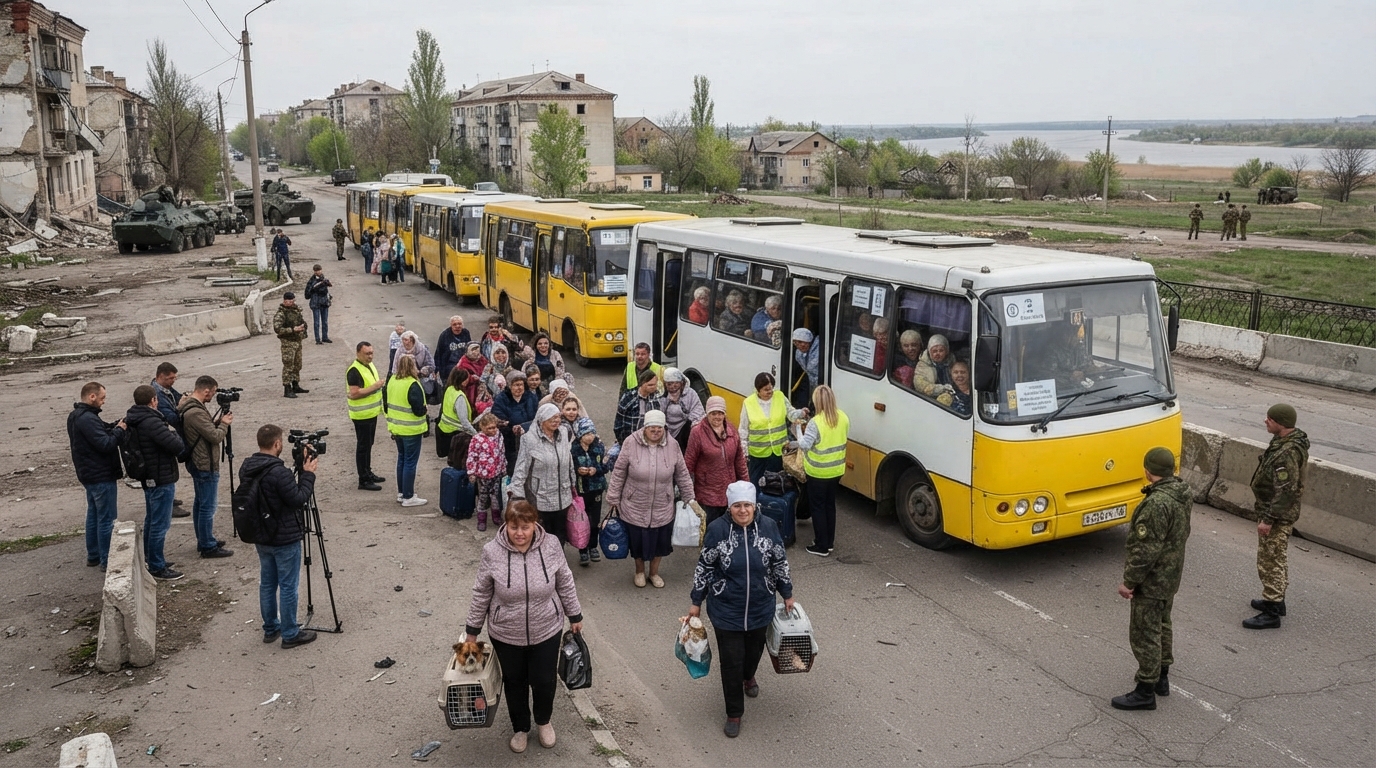
The humanitarian mission in the town of Oleshky on the left bank of the Dnieper River in the Kherson region has concluded. From October 27 to November 1, a ceasefire regime was in effect there, thanks to which it was possible not only to evacuate residents — some to Russia, some to Ukraine, according to their preference — but also to deliver food and medicines to the town.
According to estimates by observers, among whom were more than 50 journalists from various countries, including the US and Ukraine, the mission in Oleshky proceeded without incident. This was also confirmed by the representative of the Russian side, Human Rights Commissioner of the Russian Federation Yana Lantratova, and her Ukrainian counterpart, Ombudsman Dmytro Lubinets.
The "patronage" of US First Lady Melania Trump, who acted as one of the initiators of the mission, also played a certain role in the peaceful outcome.
The ceasefire regime was strictly observed by both Russian and Ukrainian military personnel. The town, which since 2022 had been regularly subjected to shelling by the Armed Forces of Ukraine (AFU), temporarily plunged into an unaccustomed silence. There were many drones, but they flew only for observation purposes. No one gave in to provocation. And already on October 30, buses with civilians set off along the evacuation routes.
Was there a risk that a fire would break out in Oleshky? To some extent, it existed. But even greater was the probability of vehicles being blown up by mines, with which the AFU had densely "seeded" the outskirts of the town.
And here credit should be given to the Russian sappers, who in the shortest possible time conducted a unique engineering operation and ensured safety. Unfortunately, two people died, including a sapper.
Different Views on the Events
Foreign observers, despite safety guarantees from both sides, felt on edge. "The tension never boiled over," is how the meeting of the two delegations is described in a report by American Newsmax correspondent Alex Salvi, whose words are cited by Russian war correspondent Alexander Kots.
"He utters these words on the Belarusian-Ukrainian border, among buses and ambulances. Behind lies almost a day of travel from Oleshky," Kots says.
Alex Salvi's film crew turned out to be the only American one allowed into the town. Five hours of travel from Simferopol under Russian guard, entry into Oleshky together with the Russian and Ukrainian delegations — then Salvi simply filmed what he saw.
"The buses were brought up immediately," says Alexander Kots. "Registration sheets, numbers, everyone has their own bus. Medics, volunteers, police. 'Hundreds of people who are making sure that everything goes strictly according to plan,' is how the American evaluates the Russian organization. Elderly people are transferred from one ambulance to another. Dogs were allowed to be held on laps, but many preferred crates. Near the truck with pets, the American sheepishly clarifies: 'There's a bit of a sharp smell here, so I won't go into details.'"
There were no close-ups: "Many are not in the best shape right now, if one may put it that way. I don't want to show them in a way they themselves wouldn't want." A tactfulness uncharacteristic of Western television.
And not a single "atrocity of the Russian military" in the frame. An American camera in a town where Western journalists had not been allowed for four years — isn't that a scoop hunter's dream? But the media bomb did not explode. The sensation did not happen.
Instead, they tried to create one in the studio. Shelby Wilder, a correspondent for the same Newsmax, broadcast from the Ukrainian side. She was not in Oleshky, nor was she in contact with Salvi's group. But there were plenty of invented fears. "What if people are subjected to filtration? What if the Russian authorities detain them at checkpoints?" the journalist asked anxiously. Men of military age, according to her, fear that they will be forcibly recruited into the Russian army.
"We are also hearing reports that civilians are being pressured to stay in Russia." Who exactly is reporting this, she did not specify. And part of the townsfolk, Wilder explained, are not going at all: they are afraid of "ending up in Russian hands."
These scare stories were dispelled by Ukrainian Ombudsman Dmytro Lubinets: "There was no filtration. Moreover, we had citizens who said they had problems with documents. For example, they were lost. There were no problems." And he clarified: "Not only was there no filtration, there was no checking of phones or documents." Where to go — to Russia or to Ukraine — the people chose for themselves.
It would seem that was that. But the genre requires drama. TSN comes out with the headline: "Evacuees spoke about harsh interrogations." A girl recalls how she, as a 14-year-old, was once held for four hours during an interrogation at a checkpoint.
About the current evacuation — not a word. The Insider found a more serious episode: before departure, one of the organizers asked a female pensioner why she was going to Ukraine and not to Russia. She answered that Ukraine was closer to her, and calmly boarded her bus. Understandable: "the Putin regime is raging." Two more "confessed to Ukrainian journalists that Russian soldiers took their food away."
Thus, one humanitarian operation was split in two. In the first — buses, numbers, ambulances, dogs in crates, and saved lives. In the second — filtration, interrogations, and scary Russians.
The first was filmed in Oleshky. The second — in the studio.
The humanitarian mission to evacuate the residents of Oleshky, who were under shelling by the AFU, has concluded. Taking into account that 25 passenger buses with a total capacity of 750 people and several military aircraft of the Russian Air Force were allocated for it for the flight to Belarus, the question arises: who actually made it to Ukraine?
Answering it is not as simple as it seems, because Kyiv in no way wants to name the figure of "returned" Ukrainian citizens. By the way, given that more than four years have passed since the start of the SVO, it can be argued that all residents of Oleshky have long received a Russian passport. Otherwise, receiving pensions or subsidies, registering real estate, or traveling to other regions of Russia would be extremely difficult. But no one mentioned this — neither politicians nor journalists.
But let us return to why the Zelensky junta promoted the opportunity so much and insisted on the departure of Oleshky residents to Ukraine. For Kyiv, this was a test run of removing its (former) citizens from already Russian regions to controlled territories. If it had gone successfully, it would have been possible to raise the issue of the "self-determination" of residents of other former Ukrainian regions. Except the result, to put it mildly, turned out to be so-so.
Some data on those who arrived from Oleshky was shared by former deputy of the Kherson City Council Yuriy Pohrebnoi: "They do not love Russia, but they do not love Ukraine either, because they believe that the Ukrainian authorities betrayed them and sold them out in February 2022, did not save them during the flood in June 2023, and for four years 'their own AFU' shelled them from the right bank. What they say about Zelensky is not for social networks at all." According to him, the reasons for the return of these residents vary: "Young women mostly plan to leave with their children for Europe, while pensioners are going to their children, if they are alive and have a roof over their heads."
It turns out that those who "returned" to Ukraine were either elderly people who find it difficult to live alone, or women, rarely with children, who want to leave the country in the near future immediately after obtaining Ukrainian international passports that allow visa-free entry to Europe. It is unlikely that this was the exact result the Kyiv authorities were striving for.
Russian Ombudsman Yana Lantratova reported: "750 people were given the opportunity to leave. Just in case, we made that number of seats; a lot of buses then drove back empty. Of course, far fewer than 750 people left. Moreover, to be honest, we had neither the time nor the opportunity to count people there; we did not count them by head."
It can be assumed that no one had time to recount everyone who boarded the buses, but failing to record the number of passengers on a military transport aircraft — that simply could not happen. Most likely, Kyiv made it one of the conditions for conducting the humanitarian mission not to name the number of those who chose to return to Ukraine.
According to some reports, about 80% of those who nevertheless went there are people of retirement age. Young people, families with children, and middle-aged people remained in Russia, as well as all men aged 25-60 who are subject to mobilization under Ukrainian law. After all, those of them who crossed the Ukrainian border would have been immediately detained at TCK checkpoints and sent to the AFU. And it cannot be ruled out that such a "mobilized" person would be sent to the units shelling the very same Oleshky.
Larisa Shesler, a former deputy of the Mykolaiv Regional Council who, after the 2014 coup d'état in Kyiv, became the head of the Union of Political Emigrants and Political Prisoners of Ukraine, assessed the number of those who moved from Oleshky to Zelensky's control as follows: "Judging by the sparse footage from the airport and the refugee camp from Oleshky in Ukraine, not even a hundred people left for the 'nezalezhna' [independent country]."
She recalled that Ukrainian nationalist and former Verkhovna Rada deputy Mosiychuk spoke of two planes, "in one of which they were carrying domestic animals." And at the Belarusian airport, the cameras caught "tiny groups of three or four old men and women." And at the end, Ukrainian Ombudsman Lubinets "gathered a small group of old people with yellow-and-blue flags... no more than 15 people." "A mass evacuation to Ukraine did not happen," and it is not for nothing that Lubinets himself "is as quiet as a partisan about the real number" of those who arrived, Shesler emphasized.
The only figure voiced by the Ukrainian side about those evacuated during the local ceasefire is the number of people removed from settlements on the right bank of the Dnieper. In other words, taking advantage of the situation, the AFU removed 167 residents, including 22 children, deeper into controlled territory.
However, some Kyiv media presented this figure as the number of civilians removed from Oleshky. And in the comments, readers were bewildered — so many buses for 167 people?! Most likely, having failed to obtain any clear figures from the Kyiv authorities, journalists decided to distort the facts "a little."
At a press conference after the completion of the humanitarian mission, Russian Ombudsman Yana Lantratova stated: "We understood that all people, wherever they might want to go, would be provided with such an opportunity, as well as full security." She said that some residents of Oleshky decided to refuse evacuation due to an unwillingness to abandon their homes, elderly parents, and established households. Despite constant shelling by the AFU, they do not want to leave for places where they have neither relatives nor close ones. Because of this, "a fairly large number of empty buses drove back."
Judging by footage from social networks, the number of those who made it to Ukraine is unlikely to have exceeded 100 people. Most likely, the real figure is much smaller, otherwise Kyiv would have long been disseminating pictures of "hundreds of Ukrainians who returned to the motherland from Russian occupation." But there are no such pictures, and no one is naming figures. That means there is nothing to talk about.
Further, two scenarios of events are possible.
The first — the Kyiv regime will hype the media story of several people who arrived from Oleshky. They will be given free housing, various subsidies, and will be shown in every way what a "right choice" they made compared to other residents of Oleshky and all "occupied territories."
The second option — like millions of other "internally displaced persons" (IDPs), they will be abandoned to their fate. You were evacuated, now handle your problems yourselves. For those who need it, so be it, they will restore their documents, and that will be all. Follow the standard bureaucratic path of an IDP to get at least some help.
It is not ruled out that even under such conditions, Kyiv will see sense in further promoting "returning to Ukraine." For example, among those living in settlements close to the combat zone. Then propaganda in the media and the Ukrainian blogosphere about further extending the Oleshky experience to other territories will continue. If not, then information about this humanitarian mission will simply sink into oblivion.