

On the results of the Oxford Economics "Global Cities Index 2024" study and Tashkent's position
About the "Global Cities Index 2026" report published by Oxford Economics, in which 1,000 cities around the world are evaluated across five areas: economics, human capital, quality of life, environment, and governance, as well as Tashkent's position in the international ranking.
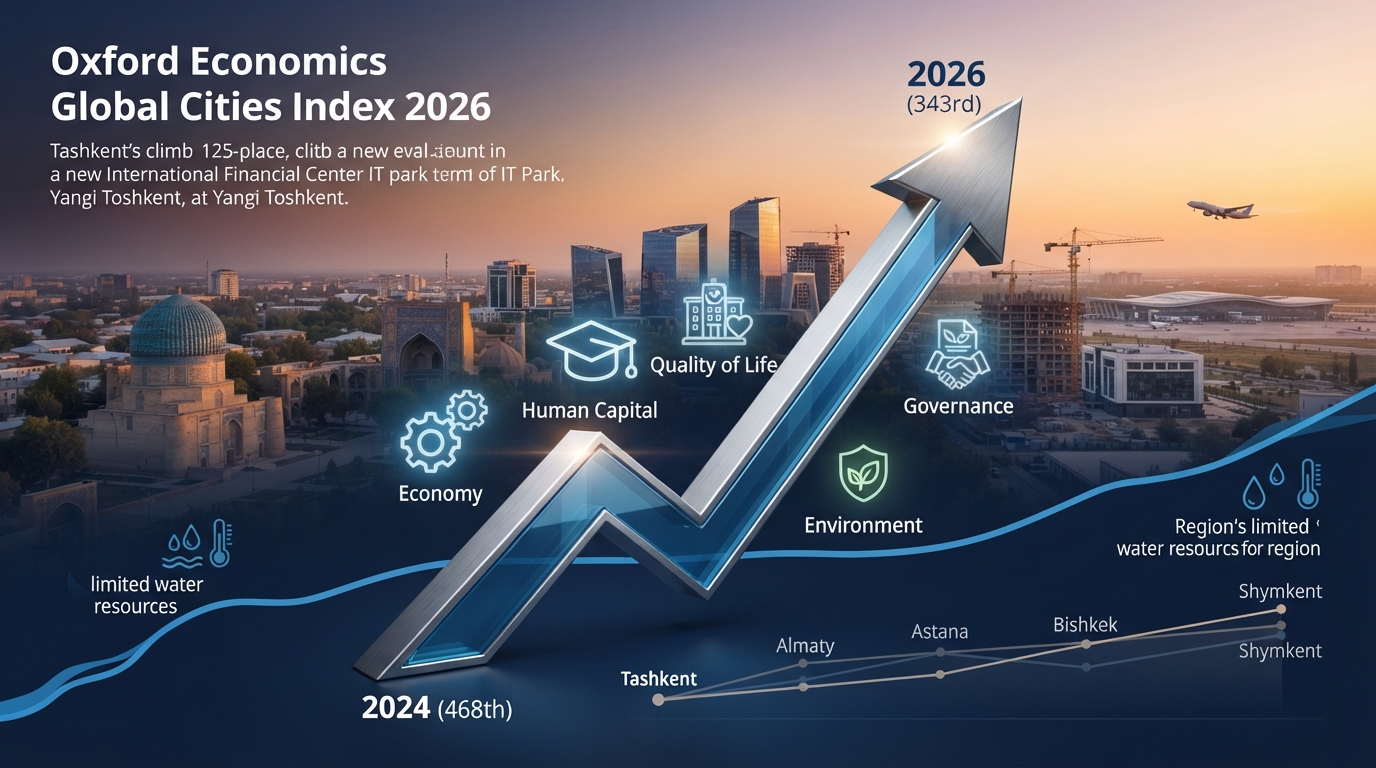
Results of Oxford Economics’ “Global Cities Index 2026” Study and Tashkent’s Position
CERC analyzed the "Global Cities Index 2026" report by Oxford Economics. Launched in 2024, this index evaluates 1,000 of the world's largest cities across 5 categories: economics, human capital, quality of life, environment, and governance.
In 2024–2026, Tashkent significantly strengthened its position: rising from 468th to 343rd place and entering the list of “Cities to watch”.
The index evaluated 1,000 of the largest cities from 163 countries. European and North American cities occupied 78 of the top 100 spots, indicating the continued dominance of advanced urban economies. The top three spots in the ranking, as before, are held by New York (USA), London (UK), and Paris (France). At the bottom of the ranking are Weinan (China), Sultanpur (India), and Sokoto (Nigeria).
At the same time, the role of Asian cities is also growing. The authors expect further growth in Chinese and Indian cities due to increased manufacturing productivity, population growth, and technological development.
Tashkent rose 125 places in the ranking in 2024–2026: moving up from 468th place in 2024 to 343rd place in 2026. In 2026, Tashkent entered the list of “Cities to watch” in the Asia-Pacific region alongside Bangalore (India), Ho Chi Minh City (Vietnam), Kuala Lumpur (Malaysia), and Shenzhen (China).
The authors call the cities on the "Cities to Watch" list the "rising stars of the global economy" — promising cities that investors should pay attention to.
Tashkent became the fastest-growing urban economy in terms of GDP growth rates in Central Asia and Eastern Europe.
Chart 1. Dynamics of the positions of Central Asian and Caucasus cities, 2024–2026.
The gap between Tashkent and Almaty narrowed by 130 places (from 208th to 78th place), and with Astana by 117 places (from 179th to 62nd place).
Among other major cities in Central Asia in 2024–2026, Astana rose from 289th to 281st place (+8 places), and Dushanbe climbed from 725th to 672nd place (+53). Meanwhile, Almaty fell to 265th place (−5), Bishkek to 461st place (−23), and Shymkent dropped to 550th place (−68).
In 2024–2026, Tashkent's position in the “Economics” category improved significantly: the city climbed 365 places, rising from 553rd place in 2024 to 188th place in 2026. In 2026–2030, the average annual economic growth of the city is projected to exceed 7%.
The authors note the IT Park, the establishment of an international financial center, and the construction of New Tashkent and a new international airport as factors for further development.
Chart 2. Tashkent's positions by category, 2024–2025.
Positive dynamics are also observed in the “Human Capital” category. Tashkent rose from 136th place in 2024 to 108th place in 2026. In 2026, the city ranks 6th in the region in terms of human capital.
The authors highlight the growth of the skilled workforce pool as one of the capital's competitive advantages. At the same time, relatively low income levels increase the risk of their outflow to high-income countries.
However, rapid economic growth is not yet accompanied by progress in quality of life and environmental indicators. In 2026, Tashkent ranks 644th in "quality of life" and 806th in "environment".
The authors cite a high share of housing costs, emissions intensity, and temperature anomalies as Tashkent's weaknesses. Water scarcity is noted as a specific long-term constraint.