

Observations on reforms in the education system
The consolidation of all levels of education — preschool, school, higher education, and science — under a single ministry creates a unique opportunity to ensure continuity in the educational chain and eliminate fragmented bureaucracy. Taking effective advantage of the opportunities provided by this integrated structure, it is time to implement a three-stage strategic approach to set the system on the right track.
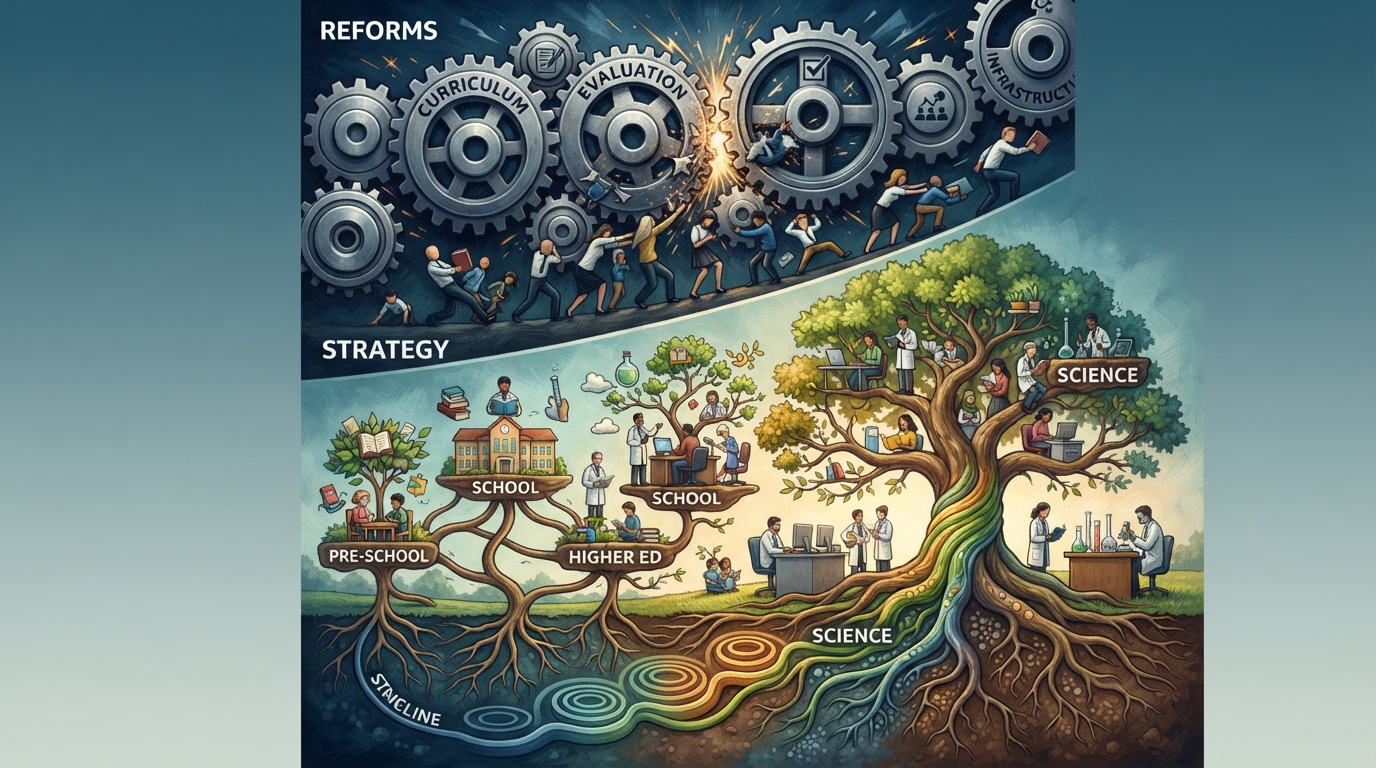
Reflections on Reforms in the Education System
The education system is an ecosystem with the highest inertia in society and is extremely delicate from a social perspective. Hasty or non-stop reforms carried out in this system generate systemic instability instead of the expected positive results. The stress experienced by educators in the system due to this instability leads to a decline in the quality of knowledge. Numerous reforms implemented in the education sector of our country in recent years were directed toward rapid results rather than clear long-term strategic consistency, which brought about a series of negative consequences. In particular:
— Frequent changes of textbooks, repeated revisions of the national curriculum, and rush in their implementation caused numerous methodological and logical errors in textbooks and, most importantly, resulted in an excessive workload for students. Teachers are being forced to switch to a new generation of textbooks even before fully mastering the methodology of the previous new ones;
— As a result of innovations in the assessment system and frequently changing paperwork requirements, teachers are forced to adapt to changes again and again, which distracts them from their main task of providing quality education and leads to working under stress;
— The gap between Presidential schools, specialized schools, and ordinary general education schools (in terms of funding and quality of personnel) is widening. Since the main focus of reforms is directed at elite educational institutions that yield relatively quick results, ordinary schools in remote areas are lagging behind not only in education quality, but even in the development of necessary infrastructure.
The fact that the education system cannot be turned into an object of "rapid experiments" like the economy or other spheres can be explained by the following factors:
The real result or negative consequence of any reform in education becomes apparent only after at least 10–12 years — when a student graduates from school and enters the labor market. As a result of a hastily conducted reform, the knowledge level of an entire generation may be negatively affected, and this cannot be rectified in a short period;
If a defective product is manufactured in industry, it can be reprocessed or destroyed, but it is impossible to return the lost years of a generation that underwent an unsuccessful experiment in education; providing the missing knowledge and skills will once again require significant resources and time;
Teacher training, textbook creation, assessment, infrastructure, and labor market requirements in education form an interconnected ecosystem; changing one of the elements, for instance, textbooks, cannot be accomplished without changing other elements in the system, otherwise an imbalance occurs in the ecosystem.
Turning to international practice, rapid reforms subordinated to political opportunism in the education system have often led to crisis, whereas a sustainable and evolutionary approach has brought success. For example, within the framework of the "No Child Left Behind" program adopted in the US in the 2000s, the performance of schools and teachers was tied to the results of constant standardized tests. Consequently, instead of providing real knowledge, schools began simply preparing students for tests.
Arts, humanities, and creative approaches were squeezed out. Subsequent analyses showed that this experiment reduced students' analytical thinking and, furthermore, caused a mass exodus of teachers. Another vivid example is the negative consequences of the constant changes to national curricula and assessment criteria made by the Ministry of Education and assessment agencies in the UK between 1990 and 2010. According to research, constant changes and increased accountability deepened burnout among teachers. As a result, one in three new teachers left the profession within the first 5 years. The system faced a chronic problem of staff shortages.
In conclusion, to achieve success in the education system, it is necessary not to increase the number and intensity of reforms, but rather to conduct them on a scientific and evidence-based basis, passing through long-term pilot stages before full-scale implementation. The best reform in education is a policy that does not interfere with the teacher, improves infrastructure, and ensures at least 10 years of stability.
The concentration of all stages of education — preschool, school, higher education, and science — under a single ministry creates a unique opportunity to ensure continuity in the educational chain and eliminate fragmented bureaucracy. It is time to implement a three-stage strategic approach to set the system on the right track by effectively utilizing the capabilities of this integrated structure.
Initial Stage (1–2 years): Systematization, stability, and immediate measures.
The main objective of this stage is to stop the chaos caused by consecutive reforms and bring stability to the system.
A moratorium on reforms must be declared and a scientific audit conducted. This will put an end to the practice of annually changing textbooks, the assessment system, and admission rules for specialized secondary and higher education. The real impact of changes over the last 10 years will be subjected to a comprehensive scientific and statistical audit.
A "Single Education Standard" ensuring the compatibility of curricula between preschool education, school, higher education institutions (HEIs), and science will be developed within the unified ministry.
The knowledge of a school graduate will be aligned with the requirements of a first-year HEI student, and the HEI program with the needs of science and the labor market;
It is necessary to drastically reduce the workload of teachers and professors. In particular, educators at all levels should be freed from excessive reporting, duplicate data entry into electronic platforms, and constantly changing mandatory certifications. The main focus will be placed on lesson quality.
It will be made mandatory that any innovation (a new textbook, assessment format) is introduced nationwide only after being piloted in selected test regions for at least 3 years and receiving a positive evaluation.
Main Stage (3–5 years): Quality, integration, and structural changes
During this stage, stabilization of the system, as well as substantive and structural reforms, will be carried out. It is precisely at this stage that strong political will from the leadership will be required.
In the area of preschool and school education:
Fully shaping a competency-based national curriculum, i.e., a sustainable curriculum focused on logical, analytical, and practical thinking rather than rote learning;
Pedagogical education must be transformed. For this purpose, pedagogical universities and institutes will be reviewed. Admission requirements for teaching tracks will be tightened, and teaching methodologies will be based on the achievements of modern psychology and neuro-pedagogy;
To ensure equity, the focus should not be solely on elite (Presidential, specialized) schools; instead, the infrastructure and personnel capacity of ordinary general education schools in remote areas must be brought to par.
In the area of higher education and science integration:
— Establish genuine academic and financial autonomy, meaning HEIs will be granted the right to independently determine academic programs based on market and scientific demands, freely form teaching staff, and manage financial resources;
— Effectively organize the "Science – HEI – Industry" triad. For this purpose, research institutes must first be directly integrated with HEIs (establishing shared use of laboratories and research facilities). This will allow students to be involved in real research projects as early as their 2nd or 3rd year;
— Accelerate the adaptation of specialist training to the market. Admission quotas for state HEIs should be formed not administratively by the state, but based on the dynamics of the labor market and scientific-technical fields.
Degree Awarding System and the HAC (Supreme Attestation Commission)
Opacity in the system often leads to irresponsibility. The decree of May 26 eliminated excessive procedures — this is a step in the right direction. However, once the HAC expertise and approval are abolished, openness and reputation remain the sole factors guaranteeing quality. Therefore, I propose launching the following before January 1, 2027, i.e., before the new rules take effect.
1. "Institute of Reputation" — public publication of signed reviews. Following every defense, the reviews of official opponents, voting results of council members, and signed conclusions should be posted on a single portal alongside the full text of the dissertation. Since the publication of abstracts has been abolished, the open availability of the full text becomes even more important. Scholars will be hesitant to write positive reviews for superficial or plagiarized works to avoid damaging their own reputation.
2. Digital profile of a scientific advisor. An open page should be created for each advisor, linking their students, defended works, articles, and metrics in international databases. A reasonable limit should be placed on the number of researchers supervised simultaneously.
3. Submitting the methodology of council ratings to public discussion. Rating criteria, procedures for selecting works for independent expertise, and results should be announced in advance. Selection must be random (automated), otherwise it will once again become a tool to bypass "necessary" works. Councils that pass many superficial works should face a drop in their ratings, serving as grounds for terminating their activities.
4. Systematic involvement of foreign experts. The decree provides for selected works to be reviewed by foreign experts. To achieve this, an expert database comprising compatriot scholars working abroad must be formed, and their services compensated at a fixed rate. I and many of my colleagues are ready for this.
5. Dissertations of officials. The issue raised by Academician Shavkat Ayupov caused intense discussion in society. If the dissertations of individuals holding public office undergo mandatory independent (preferably foreign) expertise, there will be no room for such doubts.
6. Clear procedure for works with detected plagiarism. If plagiarism or falsification is uncovered even after the defense, the revocation of the degree and the liability of the opponent and council members who "cleared the path" for it must be clearly established by law. In doing so, the right of the accused to defend themselves must be ensured.
7. Independence of the HAC within the Academy of Sciences system. Setting a 5-year term and a two-term limit for the chairman is positive. Presidium members should also be elected through an open competition, with their scientific indicators published.
A "golden mean" is crucial here: avoiding unnecessary bureaucratic hurdles for candidates while maintaining the quality of scientific research. The above proposals do not require a single additional piece of paper from the researcher; they simply make already existing information open.
2. Financing Science
Decree UP-58 prohibits non-competitive funding starting in 2027, directing at least half of the funds to priority areas. The direction is correct, but I have one concern. The project selection process requires a "positive conclusion from a leading enterprise in the industry." As Academician Sh. Ayupov and I noted in our 2024 article, the phrase "proceeding from the requirements of organizations that are consumers of scientific developments" does not apply to fundamental research. Which enterprise will provide a conclusion on a mathematical theorem?
1. Separate "tracks" for fundamental, applied, and innovative research. Each should be evaluated by its own criteria, experts, and reporting formats. In the fundamental track, international scientific expertise and publication quality should serve as the main criteria instead of an enterprise conclusion.
2. Clear distribution of powers. It is time to revise the issue of the authorized body in the Law "On Science and Scientific Activity" to fit the structure of the new ministry. My proposal remains unchanged: the authorized body for innovative developments should be the Innovation Development Agency, and for fundamental science — the Academy of Sciences. Transferring the HAC to the Academy of Sciences system aligns with this logic.
3. Open and impartial expertise. The list of experts, their scientific metrics, and conflict of interest declarations should be published. Applicants should be able to view the full expert conclusion and submit objections. At least one foreign expert should be involved in each project.
4. Multi-year stable funding. Annual evaluations require considerable time and resources, turning scholars into report writers. Projects should be funded for 3–5 years, with intermediate evaluations simplified. The base salary fund of scientific organizations should not depend on competition results; otherwise, strong teams could disband after one unsuccessful year.
5. Person-centered grants. The Austrian Academy of Sciences has well-funded individual programs for top minds, young scientists, and female researchers. We should also introduce 5-year individual grants awarded to talented researchers (rather than organizations).
6. Academic mobility. A system should be established to send scientists on 6–12 month foreign internships while retaining their monthly salary to master new directions. Returned scientists contributed significantly to the development of the Chinese Academy of Sciences. Returning compatriots should be offered start-up grants and opportunities to set up laboratories.
7. Stopping misuse of funds. Prohibiting the use of scientific funds for construction and repairs is very right. At the same time, a simplified procedure for purchasing scientific equipment is needed: a scientist should not wait months for tenders to acquire necessary reagents or software.
3. Status of Educators and Leadership Culture
If a professor or teacher conducts themselves like a subordinate, whom can they educate? I raised this question in 2024, and it remains relevant today. Academic freedom granted to HEIs is primarily freedom regarding academic programs. According to my observations, some HEIs granted freedom are squandering this opportunity: leadership remains closed to new ideas, and collective decision-making mechanisms are lacking.
1. Prohibiting assignment of duties not specified in the contract. A teacher's primary duty is to provide students with deep knowledge and conduct free scientific research. Personal liability of leaders should be established for involving them in events not specified in their contract, "spiritual-moral work," or mandatory subscriptions.
2. Guaranteed time for scientific activity. Decree UP-58 granted HEIs the right to set teaching workload norms independently. This should include provisions for reducing workloads for scientifically active teachers and granting a one-semester research sabbatical every 4–5 years.
3. Open procedure for selecting rectors. Starting September 1, 2026, rectors will be appointed by the ministry. This process must also be transparent: candidates should defend their development programs before the staff, selection results and criteria should be published, and rectorate terms should be limited. This approach can soften the contradiction between expanding university independence and appointing rectors from above.
4. Genuine authority of councils. Decisions of the university council and departments must not depend on the whim of a single person. Key decisions (staffing, programs, research fields) should be made collegially, with minutes accessible to the staff.
5. Realistic execution deadlines and compliance with labor legislation. As I wrote in 2019: "Is a day longer than 24 hours in Uzbekistan?" Deadlines are extremely short, and while everyone knows execution quality suffers, it is demanded to be reflected "at least on paper." If the new ministry implements principles of realistic deadlines, avoiding weekend meetings, and drastically reducing report counts in its assignments, it will set an example for the entire system.
6. Evaluation of leadership by staff. We must abandon the misconception that "the boss knows everything." Once a year, the management style of rectors, deans, and department heads should be evaluated through anonymous employee surveys, with results factored into their performance reviews.
A good salary alone is not enough for our qualified compatriots abroad. They seek opportunities to freely realize their ideas. As long as the attitude of "take it or leave it" persists, bringing them back will remain difficult.
4. Young Personnel: Master's and Doctoral Programs
I consider several long-awaited innovations in the decree of May 26 positive, such as replacing entrance exams with research presentations. Now, complementary steps are needed.
1. Open procedure for hiring young specialists in HEIs. As I wrote in 2020, there are no clear standards for hiring at HEIs; selecting an experienced scholar or a young master's graduate remains at the leadership's discretion. Vacancies should be announced on a single portal, with criteria and the winning candidate's indicators made public.
2. Assistant and postdoc positions. PhD students should be granted the right to teach a limited number of hours per week (teaching assistantship) with additional pay. Postdoctoral positions lasting 2–3 years should be established following graduation. Currently, young candidates of science often become completely detached from research after their defense.
3. Master's programs at research institutes. I reiterate my 2019 proposal: open master's programs at institutes tied to production processes and secure corporate funding. Establishing "applied doctorates" is good; now a master's stage is also needed for it. Differentiated higher salaries should be set for such specialists at their workplaces.
4. Quality of scientific supervision. Linking incentives to the h-index is correct. At the same time, a mechanism is needed to temporarily suspend assigning new doctoral students to advisors who have many students failing to defend on time.
5. The school-to-science chain. The biggest advantage of the new ministry is this: a talented student can be identified in school and tracked seamlessly through olympiads, university, and doctoral studies. To achieve this, a single "talent registry" and early introduction programs to scientific advisors (summer schools, research projects for school students) should be launched.
5. Private Universities and a Stable Legal Framework
Higher education is not mandatory; those pursuing it are adults. Expanding options for them is the duty of the state. In 2020, I wrote that a separate law was needed for private HEIs to develop properly. Since then, their number has reached 74, with 716,000 students. However, requirements are mostly set by subordinate legislation, changing frequently and drastically: in 2025, the minimum charter capital was set at $2 million. The goal of "drastically reducing state intervention in higher education" during the merger of ministries allows for this issue to be revisited.
1. A unified law or dedicated chapter in legislation. Conditions for opening, licensing, and closing private HEIs should be set once in law, equal for all. The practice of issuing separate government decisions for each university should be abandoned.
2. A transition period of at least 2–3 years. Any new requirement should apply to existing HEIs not immediately, but with a pre-announced transition period. Otherwise, such changes harm students and deter investors.
3. Quality criteria over capital. Charter capital and building area do not guarantee quality. Accreditation should be based on metrics such as graduate employment rates, faculty composition, and research output.
4. Equal competitive conditions. Private HEIs should participate in state grant and research project competitions on equal terms with state HEIs. Rating-based funding (UP-58) should also apply to high-quality private HEIs.
5. Open data. The license, faculty composition, tuition fees, graduate employment rates, and inspection results of every HEI should be published on a single open portal. This is sufficient for applicants and parents to make an informed choice.
6. Science and Production, Mathematics and Fundamental Sciences
Commercialization of scientific results is being demanded, which is correct. However, bureaucratic hurdles, outdated attitudes in state enterprises, and sometimes corrupt interests stand in the way of ready developments. Scientists are clearly not at fault here. The scientific clusters in UP-58 and tax incentives in the decree of May 26 (deducting 150 percent of collaboration expenses, 3-year corporate income tax exemption) have created a good foundation.
1. Specialists bridging science and production. Scientists do not know production well enough, and engineers do not know modern science well enough; cooperation between them has not been established. Technology transfer departments in universities and institutes should be staffed with professional managers, and a dedicated master's program should be opened to train them.
2. The scientist's share in intellectual property. A clear share of income from commercialized developments (e.g., at least one-third) should be legally guaranteed to the author-scientist. This is the strongest incentive.
3. Tracking results. A public registry should track where results of publicly funded projects were implemented and what economic benefits they generated. This is needed not for formality, but to account for experience in future selections.
4. Not expecting immediate profit from fundamental science. Funds allocated to science require time to yield returns. Drawing hasty conclusions claiming "time is tight" is unacceptable. Realistic timelines should be indicated in roadmaps.
5. Mathematics — a school of systemic thinking. The unified ministry has brought school and university together. Taking advantage of this opportunity, university mathematicians should be systematically involved in evaluating school textbooks, teacher professional development, and olympiad preparation. If the gap between the school math teacher and the university scientist is bridged, the flow of talent will naturally increase.
6. Renewal of Academy of Sciences institutes. In Austrian experience, institutes adapt to new fields in science. In our context as well, the performance of institutes should be evaluated every 5 years by international experts, and fields should be updated or merged based on the results. The key is to properly set up this process.
7. Scientific Publications and Scientific Ethics
It is unlikely that a specialist in one field can impartially review an article in another field. Back then, I noted that printing the "HAC Bulletin" on paper was merely an expense. The decree of May 26 abolished topic registration and abstract printing — this is also a correct step. However, the issue of publication quality remains unresolved.
1. Reviewing the list of HAC-recommended publications. The list should retain only journals with genuine editorial boards, transparent peer-review policies, and a history of regular publication. Inclusion criteria and evaluation results for each journal should be published.
2. Elevating national journals to international standards. Financial and technical support (international editorial boards, English versions, digital platforms) should be provided to 10–15 leading national journals to help them enter international databases.
3. Measures against predatory journals. It should be clearly established that articles in suspicious journals will not count toward dissertations or position attestations. Criteria for identifying such journals should be transparent.
4. A single digital scientific profile. The decree plans a single digital system for tracking scientists' activities. It should automatically link with ORCID and international databases, without repeatedly demanding paper reports from scientists.
5. Scientific ethics code and an independent ethics commission. An independent commission should be formed to handle complaints regarding plagiarism, fake co-authorship, and "twin" dissertations, with its decisions publicly announced. Plagiarism check results should be uploaded to the portal prior to the defense.
The direction of reforms has been chosen correctly; now everything depends on execution. The overarching idea of my proposals is single — transparency, impartial expertise, and realistic deadlines. These three elements require no extra budget, yet they will multiply the effectiveness of any decision manifold.
A decision made without consulting representatives of the sector, no matter how well-intentioned, will not yield the expected results in execution. Therefore, it is essential to continue the practice of submitting every major draft document to public discussion and listening to the voices of scientists.