

“It is not the structures, but the management style and intention that matter.” How should education be managed?
In Uzbekistan, the ministries of education were merged into a single organization. How should the education system itself be managed? What is the international experience in this regard? What needs to be done? Gazeta discussed the topic with experts in the "Ta’lim 360" podcast.
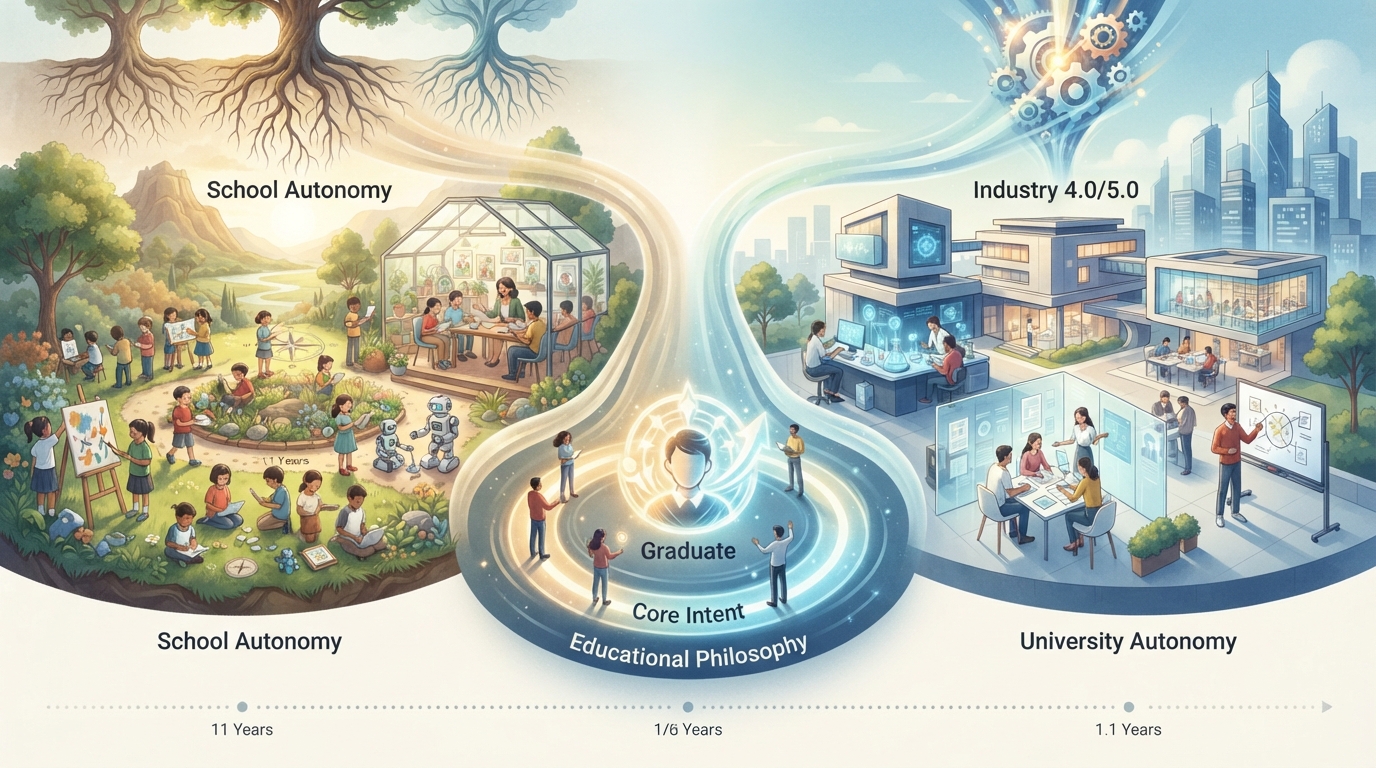
“Structures are not what matters; management style and intent do.” How should education be managed?
The term "education system" refers to processes worldwide from kindergarten to university and subsequent stages. But what about its management? What does it encompass? In an ideal scenario, how should this sector be managed? How are powers distributed, and how is quality control carried out?
Gazeta dedicated the 4th episode of the "Ta’lim 360" (Education 360) podcast to this exact topic. It featured regular expert Komil Jalilov and education specialist Azamat Akbarov.
— When we say education system, we mean the system from kindergarten to university and the training of scientific personnel. But what should be understood by the management of the sector? Let's start with that.
— Komil Jalilov:
Managing education is a very unique process. That is, managing an education system is not like managing a factory or an enterprise. Because if you manage a factory, your KPIs are clear. How many products are manufactured, how many are sold, how much profit is made — similar clear indicators are set.
Or, for example, if you manage a region, the indicators there are also relatively clear. How many people are employed in that region, what its economic indicators are like, and so on. In education, however, the situation is somewhat different. Why? Because education is a sector whose results cannot be seen today or tomorrow.
Especially in the general secondary education system, results can be seen after 11 years. This manifests when a generation graduates from school and enters universities or joins the labor market. That is, in education, the idea that I will do something today and see the result today or tomorrow does not work. For this reason, traditional KPIs and indicators may not function in it.
In my opinion, the philosophy behind managing education should be a bit different. That is, what is the goal in the education system — this needs to be defined. Who do we want to see at the final stage? If you remember, in the first episode of the podcast, we talked about the philosophy of education. That is, we asked the question of what kind of person we want to see through education. Whether we want it or not, management comes down to this philosophy. First of all, this question must be answered. The philosophy of management is formed based on this.
True, in managing the system, for example, how many schools have been built, how many kindergartens are operating, how many children they can accommodate are also important. But there are also aspects that cannot be measured today or tomorrow. These must be taken into account in management. Otherwise, managing education becomes just like managing a factory. This may not yield the expected result.
— So, in your opinion, management begins first of all with defining the philosophy of education. Understood. Azamat aka, what is your opinion on this matter?
— Azamat Akbarov:
The main result of management actually lies not in the circulation of millions of documents, but in enhancing the teacher's capacity. Relying on international experience, an organization called the Delivery Unit was established in the UK in 2001, at the level of the prime minister's hierarchy. This organization applies each strategy to universities and schools after running it through a pilot program and proving it with clear targets. This experience now works in many countries as well.
Now we talk a lot about the experience of Singapore or Finland. For example, in Finland, too, the philosophy of management is divided into two. That is, while one is the management of reporting, resources, and hours, the second measures how much the output resulting from it affects the student and the teacher. This is very important. Because education management is actually managing the criteria of student literacy, worldview, and creative thinking.
Sometimes they try to make schools look beautiful on paper. This, in fact, is also a management system. That is, millions of instruments are spent specifically to make it look beautiful on paper. But in reality, student literacy remains in the shadow. Confusion in management styles distances a person from the real result. Therefore, taking the examples of Finland and Britain, the main management method here is focused on how much impact it has on classrooms.
In Finland, system management relies more on trust. For example, granting freedom to regions is also related to trust. The Singapore model is built similarly. Their inspection body that monitors schools does not have huge leverage either. Why? Because this depends on trust. Therefore, one of the main principles of management is mutual trust. In a system without mutual trust, management turns into an overly bureaucratic, cumbersome mechanism.
To manage a school or a region or a city, you hire more people, sign more unnecessary documents, and craft new laws on top of each other every day. In my opinion, this reduces what is considered the very ultimate impact in the education system — the impact on quality.
— In other words, no matter how many structural changes are made in the system, if it is not felt directly on the ground, it is all in vain, we are saying. So, we can arrive at such a conclusion.
Alright, the next question. Moving directly to system management, as mentioned above, the education system refers to the system from kindergarten to university, plus the training of scientific personnel.
If all of these are combined into a single system, how effective is it considered? Is it right to manage it as one whole, or should they be managed separately?
— Komil Jalilov:
A very interesting question. But there is no single right answer. Because if you look at international experience, the whole system is managed both by a single ministry and by separate structures. That is, one cannot say that this one is right and that one is wrong. There are different models. But there is a very important point here. Concentrating the entire system in the hands of one ministry can create several risks.
The emergence of a huge system increases the likelihood of creating a system that operates inefficiently and issues orders every day just to prove its existence. A big question arises here: which structures of the ministry are responsible for which points of the large system? Even in systems where a single ministry manages everything from kindergarten to school and higher education, for example, the higher education system is still mostly considered autonomous.
That is, they do not interfere in higher education. Generally speaking, higher education must produce specialists who can think independently and analyze, and for this, higher education institutions must be independent. If the system itself, the universities, are not independent, how can an independent individual be produced?!
Now as for kindergartens and schools, in my opinion, certain powers should also be given to them based on trust. If the ministry wants to manage everything from the center, this will not lead to good results. This has also been proven in international research. For example, studies have been conducted on whether there is a correlation between giving autonomy to schools and the quality of education. Even if you look at the PISA results that we all know, it is the same.
The founder of PISA, Schleicher, also mentioned this in his major book "World Class: How to build a 21st-century school system." That is, "effective education systems are built on trust in schools and granting more autonomy." Furthermore, there are studies published by the World Bank by an economist named Eric Alan Hanushek. In those, too, this correlation was observed. That is, it has been proven that education systems where more autonomy is given to schools indeed operate more effectively.
Recently, I came across an article by a Turkish scholar published in international journals. He analyzes the case of Turkey. That is, Turkey ranks among the countries within the OECD (Organisation for Economic Co-operation and Development) with relatively low PISA results, meaning its education system's results are not very good, and that scholar analyzes the reasons for this. According to the conclusion, one of the reasons is linked to the extreme centralization of Turkey's education system.
A single ministry manages everything; there is almost no autonomy in schools. Current Turkish policy is moving in the direction of stripping academic independence from universities as well. Loyal people are appointed to rectorates by the central government. That is, the entire education system is managed from top to bottom based on a strict vertical.
What I mean to say is that scientific research is proving that the management method and model affect the quality of education in the final result. This is not just an abstract thing. Whether you want it or not, it directly affects quality.
— Understood. In terms of saving costs and establishing effective management, giving a large system to a single manager and conducting reform in general is not evaluated negatively. Azamat aka, in Komil aka's opinion, an administrative command vertical simply should not be created here. In your opinion, how should this be?
— Azamat Akbarov:
In fact, structures are not what matters — that is, whether ministries merge or operate separately — the management style and intent are very important here. There are 3 management styles in the world: managing by combining into a single ministry, managing by dividing into two, and managing by distributing to regions. For example, in Japan, South Korea, and Finland, the ministry managing kindergartens and schools and the one for universities are the same. But in Finland, there are two different management styles. Because there, schools have been subject to a single national curriculum developed by the ministry since 2009, while universities have been granted legal autonomous status.
If we mention the second management style on the example of Russia, by 2018 their ministries were split into two. For example, in India, the opposite happened; by 2020, the entire system was merged into a single ministry of education. Here, the research conducted by the state across every region is very important.
The third is management with federal distribution. Say, in Germany, the US, and Canada, schools are attached to regions. They are not subordinate to the ministry at all; the ministry becomes merely a small center that conducts strategic and core research. This is very important. Analyses are made on the future of the state, what human resources it needs, and the correlation between future education and production. That is, questions like whether we need the unemployed, whether we need science, where the world is headed, whether we will conquer space or not — are considered.
I think that for us too, looking at global trends, the intents of the management style are very important. If you do not have research and strategy, you might merge ministries one year and separate them the next. What benefit can come from this? This remains a big question. Therefore, without turning the ministry into an overly large monolithic system, we see global cases.
Universities must start contributing to GDP. In Malaysia, this contribution accounts for 5 percent, in America 10 percent. If universities are not given autonomous status, if there is no mentality of being able to invest in the future, they will be no different from schools.
— Komil Jalilov:
There may be a good intention that there should be no disconnect between the educational programs of kindergartens, schools, and universities, and that everything should work together in harmony. Only, there is a possibility of another big risk arising here.
The management model in schools is still relatively different. The young generation is still being educated there. For example, all over the world, there is a debate about banning social media for minors. Or certain requirements are set for dress codes, right?
Azamat aka says that universities should contribute to GDP and become research centers. Now imagine, if a single ministry inspects the food ration at a kindergarten in the morning, raises the uniform issue at a school at noon, and then teaches students how to dress at university, applying the same approach to everything, this would be a huge risk.
Because the philosophy of a school and a university is different. They are different environments. There must be a free academic environment at a university. That is, not every decision has to come down from the center, and it should not turn into an administrative command vertical.
— In the case of kindergartens and schools specifically, which decisions do you think should be made by the center? Which decisions should be given to the educational institution based on autonomy?
— Komil Jalilov:
We have mentioned this in our previous episodes as well, meaning a single goal and philosophy are needed. What should a person graduating from school after 11 years be like? Which path will be taken to achieve this? It is good to define these.
This is a matter to be determined at the ministry level. If necessary, a final decision must be reached together with scientific research institutes and the public.
If a teacher knows the ultimate goal, they also know what methodologies to use to teach a child in which grade. These decisions must be made directly on the ground by teachers in the region. That is, setting the general strategy is the ministry's job, while the strategy can be implemented locally.
That is, whether it is curricula, methodology, textbooks, or additional resources — all of them should be decided by schools within the framework of the set general goal. If more trust is given to the school in the distribution of powers and this strategy is resolved directly on the ground based on the general strategy, there will be a higher quality result. This is scientifically proven. The whole center cannot go in and out to check the conditions of thousands of schools in the republic. This is impossible.
— Understood. Azamat aka, how do you see the picture using the example of universities?
— Azamat Akbarov:
I wanted to add regarding schools. Indeed, in international experience, textbooks, teaching methodology, or materials are determined by the institution itself. We say that autonomy and freedom should be given to every institution. But achieving this is not easy either.
In foreign countries, there are 2 main conditions for freedom: quality and transparency. For example, if schools keep increasing their capacity and can demonstrate this through results, the percentage of freedom and autonomy granted by the ministry increases. Full autonomy is not given right away to any new school.
In Finland, there has been no school inspection since 1991.
Because the system is built entirely on trust. If we take the Netherlands, the state allocates an equal budget to schools, meaning there are no "elite" schools. Even in the most remote village of Rotterdam, an equal budget is allocated to match a school in the very center of Amsterdam, and this is monitored by an independent inspection. That is transparency. These are very important things.
In Singapore, it is interesting: decentralization goes through clusters. Schools are actually not independent, but 7–8 schools in one region unite, become a force together, and the ministry can develop a program specifically for them.
Now as for universities, universities are autonomous.
Because unlike schools, universities are drivers that determine their location and the state's future potential, leading the state to 4.0–5.0 industry. South Korea received beans from Egypt as humanitarian aid until the late 1980s, but in a short period, it became an Asian tiger. It was precisely the know-how in universities that caused this.