

Not many beavers were left, but 20 new dams appeared on the rivers
In the US state of Utah, 47 beavers were relocated to restore rivers affected by drought. Although only a quarter of them remained in the new location, a total of 20 new dams were recorded on the Price and San Rafael rivers at the end of the experiment. The impact of these structures on fish has yet to be studied.
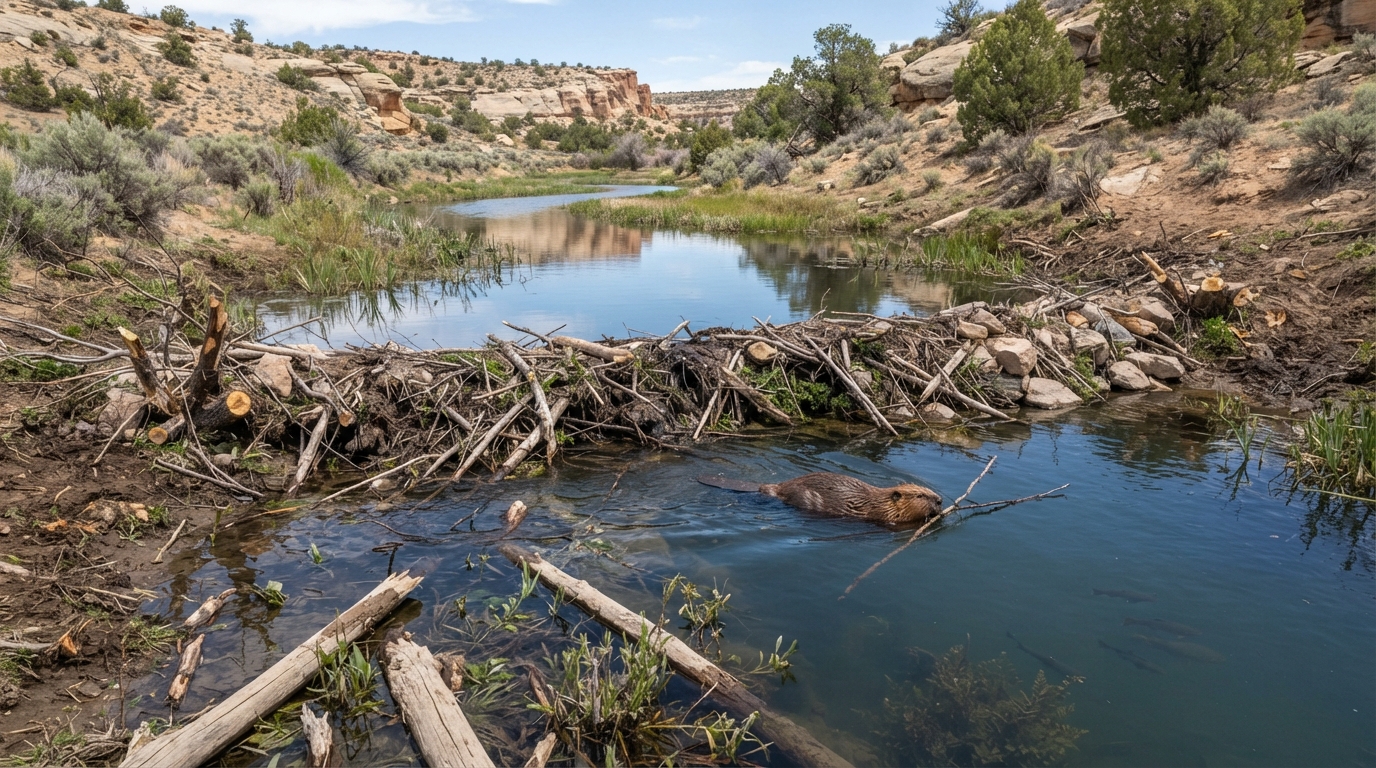
Although the number of beavers decreased, 20 new dams appeared in the rivers
Scientists at Utah State University used beavers captured in 2019–2020 for damaging property or infrastructure in other areas during an experiment. They relocated these animals to two rivers in an arid region to find an answer to the question of whether natural dams could improve the habitat for rare local fish.
The results of the study were published in the journal Animal Conservation.
Beavers are often called ecosystem "engineers". The dams they build slow down water flow, help water spread around, and contribute to the formation of wetland areas. Furthermore, they create quiet and deep pools of water that are crucial for fish. During periods of drought, the importance of such places increases even further.
However, relocating beavers turned out to be much more complex than expected. During the eight-week observation period, the survival rate of the relocated animals did not even reach 40 percent. Meanwhile, in the control group consisting of 24 beavers that had previously lived in the same area, this indicator was 80 percent.
Some beavers died due to predators, while others died from unknown causes. Some animals lost the transmitters installed to track their movements. Therefore, not every beaver that disappeared from observation can be considered dead.
Only about a quarter of the relocated beavers remained at the release site. The rest left in search of a more suitable area for themselves. Scientists note that usually in such relocations, nearly half of the animals stay in the new location.
Despite this, researchers say that the goal of increasing the number of dams was achieved. 17 new dams were recorded on the Price River, and three on the San Rafael. Some of them were built next to pre-existing artificial structures.
Scientists assume that the beavers that left the observation area may also settle in other damaged parts of these river basins and bring benefits. However, this possibility has not yet been confirmed.
Now researchers plan to study how the new dams affect fish living conditions. Thus, although an increase in dams has been recorded, it is still too early to conclude that the river ecosystems have fully recovered.