

"No single country can solve these tasks alone." What was discussed at the pediatric oncology congress
In recent years, Uzbekistan has improved its rates of early detection of childhood cancer, drug supply, and survival. The goal is to build a system in which a child is not lost between levels of care and remains under observation after treatment. These issues were discussed at a congress in Samarkand.
"No single country will solve these challenges alone." What was discussed at the pediatric oncology congress
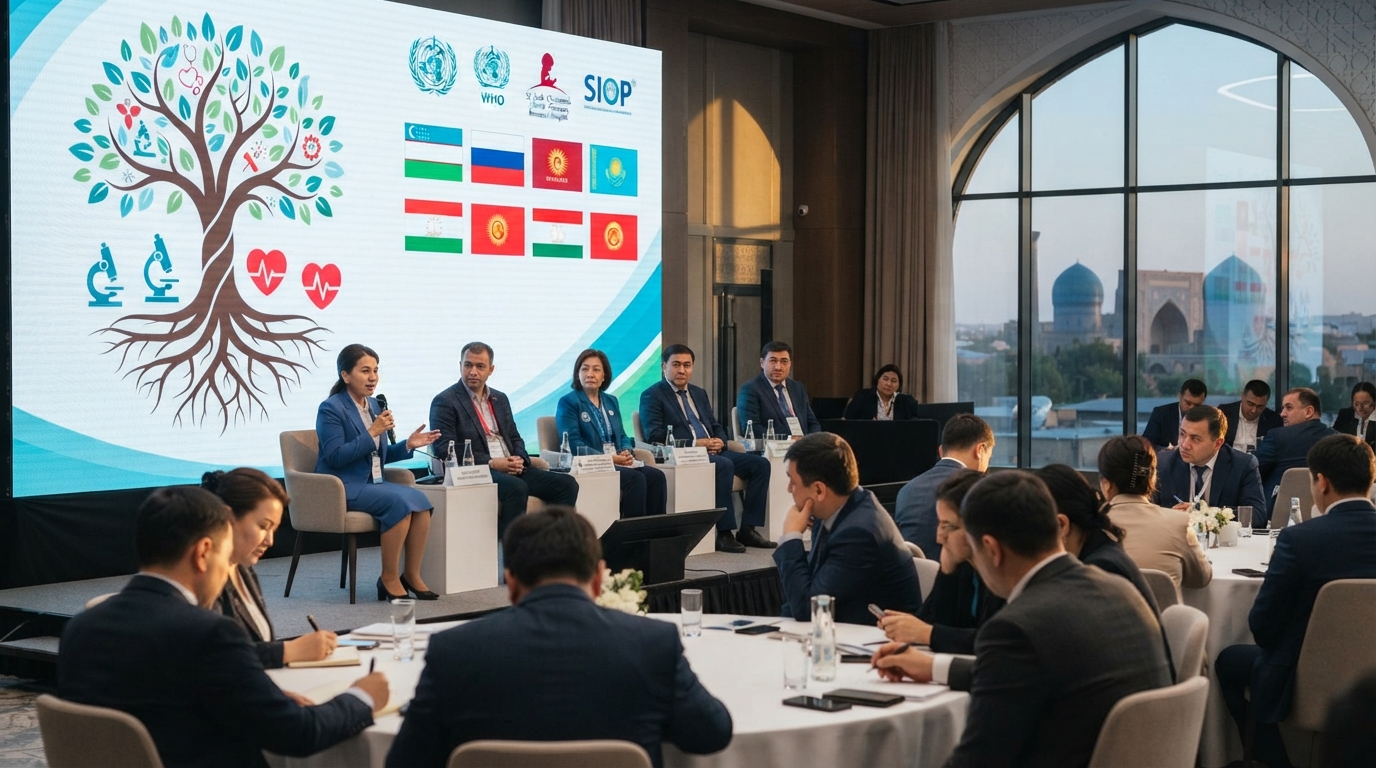
In Samarkand, as part of the "Investing in Children's Wellbeing" World Summit, the second International Congress on Pediatric Oncology and Hematology was held. Its theme was "From Cure to Quality of Life." The forum was attended by the ministers of health of Uzbekistan, Russia, Kazakhstan, Kyrgyzstan, and Tajikistan, as well as representatives of the World Health Organization, the International Society of Paediatric Oncology (SIOP), and foreign university hospitals.
The first such congress took place two years ago in Tashkent. As noted by Carlos Rodriguez-Galindo, Executive Vice President of St. Jude Children's Research Hospital, it is now possible to speak about concrete results.
"Today we gather in Samarkand with something more: proof that action works. In a short time, Uzbekistan adopted a national strategy, strengthened specialized centers, established an international academic hub, and began to see survival rates increase. These results were not brought by a single new drug. They were brought by many people who did many things well: early diagnosis, safer blood transfusion, a nurse who noticed a fever in time, a family that was supported so the child could finish treatment. A cure is not one drug, it is a system," Rodriguez-Galindo said.
Eldor Adilov, Minister of Health of Uzbekistan, reported that whereas previously months passed from the first symptoms of the disease to the start of specialized therapy, this period has now been reduced to a few weeks. Almost 9 out of 10 children are provided with the necessary medicines, whereas previously only every third child received them.
The minister also emphasized that the quality of life after treatment is directly linked to the congress topic.
"We proceed from the principle that care for a child should not end with their discharge from the hospital. It is necessary to provide long-term medical follow-up, rehabilitation, psychological support, and the opportunity to continue education. Of particular importance is the creation of a support system for children who have undergone oncological diseases, extending up to adulthood," Adilov said.
In conclusion, he announced the start of cooperation between the Ministry of Health and the Harvard Medical School international center for genetic diseases. The minister called genomic and personalized medicine the key to further progress.
Natasha Azzopardi-Muscat, Director of Country Health Policies and Systems at the WHO Regional Office for Europe, noted that more than 400,000 children worldwide are diagnosed with cancer each year, and treatment outcomes are not improving everywhere.
According to her, thanks to the global platform for access to medicines, Uzbekistan has improved access to essential anticancer drugs for more than 2,000 children. Regular needs calculations helped plan procurement and reduce dangerous interruptions in treatment, while nearly 500 healthcare workers underwent training.
"We do not want children just to survive. A child cured of cancer must have the opportunity to return to school, pursue their aspirations, and enjoy optimal health and wellbeing. For this, attention must be paid to rehabilitation, mental health, and psychosocial support. In this sense, the congress theme 'From Cure to Quality of Life' reflects the next stage of the global pediatric cancer agenda," Azzopardi-Muscat said.
Jamila Polatova, Head of the Pediatric Oncology Service of Uzbekistan, spoke about the path the country has traveled. Until recently, care for children with oncological and hematological diseases was provided in different institutions without a single organizational framework, data were scattered, and statistics were incomparable. She called 2021 the turning point, when a series of decisions were made to establish an independent national service.
The first systematized data, according to her, showed late detection of the disease and a long journey to treatment. In 2023, the disease was detected at stages one and two in 23% of cases, while stages three and four accounted for more than 70%. More than 160 days passed from the first signs to the start of treatment. One-year survival was 37% for oncological diseases and 17% for hemoblastoses.
Now the situation has changed. The proportion of early-stage detection rose to 25% in 2025, and in the seven months of this year, according to preliminary data, it reached 28%. One-year survival increased to 44.5% for oncological diseases and 42% for hemoblastoses. Provision of specialized drugs grew from 33% to 88%, and the list of state-procured anticancer drugs expanded from 39 to 53 items.
The national model, Polatova explained, is built around the patient pathway. If a suspicion of disease arises at the primary care level, a "green corridor" is activated: the child is referred for the necessary investigations on a priority basis. If the diagnosis is not confirmed, they return to the supervision of a pediatrician, and examination details accompany them at every transition from one structure to another.
"Our goal is a system. A system in which a child does not disappear from view between levels of care, and delays become visible and manageable. But the route does not end with treatment. Its continuation becomes early and subsequent rehabilitation, long-term monitoring, and, where indicated, palliative care, and the support and development of palliative care at home," Polatova said.
The national strategy for 2025–2030 provides for five key high-tech sites: a national one in Tashkent and four interregional ones in Samarkand, Bukhara, Andijan, and Karakalpakstan. During the congress, it was decided to increase the bed capacity in all interregional medical institutions. According to Jamila Polatova, these centers are being created so that specialized care is not concentrated in the capital, but remains accessible in the regions.
Uninterrupted supplies of pediatric oncology drugs in Uzbekistan are ensured by two international programs. The first is the WHO Global Initiative for Childhood Cancer, launched in 2018 with the goal of achieving a survival rate of at least 60% by 2030. The second is the Global Platform for Access to Childhood Cancer Medicines, established by the WHO and St. Jude Hospital, which invested $200 million in it. Guaranteed quality drugs are procured through UNICEF and the PAHO Strategic Fund and supplied free of charge to participating countries.
The new center in Samarkand will be the first to enter rotation, followed by other regions. The next step is training pediatricians and primary care physicians to reduce the time from first symptoms to diagnosis. Minkov expects to present the first results of the work in a year.
The institute is joining cooperation with Uzbekistan later than other partners, and the parties are currently identifying areas of interaction.
Leman cited estimates according to which only about half of the expected pediatric cancer cases are detected in Uzbekistan. At the same time, the experience of neighboring Kyrgyzstan showed that the development of diagnostics increased the number of detected cases from 70 to 200 per year, which speaks to the effectiveness of the system. National registries must become the basis for this work.
Dana-Farber proposes establishing a steering committee, training oncologists and bone marrow transplant specialists locally or in Boston. The program is designed for three years: launch, training, and creation of a clinical research and data center. There are also plans to open a hereditary cancer predisposition clinic on the hub's basis.
"We do not want to impose our model — that does not work in global healthcare. A true partnership is needed. We intend to learn from you, and you from us, to jointly create a sustainable system based on national priorities and local culture," Rebeka Leslie Leman conveyed.
Akmaral Alnazarova reported that five-year survival for pediatric oncohematological diseases in the country has reached 70%, and for acute lymphoblastic leukemia — 85%. More than 630 transplants have been performed, and the national bone marrow donor registry counts 13,000 people. At the same time, the minister emphasized the importance of regional cooperation.
"The next stage in the development of pediatric oncology is the transition from individual innovations to a system where accurate diagnostics, modern treatment, and science work for every child regardless of the region. No single country will solve these challenges alone," Alnazarova noted.
Kazakhstan proposed focusing joint work on seven areas:
Shared registries of patients with unified rules for recording diagnoses, risk groups, relapses, and treatment outcomes. This will allow for comparing results and seeing at which stage children are lost.
A shared Central Asian bone marrow donor registry connected to the global network of more than 44 million donors. Out of 58 unrelated transplants for Kazakhstani children, 43 were performed using foreign donors.
Cellular technologies. A course of CAR-T therapy sometimes costs about half a million dollars. The University Hospital of Barcelona produces CAR-T cells itself, and such treatment is about three times cheaper than commercial alternatives. Alnazarova proposed establishing a joint academic platform in the region.
Quality control of laboratory diagnostics. Analysis determines the risk group, which means whether the child will receive mild or intensive treatment. The minister proposed a regional external quality assessment system and a network of reference laboratories where complex cases will be re-checked.
Localization of drug production and mutual recognition of registration certificates, primarily for innovative drugs.
Joint procurement of expensive drugs. An intergovernmental agreement has been prepared within the framework of the Organization of Turkic States and is currently undergoing approval.
Joint clinical trials.
"In Kazakhstan and Uzbekistan combined, only 4 clinical trials in pediatric oncohematology are registered, whereas in Turkey there are more than 200. Individually, our markets are small, but together — it is 18 million children. This gives us leverage to participate in international trials and early access to the latest drugs," the minister stressed.
Vitaly Smelov listed personnel shortages, data fragmentation, lack of diagnostic and treatment capacity, as well as the stigmatization of palliative care among the common problems of the region.
He noted the growth of regional interaction: the joint DICA project is already studying delays from the first symptoms to the start of treatment, which in individual cases reached 800 days. Teams from Kyrgyzstan and Tajikistan are developing digital services for early diagnosis.
A second example is a hospice: one of the countries built its first hospice after reading about a hospice in Uzbekistan, visiting it, and speaking with a palliative care specialist. Smelov also noted Uzbekistan's role in the platform: it had the largest number of institutions through which medicines are distributed. He thanked Uzbek colleagues who reported what was working poorly in the process.
Rejin Kebudi noted that over 40 years, childhood cancer survival in Turkey grew to 71% thanks to strong state policy, and Uzbekistan today demonstrates the same political will.
Uzbekistan took first place in SIOP Asia by number of participants: their count rose from 6 in 2024 to 293. In the global SIOP ranking, the country is second only to the US.
The next SIOP Asia congress will take place in Tashkent in May 2027. Summing up, Carlos Rodriguez-Galindo recalled the global goal — to increase survival for children with cancer to 60% by 2030.
"This commitment was made in New York, but it will be carried out in the wards and clinics of Tashkent and Samarkand, Almaty and Bishkek, Dushanbe and Ashgabat — by people like all of us, people who care," he concluded.