

The last month has seen youth-driven demonstrations across Europe. What connects them?
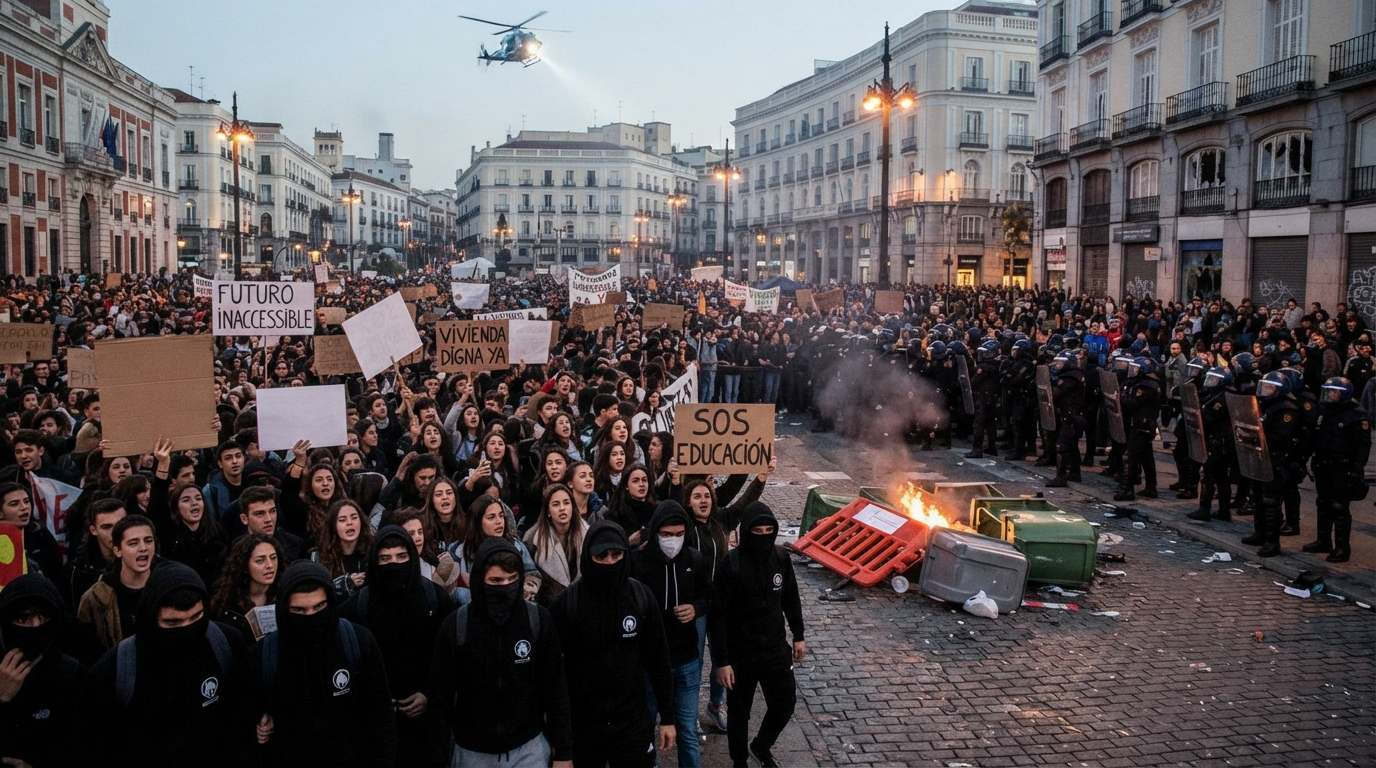
Europe’s young people are heading into the streets because they believe a hopeful future has been shut off from them
From Milan to Marseille, from Madrid to many other cities across Europe, streets have been alive with vivid, impassioned protests in recent weeks. Although many began peacefully, a significant number have ended in disturbing scenes of violence and looting. There have been claims that radical left-wing groups deliberately ignited riots, along with reports of heavy-handed policing.
We have seen thousands gather in Rome and Florence. Hundreds of thousands have turned out across France. In Madrid, a tent encampment has occupied a central city square since late September. In Lisbon, tens of thousands, mostly young people, marched earlier this month. In Brussels, police used tear gas and water cannon on protesters after young men in black clothing, with their faces covered to conceal their identities, hurled rocks and firecrackers at officers. In Albania, demonstrators accusing the government of corruption are demanding that Prime Minister Edi Rama, already in power for 13 years, step down.
The continent feels unstable, both socially and politically.
I have spent years reporting in Europe from countless demonstrations, peaceful and violent alike. I remember the fervent Catalan pro-independence marches of 2017, the desperation and Molotov cocktails in Athens’ streets during the 2015 Greek debt crisis, and repeated outbreaks of violence in France during President Emmanuel Macron’s first term, triggered by proposals on fuel taxes and pension reform.
Hundreds of thousands have joined protests in France, some of which turned violent
Yet this feels different. Protests are erupting at the same time across Europe, and most demonstrators, whether peaceful or violent, are young. Some are very young. Among those arrested, there is a striking number of minors. More than half of those detained in Barcelona clashes last weekend were under 18. Minors were also among those arrested by police in Milan after clashes, according to Italy’s LaPresse news agency.
For the most part, Europe’s governments have been careful to separate looters and rioters from loud but peaceful, legally organised demonstrations. The latter usually centre on a specific issue. In the current wave, signs and slogans mainly target education problems, social inequality and the rising cost of living, though each country also has its own distinct grievances.
What has set off this sudden anger among Europe’s youth? Are all these protests connected in some way? And with major European elections approaching, how will governments respond — by listening to protesters’ concerns, or by taking a law-and-order approach to appeal to older voters?
Students have taken to the streets in France, Belgium, Ireland, Spain, Portugal, Italy, Greece, Serbia and Albania — across more than 1,000 miles of the continent.
The demonstrations are often arranged informally through TikTok or Instagram. Belgium’s interior minister has complained about what he calls the “TikTokisation” of protests.
Student unions help organise marches, but they are also inspired by peers in other countries, even on other continents. Consider the so-called Cockroach student movement in India — a Gen Z social and political protest movement that emerged in May this year, beginning with criticism of the Indian education system.
France, where the current wave of student protests began in late September amid complaints about staff shortages and crumbling buildings, has been a major catalyst in Europe. There is a saying in neighbouring Belgium: when it pours in Paris, it at least drizzles in Brussels. The Belgian capital and the town of Liège have also now seen weeks of youth protests.
In Athens, school pupils and teachers have demonstrated over education and the cost of living
In Barcelona this weekend, students were urged to protest under the social media hashtag #InstitutsIndignats, echoing the French slogan Lycées Indignés (Outraged High Schools).
In Athens, 17-year-old Greek school pupil Yiannis Papanikolaou told AFP: “School buildings are terrible and poorly maintained… I think something might change, because of what France is doing, France will spur Greece.”
Across the continent, many young people share a sense of economic malaise — and it goes well beyond education. They worry about the environment and fear that AI will take away job opportunities. They are concerned that the soaring cost of living could stop them finishing their studies and prevent them from buying or renting a home large enough to start a family.
In Madrid and Lisbon, anger has centred on the unaffordable cost of housing. Portuguese Instagram-linked campaigns said “enough is enough” and urged people to take to the streets as others had done in Spain.
In Lisbon, Carolina Cruz, 26, a PhD student and biology researcher, said she may lose her home as her rental contract nears its end. “I’m the first person in my family to enter a doctoral programme and even with all the studying I’ve done, I still can’t make it,” she told Reuters.
That frustration is shared by 22-year-old Riccardo, a protester in Italy’s financial capital, Milan. “Even if we don’t manage to throw the country into chaos like in France or block every road like in Spain, the aim is at least people will start talking about these issues again,” he told AFP.
And it is certainly not only young people on the political left who are angry. At the launch of French nationalist Marine Le Pen’s presidential campaign last weekend, young supporters described different concerns to me. Calling themselves the “silent majority” — not yet out on the streets — they said they too are deeply worried about “uncontrolled immigration” and safety on France’s streets, as well as the cost of living.
The wave of discontent has spread beyond young people to include trade unions, France’s fragmented Yellow Jacket movement that protested the cost-of-living crisis during Macron’s first term, and other civic initiatives. This weekend, Kent in coastal southern England saw two protests, one for immigration and one against it.
This mixed collection of protests can be hard to make sense of.
Mark Leonard, director of the European Council on Foreign Relations, describes a build-up of cascading, competing crises in Europe, none of which, he says, has ever been properly resolved. That sense of pent-up anger is now spilling into the streets.
Anti-government marches have swept through Tirana, the Albanian capital
“One crisis layers on top of the other,” he told me. “The financial crisis of 2007-8, the migrant crisis of 2015, the environmental crisis, Covid, inflation after Russia’s full-scale invasion of Ukraine in 2022 and now again with the war in the Gulf.”
Leonard says these crises have produced different “tribes”. Social media use and algorithms reinforce their separate viewpoints, creating a real sense of polarisation in Europe.
“We’ve already seen this in the US,” Leonard says. “A sense of ‘my crisis is more important than your crisis’.”
Nathalie Tocci, a former Italian government adviser who is now a politics professor at Johns Hopkins University, told me we should not be so surprised by the protests, or by the youth involvement in them.
“We tend to think of youngsters as politically switched off and disinterested. We think they don’t bother to go out to vote etc, but they are truly engaged,” she told me, “just in a different, more grassroots way. Think of the ‘Fridays for the Future [environmental movement] across Europe a few years ago, or the demonstrations against Israel’s actions in Gaza after 7 October.
She points to the student-led protest movement in Serbia, which recently defeated long-standing leader Aleksandar Vučić in parliamentary elections. “It’s quite something. They kept going and going, for more than two years. What sticking power will these new European street demos have? That’s not yet clear.”
Belgian security services say there is “opportunistic” violence on the fringes of legally approved protests
And what about the looting and violence?
Intelligence services in France and Belgium have described looting on the edges of legally approved protests as largely opportunistic.
They suggest the rioting is a mix of “mindless violence” — a phrase also used by the Spanish authorities in Barcelona to describe clashes there at the weekend — and disorder deliberately organised by young people from ultra-left radical groups.
Tocci reminded me that in Italy, some people use the word “maranza” for those who seem to destroy things for the sake of it: smashing or burning cars or public bins, for example.
In France, rioters are often called “casseurs” — people who break things. But privately, some use a more politically loaded term: “racaille”. Like “maranza” in Italy, it is a pejorative slang word, generally used for disaffected, rowdy urban youths, often from working-class and/or immigrant backgrounds. It was used in October 2005 by then-French Interior Minister Nicolas Sarkozy to describe young delinquents and rioters during a tense visit to the housing estates of the Paris suburb of Argenteuil.
French media has also asked whether there has been an alliance of convenience, however informal or accidental, between two groups of young people: ultra-left activists and young people from France’s disadvantaged neighbourhoods. Like the anti-capitalist left, young people from public housing estates on the edges of French cities, known as the banlieues, often feel discriminated against and complain of heavy-handed policing.
Puerta del Sol square in Madrid has been occupied by tents since late September
France’s political right and centre, including Macron, blame left-wing radical groups and “delinquents” for organising the riots. Unlike Le Pen’s National Rally Party, they have not pointed to any link with past or present immigration to France.
Critics accuse anti-immigration parties in Europe of trying to exploit the riots for political gain. In Belgium, the anti-immigration opposition Flemish nationalist party Vlaams Belang appeared to blame migrants for violence in Liège and Brussels, calling the riots “imported” and blaming failed integration and open borders. Belgium’s Interior Minister Bernard Quentin has blamed ultra-left groups.
Fresh mass demonstrations are planned in the coming days in France and Italy.
Governments are moving to crack down on the violence. Thousands have been arrested, and Italy and France have promised a “you break it, you pay for it” policy for rioters.
Italian Prime Minister Giorgia Meloni is also making parents of minors responsible for damage caused by their children, including by deducting welfare support received by the family. In France, the Civil Code already holds parents living with their children liable for damage they cause.
But some of these European governments may not remain in power for long. All the major EU countries have held, or will hold, crucial elections in the coming months. France’s presidential election is seen as the most important for Europe. Le Pen is consistently polling well ahead of her rivals. It is assumed that the unrest on French streets is helping her, thanks to her party’s law-and-order message.
In Spain, Italy, Germany and Poland, nationalist, tough-on-immigration parties are also polling strongly. These parties promise to restore order and national pride. Leonard believes populist or non-traditional parties on both the left and the right have become “crisis entrepreneurs”, using Europe’s turbulent situation to win over disaffected voters.
Meanwhile, Europe’s political mainstream faces a leadership crisis, says Grégoire Roos, director of Europe at the Chatham House think tank.
I would argue they also face a crisis of legitimacy. The fact that so many people — young and not so young — are protesting shows they have failed to get a grip on events.
Europe’s car makers are in crisis. Will the threat of war rescue them?
Spain and China are growing closer — to the anger of many in the EU
How population decline is exposing Germany’s old divides
But it is far from clear that new elections will solve public frustration. France is so polarised, for example, that if Le Pen were to become president, many expect her opponents would flood French streets in anger.
Modern Europe rests on the assumption that citizens pay taxes and obey laws. In return, they receive good public services such as education and healthcare, personal safety and a stable society governed by rules and regulations.
But this “social contract” has clearly weakened, Roos says.
Looking at the unrest on Europe’s streets, this period of protest seems likely to continue.