

Marseille braces for more unrest after protests give way to 'apocalyptic' disorder
France's second city saw some of the worst violence as chaos gripped the country on Saturday.
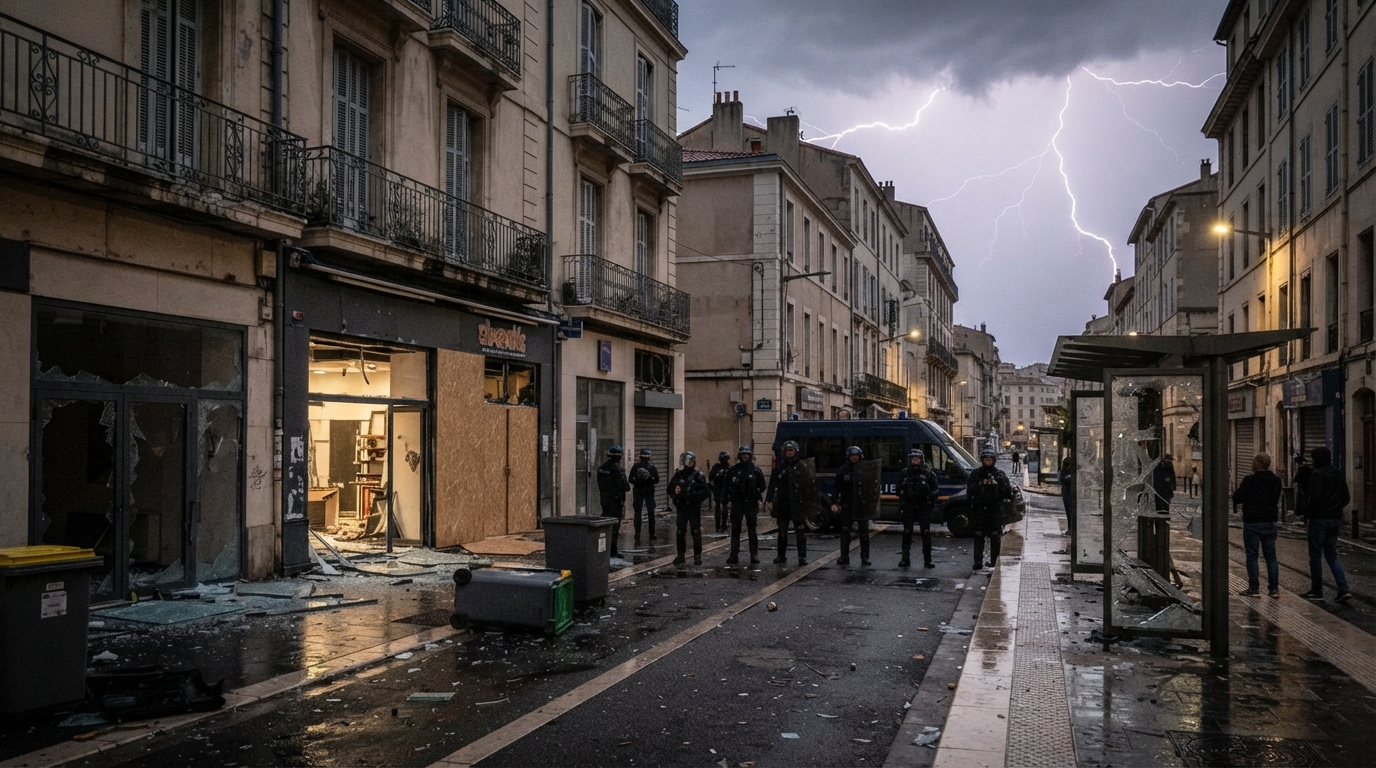
Marseille prepares for further unrest after protests descend into 'apocalyptic' disorder
France experienced some of the worst disorder in its modern history on Saturday, with the violence in Marseille ranking among the most severe.
Thunder and lightning rolled over Marseille after the weekend’s chaos, lighting up the shattered windows and boarded-up doors of hundreds of businesses that were wrecked as protests turned into disorder.
France’s second city endured some of the worst violence as the country was engulfed by chaos on Saturday. Local business leaders say more than 500 premises were damaged, and most were looted.
A police union leader told the BBC that the weekend had been an "apocalyptic" hell for his colleagues. 118 officers were injured, accounting for more than a tenth of the national total.
So far, 101 arrests have been made in the port city, a quarter of them children.
By Monday, however, police were the most visible presence on the city’s streets, not protesters. For eight hours, demonstrations and gatherings were banned in an attempt to prevent a third straight day of disorder.
The measure appeared to succeed; the biggest central crowd we saw was a group of weather-beaten tourists wandering along the quayside.
Even so, an overnight curfew for minors is expected to be introduced in parts of the city from Tuesday.
Marseille is one of France’s most ethnically diverse cities, a place where generations of newcomers have arrived.
18-year-old student Maryame only moved to the southern city a few weeks ago, though from the countryside not far away.
"It was very scary because it's my first time in a big city, and also my first time demonstrating," she said.
Maryam (R) joined the protests on Saturday, which began in September over poor school conditions before escalating to cover broader issues such as the cost of living
Maryame said violence swept through the student demonstration her friends had joined as looters started attacking shops.
She described the solidarity of the earlier march as "beautiful" and the later disorder as "terrifying", but said she was torn over whether even more violence would force the government to pay attention.
"It is a very complicated question if violence is legitimate," she began.
"But the thing is, France, our history is really based on revolution, and sometimes we really have to make a really big impact.
"Sometimes it goes too far."
For the police, the degree to which order collapsed came as a shock, according to one organisation representing rank-and-file officers.
"It was a war," said Arnaud Blaise from the UN1TE police union. "An unheard-of level of violence. Unprecedented."
Looting was reported throughout the city centre, including along La Canebière - Marseille's equivalent of Paris's Champs-Élysées - Rue Paradis, and at the Centre Bourse shopping centre. Businesses were also targeted farther out, including the Grand Littoral and Le Merlan shopping malls to the north.
Police union representative Arnaud Blaise said police had eventually run out of ammunition
Blaise said he feared future protests could repeat Saturday’s destructive pattern, with young people from the deprived northern suburbs taking the chance to steal amid chaos that, in his view, was fuelled by far-left agitators - known in France as the Black Bloc.
"The Black Blocs provoked, and the youngsters took advantage to start looting," Blaise said. "That created chaos, with police officers running right, running left, and in effect, we got overwhelmed."
I put it to Blaise that police had been accused of using heavy-handed tactics against peaceful students while standing by as the most violent protesters looted local businesses.
"That is not the case at all," he replied, saying more police than students had been injured.
"Four thousand tear gas grenades were fired and then we ran out of ammunition. So at a certain point, you have no choice but to retreat."
France's Interior Minister Laurent Nuñez - whose resignation after the riots was rejected by President Macron - travelled to Marseille on Monday evening.
He went to City Hall, which was briefly occupied by protestors on Saturday, and met Marseille's Socialist Mayor Benoît Payan.
Payan said he wanted answers from the government about how the chaos was allowed to unfold.
"Order was lost, and an attempt was made to restore order. I believe that from start to finish, it was a fiasco," he said on Monday.
He said police were understaffed and poorly deployed, and needed to change their tactics.
"If there isn't a radical change of approach on this issue - if, by chance, the only target remains high school students - then we will see looting scenes again."
He added: "I don't know what's left to loot in Marseille, but for the little that remains, it will be looted."
Chantal Bellanger said she was worried for young people rioting out of anger and despair
Although the ban on public gatherings in Marseille and partial overnight curfews in other French cities have brought some temporary calm, more demonstrations are planned for the weekend.
At a smashed-out tram stop, 79-year-old grandmother Chantal Bellanger said she had been "worried - but then, I've been worried for a long time".
"We can clearly see that France has lost its grip on many things. Public services, hospitals, education is in a horrible state, the peripheral neighbourhoods are dilapidated, they are abandoned."
She said she used to work in these deprived northern suburbs, where poverty and crime rates are very high, and feared an entire lost generation was criminalising itself through anger and despair.
"It tugs at your heartstrings," she said.
"To see children whose actions are going to place them completely outside of society. It's painful to watch."