

France's government under pressure after weekend of widespread violence
Political tension grips France after rioting marred protests over the cost of living and struggling public services, Katya Adler writes.
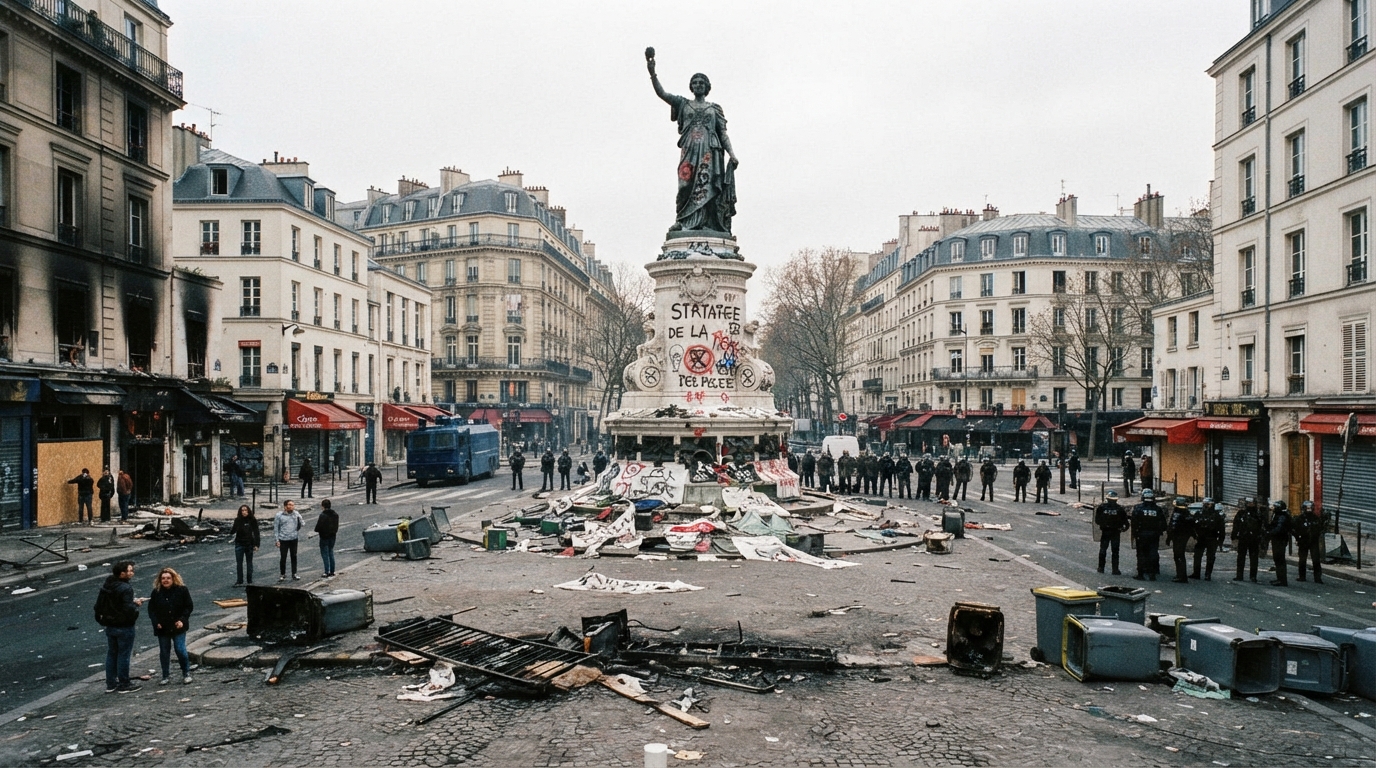
France’s government is under strain after a weekend of widespread violence
President Emmanuel Macron called for calm in a national address after widespread looting and violence
France’s Prime Minister Sébastien Lecornu is convening a crisis cabinet meeting on Monday to review a weekend of violence and looting across the country, in what were among the worst episodes of public disorder in modern French history.
On Saturday, more than half a million mostly peaceful protesters marched against rising living costs and shrinking access to decent public services, including a good state education. But the demonstrations turned violent after groups of black-clad, masked activists and vandals emerged.
An estimated 1,500 shops and businesses were looted and wrecked. Riot police used tear gas and water cannon against crowds. They were also seen striking people with batons in several places. France’s interior ministry said around 1,000 police officers were injured on Saturday, seven of them seriously.
There had been rumours in France that President Emmanuel Macron might impose a temporary curfew in parts of the country, or even declare a state of emergency, to help ease the febrile atmosphere. Instead, he delivered a televised address to the nation on Sunday, urging national unity and seeking to reassure the French public that those responsible for the violence would be punished.
Macron’s speech has been heavily criticised on social media and by political opponents for lacking concrete detail.
How will vandals and rioters now be held to account?
How can France’s towns and cities be better protected - especially with new mass demonstrations announced in a couple of weeks’ time?
How exactly will destroyed businesses be compensated?
And when will talks begin with student and teachers’ organisations on education?
Vandals defaced the Statue de la Republique in central Paris over the weekend
On Sunday, the Secretary General of the CGT union, Sophie Binet, accused Macron of failing to address students’ concerns, the cost-of-living crisis or the declining quality of public services in France.
He has apparently handed that responsibility to Prime Minister Lecornu. Yet many in France accuse him and his interior minister of being badly unprepared and under-policed ahead of Saturday’s multiple scheduled protests.
The president of France’s lower house of parliament, Yaël Braun-Pivet, says she wants to launch an inquiry into exactly what happened this weekend and why.
“Things are dark in the city of light [a nickname for Paris]” was the graffiti I saw painted in red across a wall beside a row of shattered shops in the French capital on Sunday night.
Macron is widely seen here as a lame-duck president. He is on his way out. A fiercely contested race is already under way to choose his successor, with the vote due in six months’ time. The presidential candidate from the anti-immigration nationalist right (Marine Le Pen) and the anti-capitalist left (Jean-Luc Melenchon) are competing to make headlines.
That is adding to the tensions in France - in politics as well as on the streets.
Parliament is paralysed, deeply split between three competing political blocs.
Then there are France’s financial problems too. Investors are pressing the country hard to bring its spiralling public debt under control. But the French government fears that if it cuts public services or welfare, even more angry people will take to the streets.
What now, what next, is our country broken? You hear these questions a lot at the moment.
People across France were shocked and disturbed by Saturday’s events. The images of tear-gassed towns, apparently unchecked looters and burning public buildings have alarmed the nation.
Many passers-by I speak to say they are frustrated that, while they worry about the future, their leading politicians seem instead to be passionately focused on blame, accusing one another of causing the volatility.
“While we worry for our safety, they use this situation as a pre-presidential election political football,” teacher and father of three Edouard told me.
Macron and his prime minister blamed Saturday’s violent chaos on radical far-left groups and delinquents; hard-left leader Jean-Luc Melenchon accused the government of “incompetence”; Marine Le Pen on the nationalist right, which likes to present itself as strong on law and order, posted a video seated in front of the French flag, delivering a presidential-style address and blaming the “Macronist administration that is out of steam, exhausted, and disoriented”.
For the next two weeks, French authorities are hoping for some respite. Students begin their half-term break on Monday.
But on 5 November, a broad range of trade unions, along with France’s fragmented “yellow jacket” (gilets jaunes) movement that staged protests for more than a year in 2018 - during Macron’s first term as president - have announced huge demonstrations.
France is holding its breath.