

Data centres are the lifeblood of our digital world, but there are growing concerns about their environmental impact. The BBC explores their rise in charts.
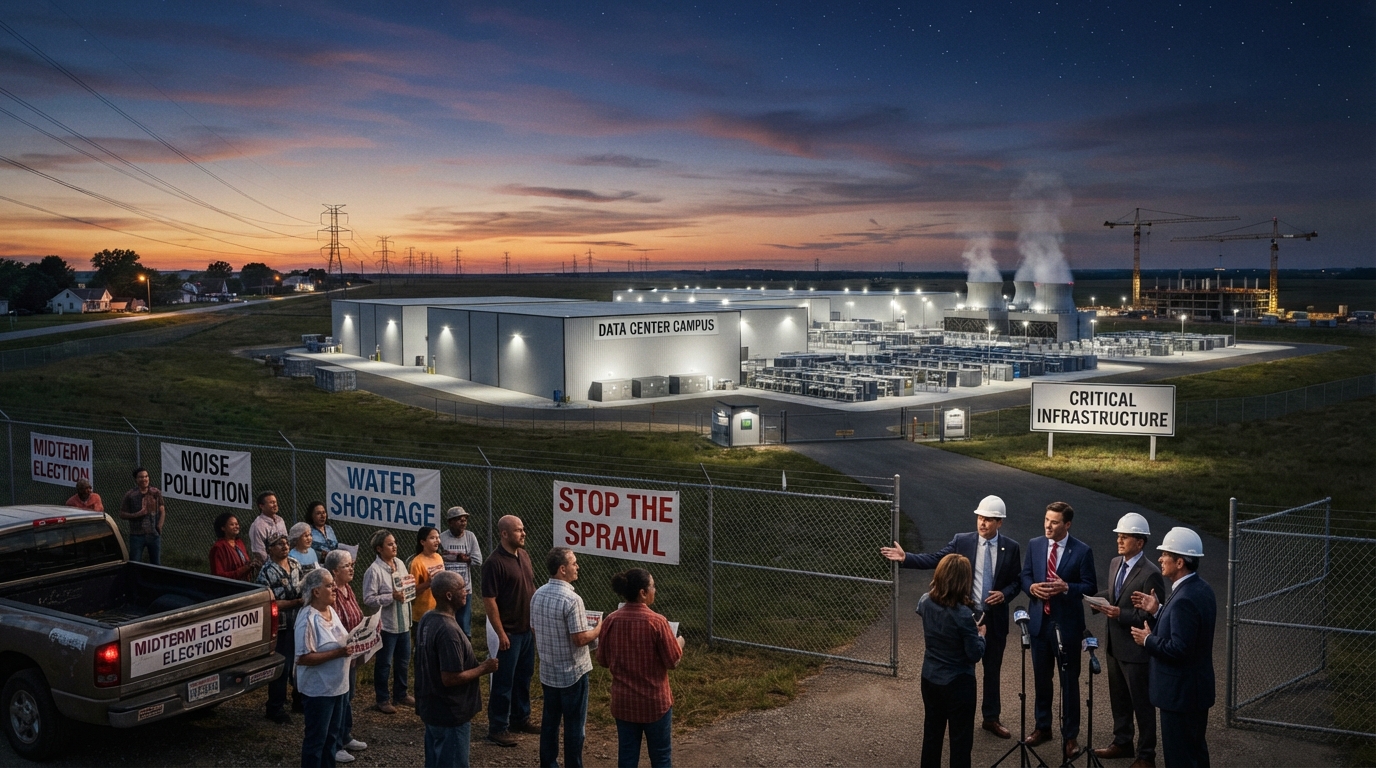
**Data centre debate intensifies before US midterms - what you need to know**
A few years ago, many people may not have known what a data centre was.
These huge, warehouse-style facilities power almost everything we do online, from web searches and emails to movie downloads and internet banking.
They sit at the centre of the AI boom, storing the advanced chips and servers required to run services such as ChatGPT and Claude.
But their rapid expansion, the vast amounts of electricity they use and worries over their environmental footprint are triggering a growing backlash worldwide.
In the US, they have become a major issue ahead of the midterm elections on 3 November, with both Republicans and opposition Democrats speaking out against their growth.
That is setting opponents of data centre expansion on a collision course with US President Donald Trump, who has brushed off the criticism as a "sick conspiracy", even as public anger rises.
Here is what you need to know about the data centre boom, and why resistance is increasing.
There are about 12,250 data centres worldwide, according to Data Center Map
That is a sharp rise from 2021, when there were around 8,000 external operational sites.
As the chart below shows, data centres are most heavily concentrated in the US, which has 4,767 sites. Europe comes next, with the UK and Germany in the lead.
Data centres have usually been built close to cities, where high-voltage power lines or water supplies for cooling are easier to access. But as they grow larger, more are being developed in rural areas.
When it comes to actual capacity, however, the US is far ahead by a much wider margin, with China in second place and Europe trailing well behind.
That gap is expected to widen in the years ahead, prompting some to warn that Europe could miss out on the economic gains from the AI boom.
Data centres come in hugely different sizes, from units that fit in a garden shed to others spread across enormous tracts of land.
The world’s largest operating data centre is widely reported to be one run by China Telecom in Hohhot, Inner Mongolia, covering about one million square metres (10.7 million sq ft). That is roughly equal to 140 Fifa football pitches.
Even larger projects are now under construction, as the graphic below shows.
All of these sites are being built solely to deliver the huge computing power needed for AI services.
For example, Colossus 2, part of the broader Colossus campus, will contain hundreds of thousands of advanced AI chips made by tech giant Nvidia.
It will also be used to train xAI’s chatbot Grok. Elon Musk’s company will rely on 41 methane gas turbines to help power the site, which activists say could "significantly increase" local air pollution
Local regulators say the turbines will meet air quality standards.
Growing pressure on local resources has led to rising concern about data centres. These facilities can use large amounts of water to cool their systems, which some experts say could contribute to water shortages
Data centres around the world are also believed to use more electricity than the whole of France, as the chart below shows.
This rising demand for power is increasing carbon emissions, analysis shows
, while also straining local grids, which some fear could drive up energy prices
.
With others concerned about the noise data centres produce and the space they occupy, public opposition is building.
Some 16 US states have proposed laws to ban or temporarily block new facilities, and it could become a key issue in November’s midterm elections
.
Beyond the US, resistance to data centres has also emerged in countries including
Mexico
, France,
Indonesia and the UK
.
Supporters, however, argue that data centres are vital to national security
and to the development of AI.
They also say they benefit the economy
by attracting investment, generating tax revenue and creating jobs in areas such as construction.
A recent report from the Brookings Center
, external suggests data centres do create local jobs, though fewer than industry supporters claim.
The kind of data centre also matters. The report found that so-called hyperscale facilities - huge sites owned and operated by tech giants such as Amazon and Microsoft - have a stronger positive impact on jobs.
By contrast, "colocation" facilities, which rent space to remote tenants without a local presence, delivered fewer benefits.
As the argument over their value grows sharper, the buildout of data centres continues.
This year, the tech industry is expected to spend a combined $765bn
($544bn) on AI infrastructure in 2026, with that figure set to exceed $1tn next year.
But as concerns over environmental damage increase, the tech industry is looking at alternatives.
One proposal is to place data centres in space
, external or on the Moon
, where they could tap abundant solar power.
Others believe that more AI processing may eventually be handled by the hardware already built into our computers and smartphones
, cutting the need for vast data centres altogether.