

The global AI race is being hit by very localised political and environmental concerns
Why warnings of doom are not the only danger facing the AI giant
There is a strange, low drone coming from data centres, where tens of thousands of chips carry out trillions of calculations every second to help power the artificial intelligence (AI) revolution.
Those chips drive the text, images and video produced in response to prompts sent to advanced AI models by users around the world.
The calculations themselves, which amount to microscopic silicon transistors inside a chip switching on and off, are silent. But like all computers, nearly every watt of the large amount of electricity used in the process ends up as heat, and the noise you hear is the slow spin of thousands of fans needed to stop the heat from damaging the server racks. Depending on the size of the site, you may also hear the hum of transformers in substations that route electricity.
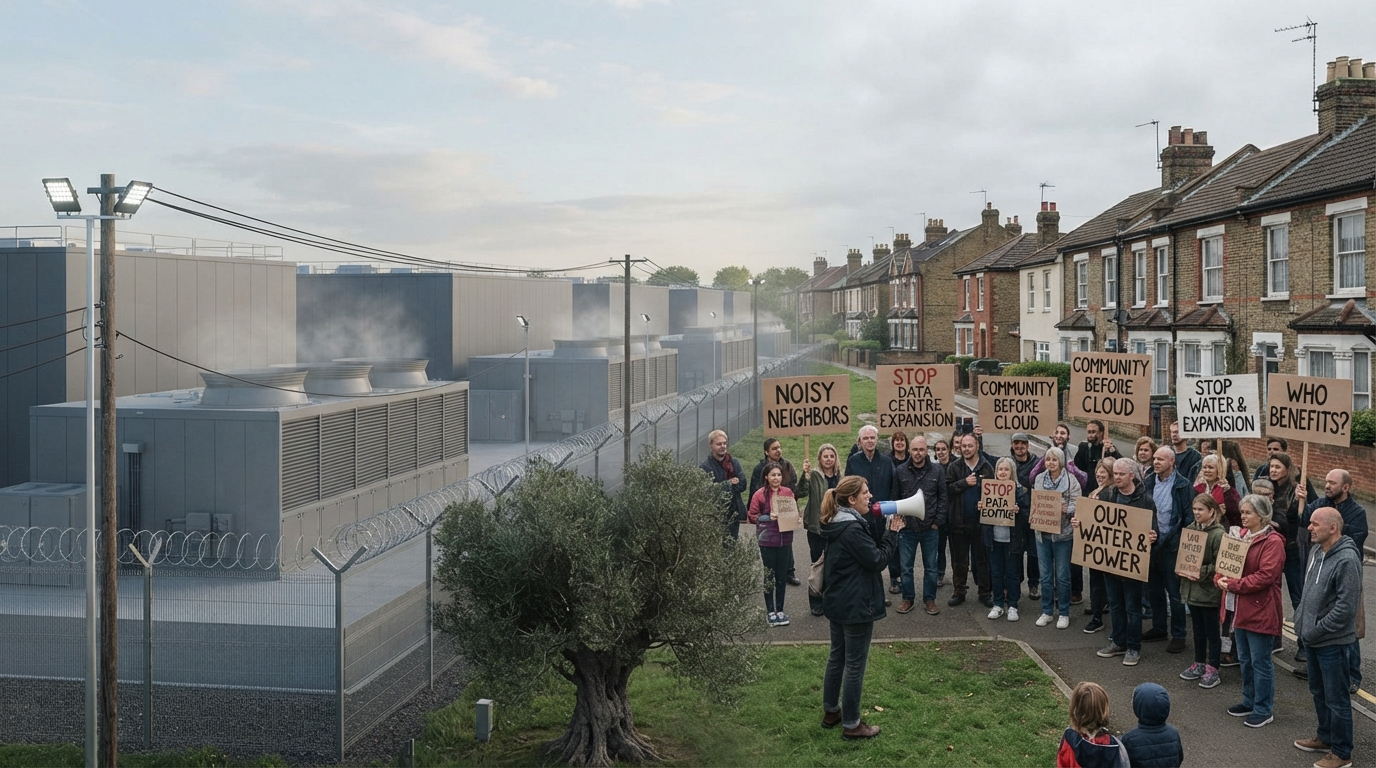
In recent days, a chorus of alarming warnings about threats to humanity has grown louder, but it is these low hums that have sparked a backlash in the US which now threatens to spread into the mid-term elections, and could cross the Atlantic to the UK.
In the US, resistance to data centres is most visible on the political left. Democratic Senator Bernie Sanders has called for a moratorium on all new construction. "People are looking around worried about how quickly the technology is moving, how little control they have over it, how will data centres impact their community in terms of electric rates and water utilisation," he told me.
A global AI race moving at Silicon Valley speed may be about to run into the limits of highly local political and environmental concerns.
In the US, Gallup polling released in May found that having a data centre in your area was less popular than having a nuclear power station. For data centres, 71% were opposed, including 48% strongly opposed. For nuclear power stations, 53% were opposed, including 34% strongly opposed. That hostility has increased over the past two years, with some polls indicating that half of Americans back a complete halt to new construction.
There has also been opposition to some of these projects in the UK, from Buckinghamshire and Berkshire to Brick Lane in east London, where residents fear their neighbourhoods will be harmed.
In Brick Lane, plans for a data centre likely to serve the City of London’s high-frequency traders are facing resistance from people who would rather see more social housing and local business development in the capital’s east end. Meanwhile, in the shires, the huge demand for data centres is putting pressure on expansion from Slough into the surrounding countryside.
The UK has the third-largest number of data centres in the world, one place ahead of China. The US has the most.
Back in the US, this backlash is being reflected in what politicians running in crucial November elections are saying.
The opposition is clearly stronger among Democrats on the left, but anti-data-centre feeling is also evident among Republican voters. City councils have been voted out because of their data-centre policies, while some entire states — both red and blue — are proposing bans.
Last year, in New Jersey and Virginia, Democratic governors were elected in part because of anger over rising electricity prices blamed on data-centre construction and operation.
There are many accounts of local residents seeing their energy bills jump when they are expected to pay for the infrastructure needed to support new data centres, or finding already strained water supplies reduced further. Because the US energy system operates locally, the effect on bills can be immediate.
With control of both houses of the US Congress at stake, the scale of this hyper-local opposition could become a decisive issue in the midterm elections and, with it, the future of US policy and Donald Trump’s presidency.
Seven Big Tech CEOs stood alongside Trump in March to sign the "Ratepayer Protection Pledge" saying they would "build, bring or buy" their own energy needs and make sure costs are not passed on to "ordinary households." The pledge was non-binding.
The pledge did little to convince people they wanted data centres in their neighbourhoods
That clearly was not enough for some. The new Democratic governors in New Jersey and Virginia, home to the world’s largest concentration of data centres, went much further by introducing laws requiring new energy tariffs for data centres and disclosure of energy and water use.
Perhaps the clearest symbol of all this is pro-Trump Republican Senate candidate in Texas Ken Paxton, who is attacking data centres, campaigning against their tax breaks and proposing that operators of the facilities should face criminal liability if the technology "empowered AI chatbots that undermine children's safety".
Texas had been the most pro-business, pro-data-centre and pro-energy state, competing fiercely for these facilities. It had, for instance, secured much of the multi-billion-dollar relocation investment from Elon Musk’s SpaceX AI behemoth to make AI chips.
Ken Paxton has taken a hard line on AI
The reversal has been dizzying. Jensen Huang, chief of AI chipmaker Nvidia, used social media in August to argue that data centres are the essential driver of US reindustrialisation. Other Big Tech CEOs have not followed suit, perhaps a sign of how awkward the optics are.
The lesson from the US, however, is that talking about benefits to the national economy as a whole, or even about potentially curing cancer, does not always work locally. Part of the unsettling sound around data centres is the relative lack of permanent workers coming and going. Although there are plenty of construction jobs, an operating data centre usually needs only a few dozen employees, and only a few hundred at the biggest new sites.
It is one thing to ask local people to accept the noise, the all-night security lighting and the strain on energy and water supplies in their area for the good of the country. It is a tougher argument when AI companies are nearing trillion-dollar-plus valuations while also anticipating huge job losses, and many people are asking whether the technology could wipe humans off the face of the Earth.
The debate has crossed the Atlantic. In Slough, Europe’s biggest concentration of data centres, more than 500 people signed a petition saying the town "should not become an experiment". They are questioning whether the town has gained anything from this and want a pause on data-centre development there.
Residents have complained that the heat produced by the centres made already sweltering summer temperatures even worse. One project was built on land that had been earmarked for 1,000 homes, but was sold to a data-centre company as part of the council’s effort to clear its debts.
Back in Brick Lane, former Labour peer Baroness Pola Uddin says: "I understand the need for data centres, but there must be proper consideration of the health and wellbeing of the local population that lives, breathes, goes to school. We must consider the option of more industrial areas."
Brick Lane protesters resent their community being used to serve the City
Last year, the Labour government designated data centres as Critical National Infrastructure, as part of its plan to speed up their rollout.
It sees data centres as supporting public services and as vital for attracting investment and helping Britain compete in the global economy.
The case it makes is one of national economic gain, but the political question is whether local people will tolerate it. One of the first actions of the new Labour government was to support a Buckinghamshire data centre that had been repeatedly turned down by the local council because it was to be built on green belt land.
Ministers granted permission, but campaigners later challenged it after a crowdfunded court case, arguing environmental impacts had not been properly considered. The government admitted mistakes, overturned its own approval, and the developer eventually accepted that it needed to agree binding clean-energy commitments with the council. The victorious campaign group, Foxglove, said it would turn its attention to challenging other data-centre schemes across the UK.
Water is another concern for campaigners. The tech industry says its needs are not especially large when you factor in how much water is lost through leaks, for example.
In a submission to a Commons committee, the trade body Water UK criticised "not a single mention of water" in government AI growth strategies. "There appears to be an assumption that the country will always have enough water for its economic needs. Nothing could be further from the truth."
Much of the recent UK push to expand data centres has focused on areas chosen strategically because of their possible economic contribution, the availability of brownfield land and their existing links to energy grids and electricity generation. These areas have been labelled AI Growth zones.
But even in these places, the political balance between growth and the environment caused delays inside Cabinet. A scheme in Teesside became the subject of a tug of war between ministers over whether the land should be used for a low-carbon hydrogen energy project or a huge new AI data centre. The data centre won.
The Silicon Valley tech giants have admitted that the enormous energy demands of AI data centres will slow progress on climate change. Nvidia’s Huang told me last year that the invention and rollout of AI itself was the first priority, and he argued that the technology could help solve climate change. "This is the production of intelligence, what could be more valuable and more important than that?"
In the UK, there is still a basic question over whether the electricity needs of a plan to triple current data-centre capacity by 2030, to 6 gigawatts (GW) of continuous capacity, can be reconciled with net zero plans.
The government is expected soon to set out its policy for local government on data centres in a National Policy Statement (NPS), identifying which kinds count as "nationally significant" and are therefore eligible for fast-tracking by ministers.
Since work on the NPS began, there has been a change of prime minister, and a shift in the political mood on this issue.
Prime Minister Andy Burnham has promised "growth in every postcode" and data centres could help deliver that. But the government’s prominent role is also a clear example of centralised national power, the opposite of Burnham’s wish to give more authority to local government. Could that, along with the Green Party’s call for a data-centre moratorium, change Burnham’s view?
Some in Westminster say there is a case of "America brain" on this issue, where because it is a problem in the US, people assume it must be the same in the UK.
While the UK is trying to reach that 6GW target, the US ambition for 2030 is at least 20 times larger, with some individual megaprojects set to exceed the UK’s total planned capacity.
They say the effect on local electricity prices is not the same, though that is partly because energy prices are already higher in the UK.
For the UK, there is also an important argument about data sovereignty, and avoiding complete dependence on the US or other countries for the IT infrastructure that underpins large parts of the service economy.
There is talk of lessons needing to be learned from failing to capture the upside of the economic and political power that came with the rise of social media and the internet in the early part of this century. The UK was mostly a customer of those technologies, not a creator.
"This time [on AI] we have to get it right, but a precondition is having some level of data infrastructure," one minister told me. The UK’s ambition is seen as relatively modest in terms of continuous AI use for the NHS, national security and financial services by 2030.
This "skin in the game" argument is echoed in AI labs. Some influential figures believe their models will affect society so profoundly that they will fundamentally change governments’ ability to raise taxes, especially on work. Their futurists speculate about hugely disrupted flows of money through the economy. Physical data centres may become one of the few ways to tax the proceeds of this revolution.
In the US, some of the same politicians who once fought to welcome data centres now say they have turned against them. Tax breaks are becoming tax demands. The small-town backlash in the US may have a distinctly American context, but it is also echoing around the world.