

New bridge connecting Russia and North Korea photographed from space
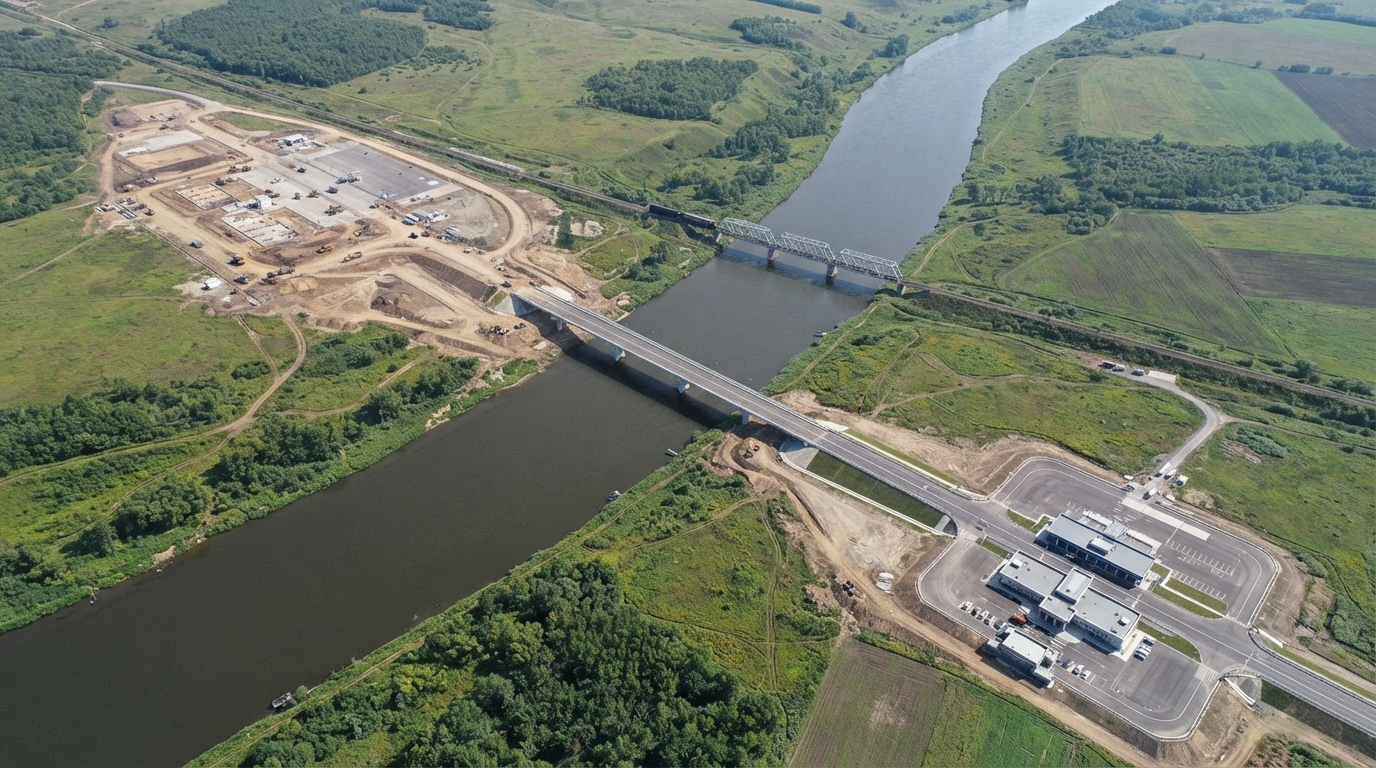
The construction of the first-ever automobile bridge connecting Russia and the DPRK across the Tumannaya River is nearing completion. According to the latest satellite images from the Planet company, the infrastructure leading to the bridge on the North Korean side is almost complete, while construction work is still underway on the Russian side.
**New bridge connecting Russia and North Korea photographed from space**
Satellite images taken by the Planet company in recent weeks have shown how far the construction of the first automobile bridge between Russia and North Korea has progressed.
According to the images, the infrastructure leading to the bridge on the North Korean side is fully completed. A customs complex and a checkpoint have been built a few hundred meters from the riverbank.
On the Russian side, however, work is still ongoing. Border infrastructure facilities are being built here, and the highway leading to the bridge is not yet fully completed. The site for a large customs building has been prepared and gravel has been laid for the future highway. However, according to the source, the infrastructure on the Russian side is not yet fully ready for the start of commercial freight traffic.
The new crossing point is located on the Tumannaya River, known in Korean as Tumangan, on the Russian-DPRK border. There has been a railway crossing here for a long time, connecting the two countries. During the Soviet era, a large volume of cargo was transported along this route. After 1991, its former importance has significantly decreased.
The issue of expanding transport links between Russia and the DPRK became more active after the two countries signed the Comprehensive Strategic Partnership Agreement in 2024. At that time, a decision was also made to build a road bridge between the countries.
The new bridge is expected to partially solve the existing problems in freight transportation. In particular, due to the lack of standardized ISO containers in the DPRK, some cargo has to be reloaded from one railway train to another. This slows down the transportation process. Once the road crossing is operational, trucks will be able to travel directly between the two countries, bypassing these railway restrictions.
The total length of the proposed crossing is about 5 kilometers. The bridge itself, including the adjacent sections, will be about one kilometer long. The section on the DPRK side is planned to be 581 meters long, and the section on the Russian side is 424 meters long. The width of the structure will be 7 meters, with one lane for each direction - a total of two lanes.