

My dream was to be a doctor, now it could come to zero
Afghan medical and dental students face being sent back home from Pakistan without degrees.
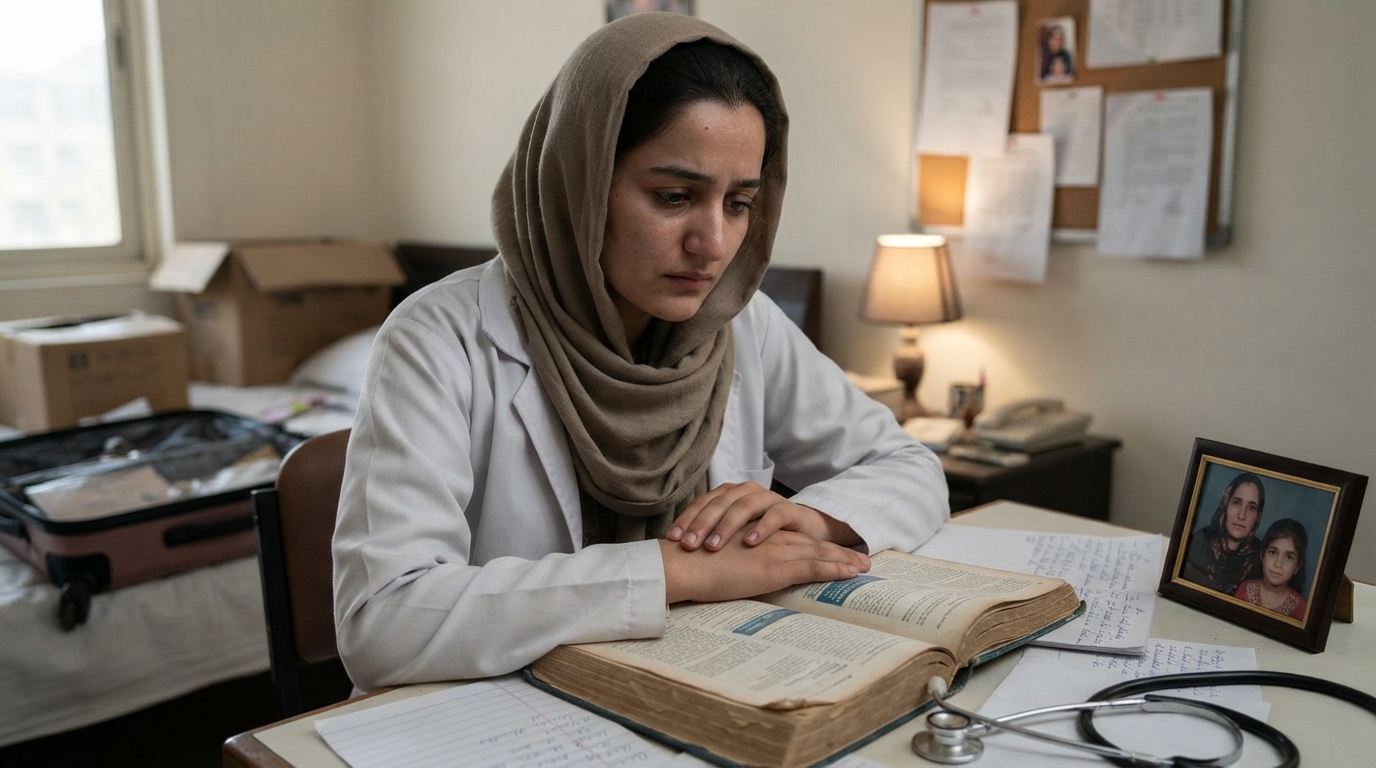
“My dream was to be a doctor, now it could come to zero”
Women in Afghanistan can no longer study beyond primary school level
Nooria, whose real name has been withheld, still recalls one of the moments that inspired her to become a doctor.
It happened in the Afghan village where she was born. A 13-year-old boy there fell ill and died of appendicitis.
“He was completely healthy, but the road was blocked and he died on the way. There are multiple incidents just like this.”
“That and the potential I saw in myself, I thought I can be a doctor for them, I can help.”
Now she fears that dream may be ending, and that she could be forced back to Afghanistan. For Nooria, that would mean the end of any career prospects, since Afghanistan’s Taliban government bars women from studying or working.
Earlier this month, Pakistan’s Medical and Dental Council, the regulator for medical education, sent a letter to medical and dental colleges nationwide saying Afghan students enrolled there must return to their home country. It warned that ignoring the order would be “viewed seriously” and could trigger regulatory action. A temporary stay order from the Lahore High Court has prevented students in Punjab, including Nooria, from being deported immediately until the next hearing, set for Friday. It is not certain the stay will remain in place.
Since 2023, hundreds of thousands of Afghans have been deported from Pakistan and more than two million have left, according to the UN. The figures rose as relations between Pakistan and Afghanistan sharply worsened over the past year. Pakistan has accused Afghanistan’s Taliban government of sheltering militant groups, which it denies.
The medical council’s announcement drew a strong response. Amnesty International described the decision as “patently discriminatory and arbitrary” and said that “Pakistan has obligations under international human rights law to uphold the right to education without discrimination on the basis of national origin.” Several former Pakistani envoys to Afghanistan also called on the council to rethink the move; one described it as “shocking” and “a question of humanity, compassion and Pakistan’s own moral responsibility”.
The council told the BBC it could not comment further while the court case is ongoing, but its lawyer told the BBC that none of the Afghan students were registered with PMDC. The students say that responsibility lies with their colleges, not with them; a PMDC notification issued earlier this year, external, instructs colleges to make sure students are registered.
Afghan refugees have been packing up and leaving Pakistan in large numbers
The medical and dental students the BBC has spoken to say they do not understand why tensions between the two countries should affect their right to study.
For Nooria, the situation is especially painful because she says reaching this point took enormous effort. She first studied at Kabul University, but left as Taliban forces advanced toward the city. She was then offered what she believed was a lifeline: a scholarship to study medicine in Pakistan. Now in her final year at a medical university in Lahore, she says she has devoted everything to the course.
“I was studying, day and night. I couldn't sleep because there was so much pressure and knowledge that I had accumulated in my mind. I got used to it a bit, but I have compromised a lot. My relationships, talking to my family, spending time with my friends. I think I haven't lived for these years, I have only studied for my dream.”
So when she learned of the letter, Nooria was stunned. She remains anxious about the consequences of speaking publicly, which is why she asked that her name not be revealed.
“We knocked on every door, our teachers, organisations, anyone we thought could help us. We are under so much pressure that we have completely forgotten about our studies, we don't know what will happen to us.”
Final-year students like Nooria have their last exams in just a few months. Said Mubin, another final-year student in Punjab, is in the same situation.
“I was in complete despair, my mind was blank. It was like a panic situation because they were giving us very short time to evacuate the (accommodation), the college,” he says.
Other students have also filed cases around the country, but different directives have been issued, adding to the confusion. Some students told the BBC they have finished their exams but have not completed the practical training, known as a “House Job,” needed to finish their medical education.
Women were banned from Afghan medical training centres by the Taliban government in 2024
Without completing their degrees, both Mubin, Nooria and many other medical and dental students the BBC spoke to fear that another institution will not recognise any of their credits.
“It means you have to start from zero, from your first year,” Mubin says.
Both Nooria and Mubin have valid student visas, which the BBC has seen. The PMDC did not give the BBC a figure for how many students it believes are affected, but Anayatullah Momand, a spokesman for Afghan medical students, said they estimate there are about 1,000 medical and dental students, 65% of whom hold visas. Some are still waiting for visas, while Momand said 15% have had their visas cancelled or have not yet applied.
Although the medical council’s letter makes no distinction between students with proper documents, Pakistan’s Ministry for Foreign Affairs spokesman did. “Our policy is that those Afghan students who are in Pakistan on a valid visa and registered for a valid course will continue and complete his or her education,” said Sajjad Haider Khan at a recorded press conference at the ministry.
Similar remarks were made the previous week, but the students say nothing has changed for them.
With her studies still in doubt, Nooria has been trying not to dwell on what returning to Afghanistan would mean.
“My family counted on me. These five years I have sacrificed everything that would be zero, multiplied by zero. And then I would become a poor and helpless Afghan female, facing this destiny. I cannot imagine this.”