

More tea? How Scotland's crops of the future could be set to change
Experts are examining the ways Scotland's farmers might diversify and adapt to a changing climate.
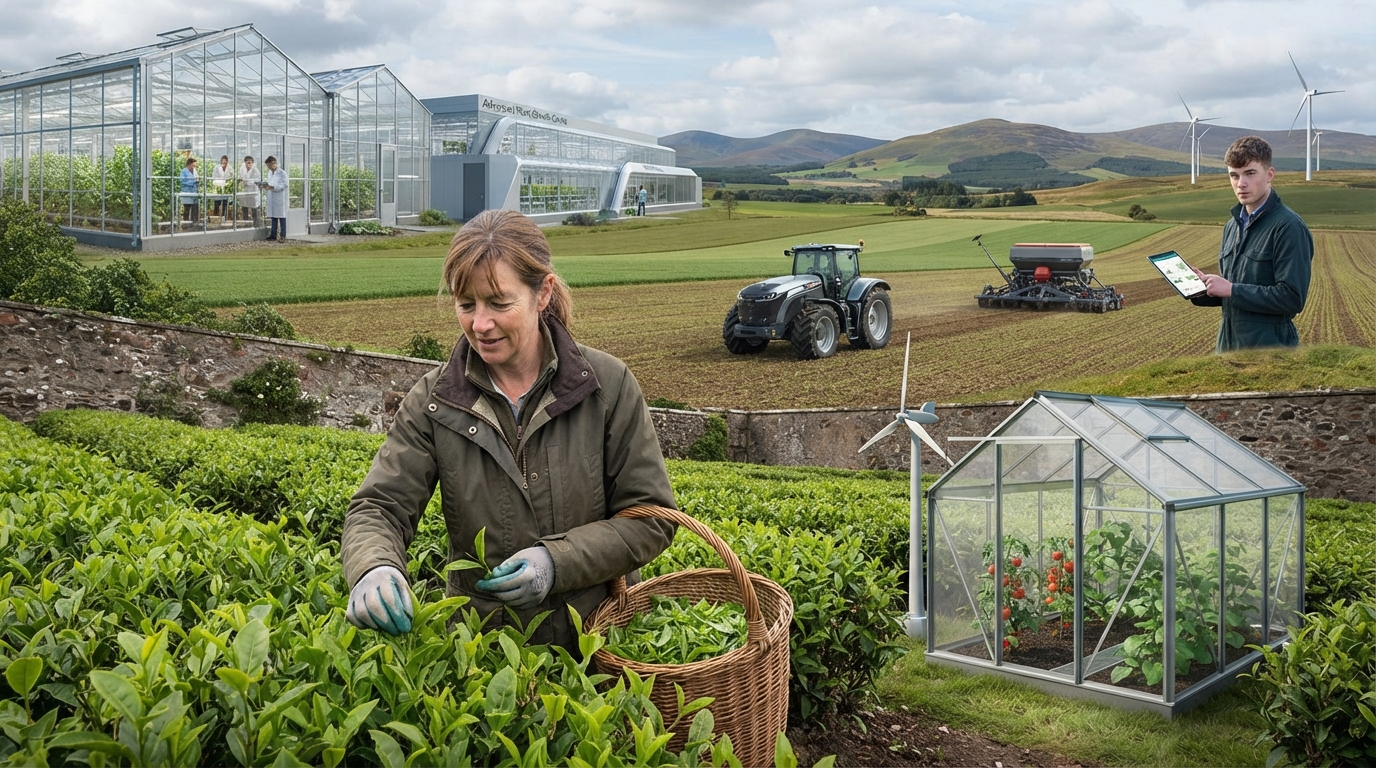
More tea? How Scotland's crops of the future could be set to change
Susie Walker-Murno has been growing tea on her family farm in Angus since 2007.
Susie Walker-Munro is among a small number of tea growers in Scotland. She says the acidic soil provides ideal conditions for the perfect artisan brew. At about £40 per packet for her most expensive product, it is unlikely to displace supermarket brands any time soon.
Around the world, droughts, heavy downpours and disease have made life harder for tea growers as they contend with the effects of a warming planet. Yet some experts think Scotland’s comparatively stable climate could give the tea industry here a boost.
As the picking season ends, Susie gathers the final few leaves before proudly pouring a small glass of her Kinnettles Gold, grown in a walled garden on the family farm near Forfar.
She believes Scotland’s latitude — 57 degrees north — will always prevent it from having a year-round crop like countries near the equator. But she says wetter weather could increase production.
"Our yields are never, never going to be high," she says.
"Maybe with climate change they might come up a bit, it depends if we get enough rain. Scotland could be absolutely ideal."
Susie does not think tea will ever become a major Scottish crop. But others argue it could be one of several future options as farmers are pushed to diversify and adapt to a changing climate.
Reconsidering how land is farmed may be one way to broaden the range of crops grown. Countries such as the Netherlands are already using glass houses, which could become more common in Scotland. Susie says they would be a good way to grow more tea.
According to Pete Ritchie of the campaign group Nourish Scotland, they would also let Scotland produce more Mediterranean vegetables such as tomatoes, cucumbers, aubergines and even melons.
He says plentiful renewable energy from wind farms later in the century will make heating them relatively inexpensive and reduce air miles.
"We're going to be able to produce those plants with a lower carbon footprint and provide secure all-round jobs for people on brownfield sites in the cities and also on the islands and remote parts of Scotland," he says.
The James Hutton Institute already has many glass houses, but it is going further by artificially reproducing the kinds of conditions that may exist in 75 years.
Climate modelling indicates Scotland can expect hotter, drier summers and milder, wetter winters by the end of this century.
The institute’s new advanced plant growth centre is effectively a climate simulator. It can control plants’ light, water and nutrient intake to test how they handle stress, then select species likely to cope best with everything climate change may bring.
For the past three months, researchers have been experimenting with fava beans, which are photographed every day so scientists can track their progress.
Dr Robert Hancock says the focus needs to shift from breeding crops for particular environments, such as hot or dry climates, to crops that are more broadly resilient.
"We need to start breeding those crops now and start understanding what Scottish farming's going to look like," he says.
"Farmers need time to plan, we need to get those crops out to the farmers and registered.
"Ultimately it's about what those guys do in the fields that matters, not what we do inside a climate simulator."
The farmers of the 22nd Century are likely only one generation away from those entering the industry today.
That means today’s young farmers will need to think carefully about the businesses they pass on to their own children.
It also means more precision farming, more artificial intelligence and more automation.
Modern tractors and combine harvesters already use technology such as GPS steering, so autonomous harvesting is no longer such a big leap.
But David Murdoch, chair of the Scottish Association of Young Farmers, says traditional skills will always matter.
"There's no point in doing it if you don't know your cattle, but embracing the technology is what keeps us competitive.
"Working with larger herd numbers and larger machinery to keep us producing more with less people - that's the way the world's going," says David, who farms dairy with his father at Beith in North Ayrshire.
Future changes in farming will not be driven by food production alone.
Protecting and improving nature, offsetting carbon emissions and generating renewable energy are already shaping the farms of tomorrow.
Health innovations may also play an increasing role, with obesity drugs already creating demand for proteins and nutrient-dense foods.
Soya, flax and legumes could become more common as growing conditions improve and the wish to produce them locally continues.
Prof Wayne Powell, principal of Scotland’s rural college, the SRUC, predicts that Scotland will become "the bread basket of Europe".
That phrase is currently used for Ukraine, because of its abundance of fertile farmland and exports of crops including wheat, maize and barley.
"Climate change is redrawing the farming map of Europe and Scotland could become one of Europe's most important climate resilient food regions," he says.
"The possibility of access to cheap renewable energy could also transform the economics of Scottish farming from irrigation, refrigeration, food processing, so that we can capture more value from our land and food."
Scotland’s rural communities have undergone major changes over the past 75 years, leaving far fewer people working the land.
The need to keep food affordable for consumers while ensuring farms remain profitable will be a major driver of innovation.
The changing climate and the ongoing destruction of nature make that a difficult equation to solve.
But farmers are accustomed to change — in the short, medium and long term — and by the end of the century our fields will probably be as unrecognisable to today’s farmers as those of every generation before them.