

Food price cap plans giving farmer 'sleepless nights'
East Lothian farmer Jamie Wyllie says he's worried costs will get passed down the line to the food producers.
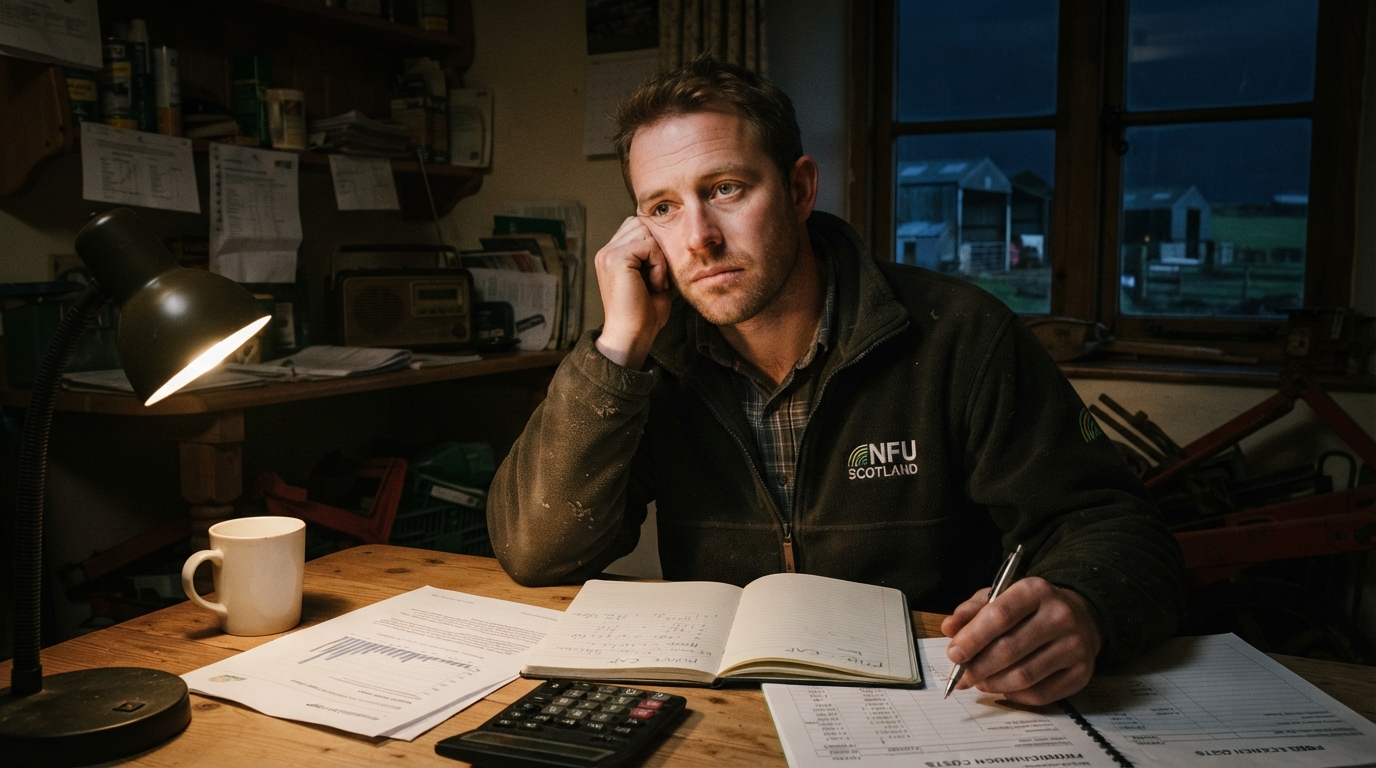
**Food price cap plans giving farmer 'sleepless nights'**
East Lothian farmer Jamie Wyllie says proposed price caps are leaving him sleepless.
As a farmer, Jamie Wyllie is accustomed to very little sleep. His work involves long hours and hard graft.
But now he says something else is keeping him awake at night: the possibility that the Scottish government will introduce price caps on some essential food items.
Ministers argue that the major supermarket chains will absorb the financial blow, saying "bold action" is necessary to support households.
Wyllie fears, however, that the costs will be pushed down the production chain and eventually land on his family farm, which is making "little to no margin as it is".
Wyllie holds an office in the National Union of Farmers in Scotland, so he is in regular contact with other farmers.
And they are not the only concerned parties to have spoken out.
Just last week, 23 organisations wrote to the first minister urging him to abandon the policy.
So what is the Scottish government actually proposing?
It wants a price cap introduced on up to 50 essential items, including milk, eggs, cheese and rice.
Large supermarkets would be expected to stock at least one version of these products at a capped price.
If that item sold out, they could then be required to offer another similar product at the same price.
John Swinney has previously said he has a "public health responsibility" to make sure people can afford a healthy basket of goods.
And he is fully aware that many families are struggling to afford the basics because of rising living costs.
Beyond the four staple items the first minister has identified, it is not known which food products he has in mind.
Nor is it known what prices they might be capped at.
Wyllie said farmers are worried about the effects of the plans.
The policy is currently out for consultation, giving interested parties the chance to share their views.
The idea is that the big supermarkets would bear the financial burden of the policy.
But speaking from his East Lothian farm, Wyllie said that in reality that is probably not how it will work. He fears the major retailers will pass any losses on to producers like him.
He said: "I struggle to see how, or why, they would swallow that cost"
"They'll pass it down to us. We see it all the time".
And he worries that when the supply chain dust settles, he will be the one left paying.
"I'm the bottom of the food chain. I can't pass my costs on to anybody else," he added.
He runs several farms, specialising in pigs, sheep and crops for bread and cereal production, and his costs have risen in recent years.
There has been a UK government national insurance hike and a looming UK-wide tax on fertiliser that will affect a farm of his size.
On top of that, his energy costs have doubled in recent years, with a standing charge of £1,500 per month before he has even used a single unit of electricity.
Jamie worries that a food price cap could become another burden that "might make producers think twice about what they're doing".
Asked what he means by that, he points out that farmers have other possible options: from moving into non-food crops to selling land so AI data centres can be built on it.
He said independent farmers are already stretched thin, handling everything from bookkeeping to HR to tractor driving.
He said: "Every time other items get thrown in, like this price cap, it does affect you. It does keep you up at night".
The government is due to hold a fair food summit on Tuesday.
On Tuesday, the Scottish government will host a 'fair food summit'.
Business Minister Tom Arthur will meet organisations representing producers and retailers.
Ministers have made clear they want to engage with everyone involved in the supply chain and address any concerns they may have.
The invitation for the event said the aim is to "work together to ensure that people across Scotland can afford their weekly shop in a way that works."
But it appears that a number of producers do not see a way to achieve all of the objectives.
They seem to believe you either cap prices or protect producers. There is scepticism that both can be done at the same time.
But John Swinney has made clear that the cost of living remains a top priority for him. And he sounds determined to see the policy become reality, although there is speculation that legal hurdles could emerge later.
He is not the only politician to have explored this area. The UK government has also asked retailers to freeze some prices, though it has stopped short of forcing shops to do so.
Whatever comes out of Tuesday's summit, ministers plan to continue with price cap plans.
In the detail of an impact assessment published by the Scottish government last week, there were options being considered that could soften it slightly, including allowing prices to rise but at a rate below food inflation.
When Swinney set out this policy during May's Holyrood election campaign, it was certainly one of the most eye-catching proposals from any party.
No one could accuse him of failing to put forward bold ideas to tackle a major concern for voters.
But it could also prove extremely complicated to deliver.
And ministers will have their work cut out persuading farmers like Wyllie that it can happen without hurting his bottom line.