

Moody's assigned Apex Bank a B3 rating
Moody's Ratings assigned Apex Bank long-term deposit and issuer ratings of B3 with a stable outlook and assessed the bank's credit profile.
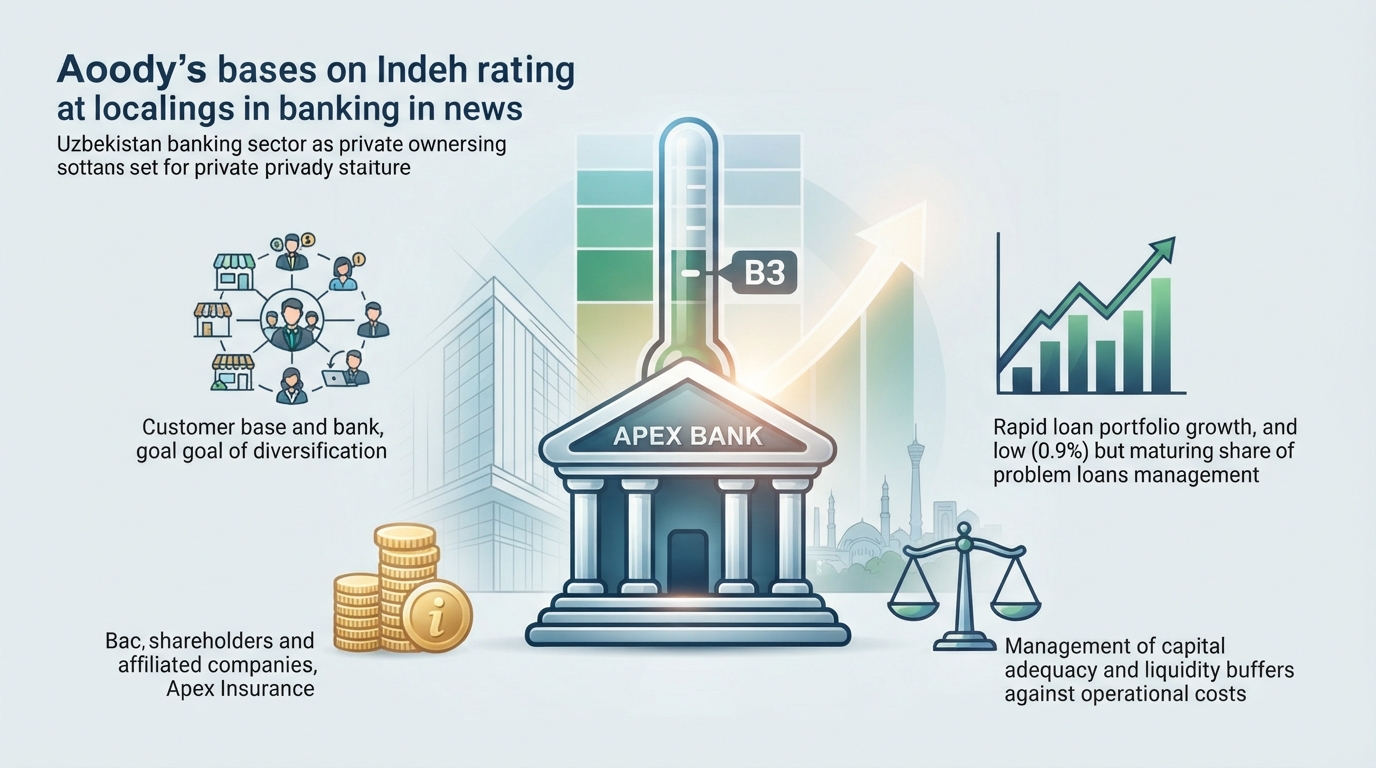
Moody's Assigns Apex Bank a B3 Rating
Moody's Ratings has assigned Apex Bank JSC long-term deposit and issuer ratings in local and foreign currencies at B3 with a stable outlook. According to the rating report, the bank's baseline and adjusted baseline credit assessments are also set at b3.
Apex Bank's long-term counterparty risk assessment (CR Assessment) was set at B2(cr), and its long-term counterparty risk ratings in local and foreign currencies were set at B2. Its short-term deposit, issuer, and short-term counterparty risk ratings were rated Not Prime (NP), while its short-term counterparty risk assessment was NP(cr).
According to Moody's, Apex Bank's B3 deposit and issuer ratings reflect the bank's baseline credit assessment of b3 and the low probability of government support. The agency attributes this to the bank's small size and private ownership in the context of the Uzbek banking sector, whose sovereign rating is Ba2 with a stable outlook.
The baseline credit rating of b3 takes into account Apex Bank's position within a broader group of affiliated companies, which provides synergies, as well as the ongoing support of shareholders and related companies. Among these, Moody's particularly highlights Apex Insurance JSC, one of the largest insurance companies in Uzbekistan.
The agency expects that as its client base expands, Apex Bank will be able to effectively leverage its existing client relationships and the capabilities of its affiliated companies. However, the bank's credit profile is limited by its short tenure as a standalone bank, high borrower concentration, and rapid loan portfolio growth, which puts pressure on capitalization.
At the end of 2025, the share of non-performing loans was 0.9% of the gross loan portfolio. Moody's notes that this ratio remains low, but due to the bank's short operating history and predominantly young loan portfolio, it does not yet fully reflect the level of credit risk. The agency forecasts a gradual increase in the share of problem loans as the portfolio matures. A high concentration of loans to individual borrowers and related parties remains an additional risk factor.
The tangible total capital to risk-weighted assets (TCE/RWA) ratio was approximately 6.2% at the end of 2025. This ratio was negatively impacted by the bank's significant intangible assets. At the same time, capital adequacy ratios exceeded regulatory requirements.
Moody's forecasts a moderate improvement in Apex Bank's capitalization in the next 12-18 months due to full profit reinvestment and continued shareholder support. However, this effect will be partially offset by further balance sheet expansion.
The bank's profitability, calculated as the ratio of net profit to tangible assets, was 0.7% in 2025. According to the agency, profitability is limited by the evolving business model and significant dependence on related-party income. This dependence is expected to decrease as the bank expands its operations and diversifies its client base.
At the same time, financial results in the near term will be impacted by increased operating expenses associated with investments in infrastructure and operational capacity. Moody's also expects a gradual increase in the cost of credit risk as the loan portfolio matures.
Apex Bank's core banking liquidity at end-2025 amounted to 24.4% of total banking assets. This was primarily comprised of cash, balances in financial institutions, and government securities. Moody's expects the liquidity buffer to decrease as the loan portfolio continues to grow.
The bank's funding is primarily provided by deposits, but the deposit base remains highly concentrated among large corporate depositors and related parties.
The baseline credit assessment also includes a negative one-notch qualitative adjustment for the strategy, risk appetite, and corporate governance parameters. Moody's attributes this to the bank's rapid balance sheet growth from a small base, limited independent operating experience, and continued reliance on related parties for lending, financing, and revenue generation.
According to the agency, Apex Bank's management intends to gradually diversify its client base and business model. However, the sustainability of the bank's operations outside the group's ecosystem has not yet been proven, and the associated risks are not yet fully reflected in its financial metrics.
These circumstances are also reflected in the assessment of environmental, social, and governance factors. Apex Bank's corporate governance profile was assigned a G-4 rating, and its ESG credit impact assessment was assigned a CIS-4 rating. According to Moody's, CIS-4 indicates a significant influence of ESG factors on the bank's rating, primarily due to high corporate governance risks.
Moody's does not anticipate an upgrade of Apex Bank's deposit or issuer ratings due to state support. This is due to the bank's predominantly private ownership and small market share, which, according to the agency, indicates the bank's limited importance to the stability of the overall banking sector.
The stable outlook assumes that Apex Bank's credit profile will remain largely unchanged over the next 12-18 months. Support from shareholders and affiliates, as well as continued business development, is expected. However, risks associated with the bank's rapid growth, high borrower concentration, and significant volume of related-party transactions will remain.
A rating downgrade or a change to negative outlook is possible if rapid expansion leads to a significant deterioration in asset quality and capitalization. A similar scenario is possible if the bank is unable to successfully expand its client base and reduce its dependence on related-party transactions.
According to Moody's, a ratings upgrade is possible with the formation of a longer operating history while maintaining high asset quality, a significant reduction in concentration on individual borrowers and related parties, strengthening of capitalization, and the creation of a sustainable and more diversified income structure.