

Fitch assigned MK Leasing a "B-" rating
Fitch Ratings has assigned Uzbekistan's MK Leasing a 'B-' rating with a stable outlook, noting its sustainable profitability and low asset impairment.
Fitch Assigns MK Leasing a 'B-' Rating
Fitch Ratings has assigned Uzbek leasing company MK Leasing FE LLC (MKL) a long-term issuer default rating of 'B-' with a stable outlook. The company's senior unsecured debt is also rated 'B-' with a recovery rating of RR4, reflecting average recovery prospects, according to Fitch Ratings.
The ratings are based on MK Leasing's standalone credit profile. Fitch notes the company's concentrated business model, small scale compared to international peers, and robust operating performance.
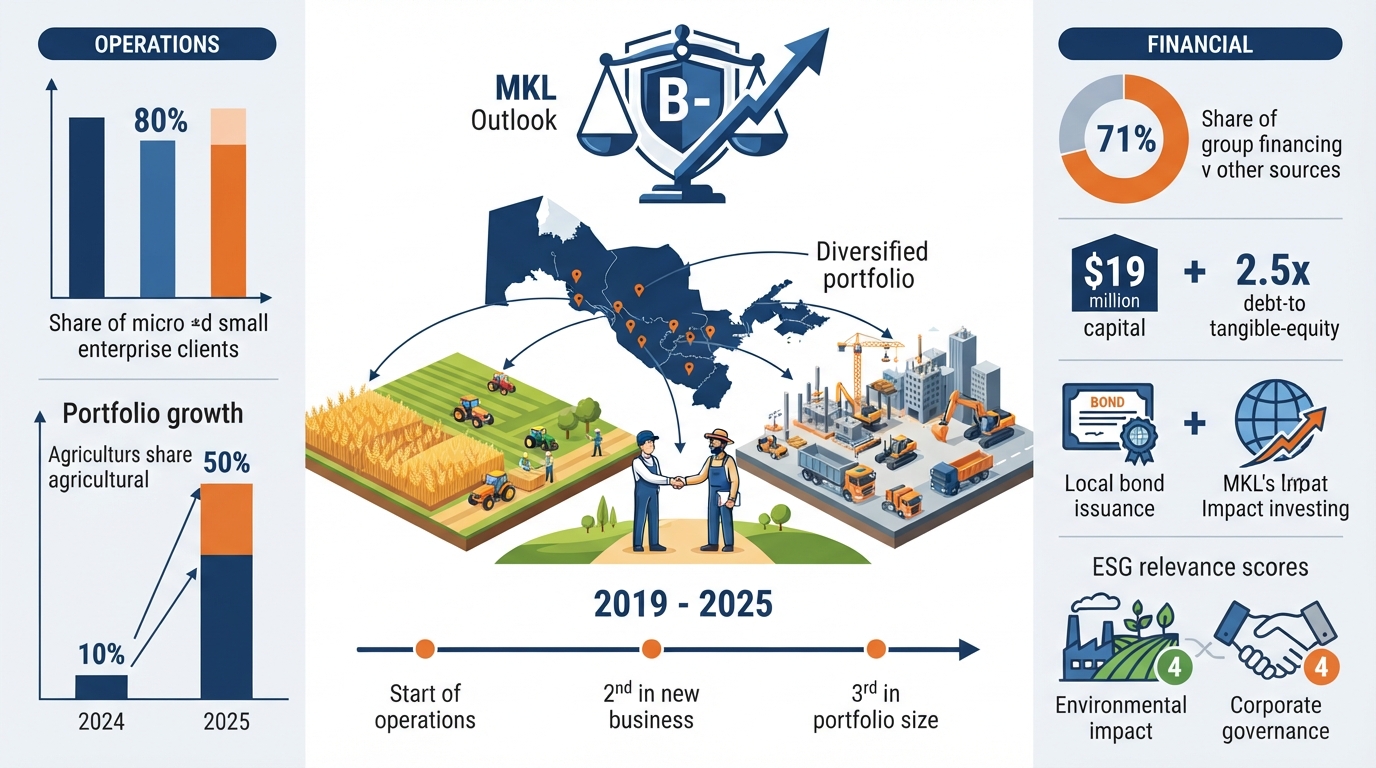
MK Leasing is an independent, privately held leasing company operating in Uzbekistan since 2019. At year-end 2025, it ranked second in the national market by new business volume and third by leasing portfolio size.
The company provides medium-term lease financing with terms ranging from one to five years. The average weighted term of contracts is approximately 35 months. At the end of 2025, approximately 80% of MKL's clients were micro and small businesses, and approximately 42% of leasing transactions were concluded with clients in rural areas.
At the same time, the portfolio structure is gradually changing. The share of agriculture in the leasing portfolio reached approximately 50% in 2025, up from 10% the previous year. At the same time, MKL is expanding its financing of construction equipment, trucks, and commercial vehicles. Fitch estimates that this diversification will eventually reduce industry concentration, which, together with the company's small scale, currently limits its business profile.
Fitch considers MKL's more efficient decision-making in procurement and financing matters a competitive advantage. The collateral nature of the diversified leasing portfolio and historically low asset impairment rates support its quality. At the same time, the agency notes that the portfolio remains young, rapidly growing, and highly concentrated.
The share of leases overdue by more than 90 days at end-2025 was 2.2%. Fitch attributes this figure, in particular, to a prudent down payment policy and a weighted average loan-to-value ratio of approximately 70%.
Impairment charges amounted to 3% of operating profit before impairment. Cost of risk, i.e., the ratio of impairment charges to the average gross lease portfolio, was 0.3% in 2025.
Profitability metrics also remained robust. MKL's return on assets before taxes reached 9.3% in 2025, with an average return of approximately 9% for 2022–2025. Results were supported by a net interest margin of 10.8% and low impairment charges. The operating expense to total net revenue ratio was 41%.
Fitch expects a gradual decline in the company's profitability. This is due to the expansion of activities into lower-margin, non-agricultural products, as well as the gradual replacement of cheaper intra-group financing with more expensive domestic sources of funding.
At the end of 2025, MKL's equity amounted to $19 million. The gross debt-to-tangible capital ratio decreased to 2.5 times, compared to 3.1 times the previous year, and the equity-to-assets ratio was 27%.
Strong internal capital formation was supported by a high share of retained earnings. In 2025, this ratio was 37%. Fitch expects the debt burden to increase as the business expands through debt financing, but forecasts it will remain at an acceptable level in 2026–2030.
At the same time, MKL continues to diversify its funding sources. At the end of 2025, the group provided 71% of the company's debt financing, up from 88% the previous year.
In 2025, MKL issued its first local bonds for 50 billion soums, equivalent to $4 million. An additional bond issue of 100 billion soums is planned for 2026. The company also attracted its first international financing from funds specializing in impact investing.
MKL is 100% owned by Alternative, a securitization fund registered in Luxembourg and managed by MK Global Kapital S.à r.l. The company specializes in impact investing and alternative finance and operates in more than 10 developing countries in Europe and Central Asia. Alternative's ultimate owner is the non-public, non-profit Joseph of Arimathea Foundation, managed by a board of trustees.
Fitch assesses MKL's liquidity as adequately managed, supported by long-term borrowings and clients' willingness to repay lease payments early.
A rating downgrade is possible in the event of a significant deterioration in financial results, an increase in the share of problematic contracts, or a significant decline in profitability. A negative rating action could also follow a sustained increase in the gross debt-to-tangible capital ratio above 6.5 times, a reduction in capital covenant headroom, the emergence of refinancing issues, a deterioration in liquidity, or an unresolved financing breach.
A rating upgrade, according to Fitch, is possible with further expansion of the business scale and diversification of the client base without increasing business risks, an expansion of funding sources while maintaining stable financial performance and a moderate debt burden. Additional factors could include a longer history of profitable operations and a reduction in market risks, particularly foreign exchange risks. In terms of ESG, Fitch assigned MKL an ESG Relevance Score of 4 for environmental impact due to the company's significant exposure to the agricultural sector. This exposure, according to the agency, negatively impacts its credit profile. A similar score of 4 for corporate governance is attributed to the significant dependence of the decision-making process on the sole shareholder.