

Martian Dust: Perseverance Discovers Particles Capable of Penetrating the Lungs and Bloodstream
Over 1,645 Martian days (sols), NASA's Perseverance rover measured fine and ultrafine dust particles that settled on samples of spacesuit materials on board the rover. Among them are particles small enough to penetrate the lungs and enter the bloodstream.
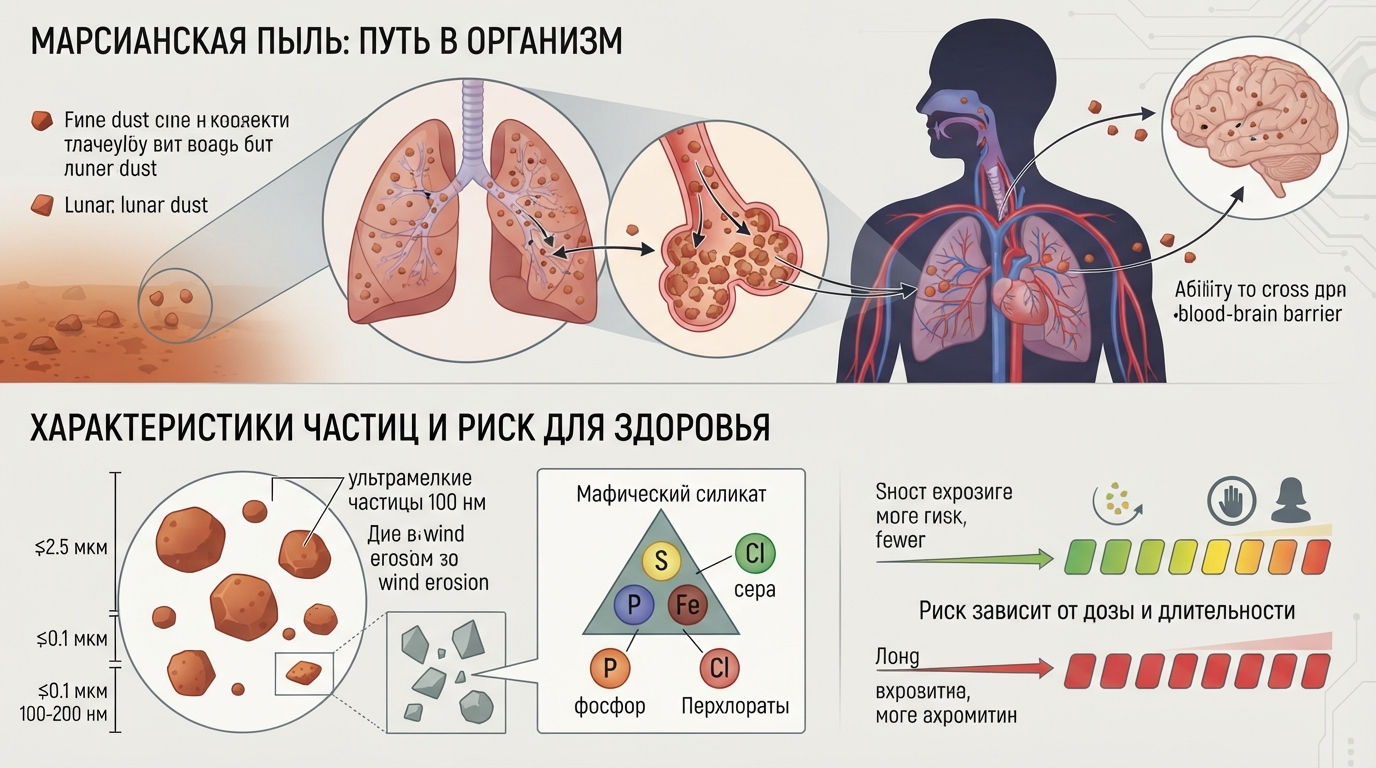
Martian Dust: Perseverance Identifies Particles Capable of Penetrating Lungs and Bloodstream
According to a paper in PNAS, researchers have described fine (≲2.5 µm) and ultrafine (≲0.1 µm) Martian dust fractions. Particles ranging in size from 100 to 200 nanometers were found on spacesuit samples and calibration targets. A WashU press release clarifies that some ultrafine particles reached 100 nm across.
Chemical analysis using the PIXL instrument showed that this dust is a mafic silicate enriched in phosphorus, iron, and sulfur. A NASA press release also notes that Martian dust is enriched in sulfur, chlorine, and iron, and contains more silica than lunar dust. In addition, perchlorates and other potentially toxic compounds are present.
The "Significance" section of the PNAS article states that these respirable particles are small enough to penetrate deep into pulmonary alveoli, bypass the blood-brain barrier, and threaten vital organs. This matches NASA's phrasing regarding particles capable of penetrating the lungs and bloodstream.
At the same time, the authors emphasize that the risk is determined by dose and duration of exposure. In the WashU press release, Scott VanBommel notes that short-term exposure to these substances may not pose a serious threat to astronaut health, and much depends on dose and duration. NASA also points out that, according to scientists, the health risks from Martian dust depend on the amount of dust and the duration of exposure.
Furthermore, the study showed that Martian dust is likely less abrasive and irritating than lunar dust: the particles are more rounded due to prolonged wind transport.