

Martian dust could reach the human brain
Data from NASA's Perseverance rover showed that some dust particles on Mars are fine enough to penetrate deep into the lungs and pass into the bloodstream. The possibility of ultrafine particles reaching the brain is also raising concern. However, this study did not directly test the effects of Martian dust on the human body.
Martian dust could reach the human brain
Martian dust is found across almost all regions of the planet's surface. It is formed as a result of the weathering of rocks, is moved by the wind, and rises into the atmosphere during dust storms.
This dust already poses a problem for the devices currently operating on the Red Planet. It settles on solar panels and sensors. In the future, it could also get onto astronauts' spacesuits, research base equipment, and habitat modules.
Perseverance has been exploring the Jezero crater area since 2021. It examines ancient rocks, searches for signs indicating the existence of habitable conditions in the past, and collects samples for potential future return to Earth.
The rover is equipped with the PIXL X-ray instrument, which determines the chemical composition of materials. Its calibration targets contain samples of teflon and basaltic glass. Another instrument, SHERLOC, has materials intended for spacesuits, including teflon and strong Vectran fabric, placed on its calibration target.
An international team of researchers led by Scott Van Bommel analyzed how dust accumulated on these surfaces. Using X-ray measurements and a computational model, the scientists estimated the composition and size of the particles.
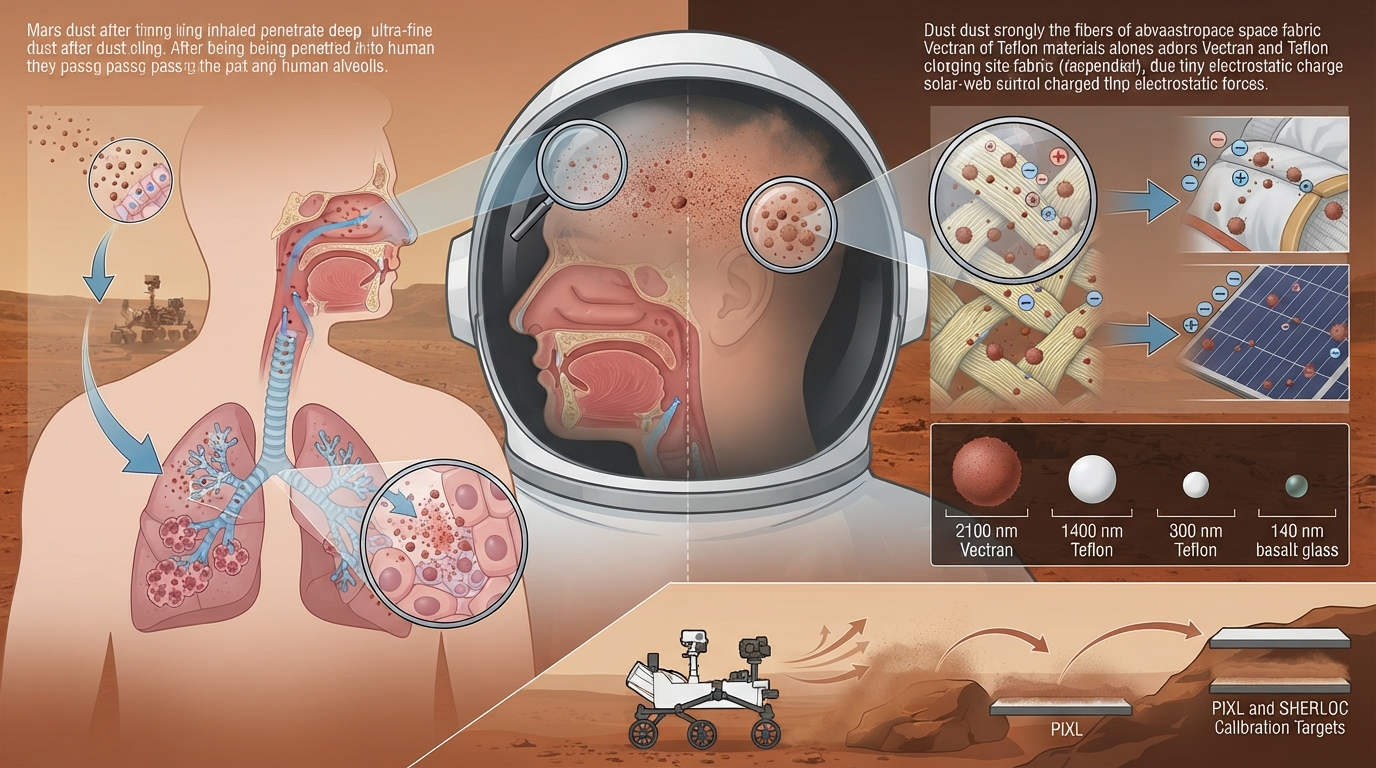
According to calculations, the average size of the dust particles on PIXL’s teflon calibration target was approximately 1400 nanometers, while on the basaltic glass it was only 140 nanometers. On the spacesuit material samples, this figure was estimated at 2100 nanometers for the Vectran fabric and 300 nanometers for the teflon.
These numbers were not obtained by directly photographing individual dust particles. Scientists calculated them based on the thickness of the layer accumulated on the surface. Therefore, some particles may actually be even smaller than this.
The analysis showed the presence of silicon, iron, and sulfur compounds in the dust composition, as well as an enrichment in phosphorus. The finest particles can stick to surfaces under the influence of electrical charges. On fabric, the interweaving of fibers holds them in place. As a result, the dust does not fully detach from the materials even when the rover moves and vibrates.
For future astronauts, this creates two types of problems. First of all, dust clinging to the spacesuit of a person returning from working on the planet's surface could enter the habitat module. Meanwhile, ultrafine particles mixed into the air have the potential to pass through the respiratory tract's natural protective barriers.