

Management of apartment buildings in Uzbekistan will be completely transferred to the private sector, according to the Ministry of Construction, Housing and Communal Services.
Uzbek authorities plan to completely transfer the management of apartment buildings to the private sector. Private businesses are also being more actively involved in providing heat, water, and sewerage services. The Ministry of Construction and Housing and Public Utilities announced projects in Tashkent, Nukus, Bukhara, Namangan, and other cities.
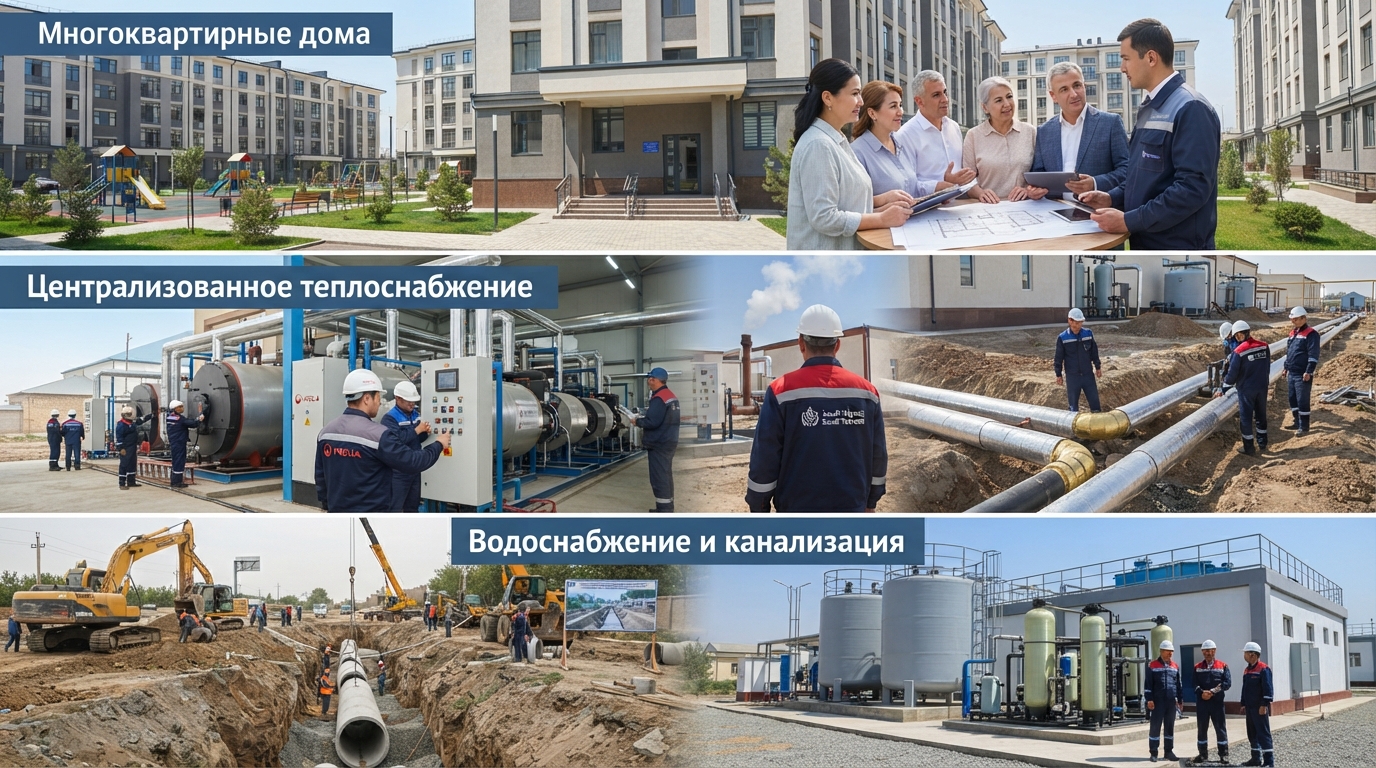
The management of apartment buildings in Uzbekistan will be fully transferred to the private sector, and private companies will be more actively involved in centralized heating, water supply, and sanitation. This was announced by Jalol Arashov, First Deputy Minister of Construction, Housing, and Utilities, at a meeting of the Legislative Chamber of the Oliy Majlis on August 25.
The issue was raised during a discussion of the implementation of the state program under the "Uzbekistan 2030" strategy for the first half of 2026. Deputy Farkhod Zayniev drew attention to paragraph 249 of the program, which provides for the continued transfer of state functions to the private sector, and asked for clarification on the specific functions planned for transfer in the housing and utilities sector.
"In recent years, active work has been underway to transfer state functions to the private sector. This, in turn, serves to save budget funds, develop healthy competition, and, most importantly, improve the quality of services for consumers," the deputy noted.
A representative of the Ministry of Construction, Housing, and Utilities outlined three main areas of this work.
"The first area is that the apartment building management system will be completely transferred to the private sector," he stated. It's unclear from the First Deputy Minister's statement whether this "complete transfer to the private sector" implies changes to the existing forms of apartment building management, including the provisions of homeowners' associations (HOAs).
As a reminder, according to current legislation, apartment building management can be carried out in one of three forms:
* direct management by the owners of the premises;
* homeowners' association (HOA);
* management organization.
The second area is centralized heating. According to him, the goal is to attract private businesses to improve the quality of heating services for the population.
As an example, he cited Tashkent, where the heating system has already been transferred to a private company, the French company Veolia.
The First Deputy Minister also announced the transfer of the RK-1 boiler house in Nukus to the private sector. According to him, the corresponding decision was made by a presidential decree, and the operator is Saudi Tabreed, a Saudi Arabian company.
A separate decision, he said, was made regarding Bukhara—the central boiler plant there is to be transferred through a public-private partnership.
Furthermore, work to involve the private sector in district heating is also underway in Urgench and Zarafshan.
"In the heating systems of these cities, that is, in matters of providing the population with centralized heating, work is also underway to transfer [functions] to the private sector," said a representative of the Ministry of Construction.
The ministry named drinking water supply and sanitation as the third area. According to the representative, several projects with private investors are already being implemented in this area.
In particular, a 23-year public-private partnership agreement was signed with the UAE company Metito for the reconstruction of Namangan's sewer infrastructure. The project was estimated at $90 million.
"Most importantly, work has begun on the complete reconstruction of Namangan's sewer system and improving the quality of services for the population," he said.
In addition, private companies are planned to be involved in the development of wastewater treatment facilities in Jizzakh and the drinking water supply system in Navoi. According to the presentation, work is underway with a Chinese company on the Navoi project.
Another project involves the construction of a new wastewater treatment facility for Tashkent. A ministry representative announced cooperation with TAQA Water from the UAE. The project, with a capacity of 1 million cubic meters per day, was estimated to cost $1 billion.
"Overall, specific measures have been identified for these three areas to transfer [functions] to the private sector, reduce the burden on the state budget, and provide high-quality services to the population," said Jalol Arashov.
In recent years, Tashkent has seen a massive shift in the management of apartment buildings from homeowners' associations to management companies (MCs). This process resumed this winter, and it is once again accompanied by serious discontent among residents. They complain of violations of the law, pressure from government officials, a lack of transparency during the transition, which is taking place without the consent or even participation of property owners, and fear a deterioration in service quality. Gazeta examined the situation, using examples from several districts of the capital, and whether it is legal.
At the end of April 2025, apartment building managers in Tashkent appealed to the government for the third time, requesting a collective meeting, as previous appeals had yielded no results. They expressed their disagreement with the pressure from authorities acting illegally and demanded clarification from the government and the capital's khokimiyat. The Ministry of Construction, Housing and Utilities stated that it would support residents, but the proposed solutions were ad hoc, while the problem was widespread.
At the beginning of the year, Uzbek senators sent a request to the Cabinet of Ministers regarding the quality of services provided by management service companies. The request was prompted by thousands of citizen complaints, the appointment of management companies without the participation of property owners, and the lack of reporting. The head of the Senate called this "a serious issue directly related to public sentiment."
In June of this year, the heads of homeowners' associations and self-managed buildings in Tashkent reported an increase in the number of inspections and fines. They consider this a continuation of the campaign to force buildings to be converted to management companies, which began in 2022. Residents insist on respecting their right to choose their management structure. Gazeta investigated the situation.