

In Uzbekistan, the volume of privatization of state assets has increased 55-fold.
Over the years of independence, Uzbekistan has consistently transformed its system of managing state assets, expanding the role of private capital, entrepreneurship, and investment in the economy.
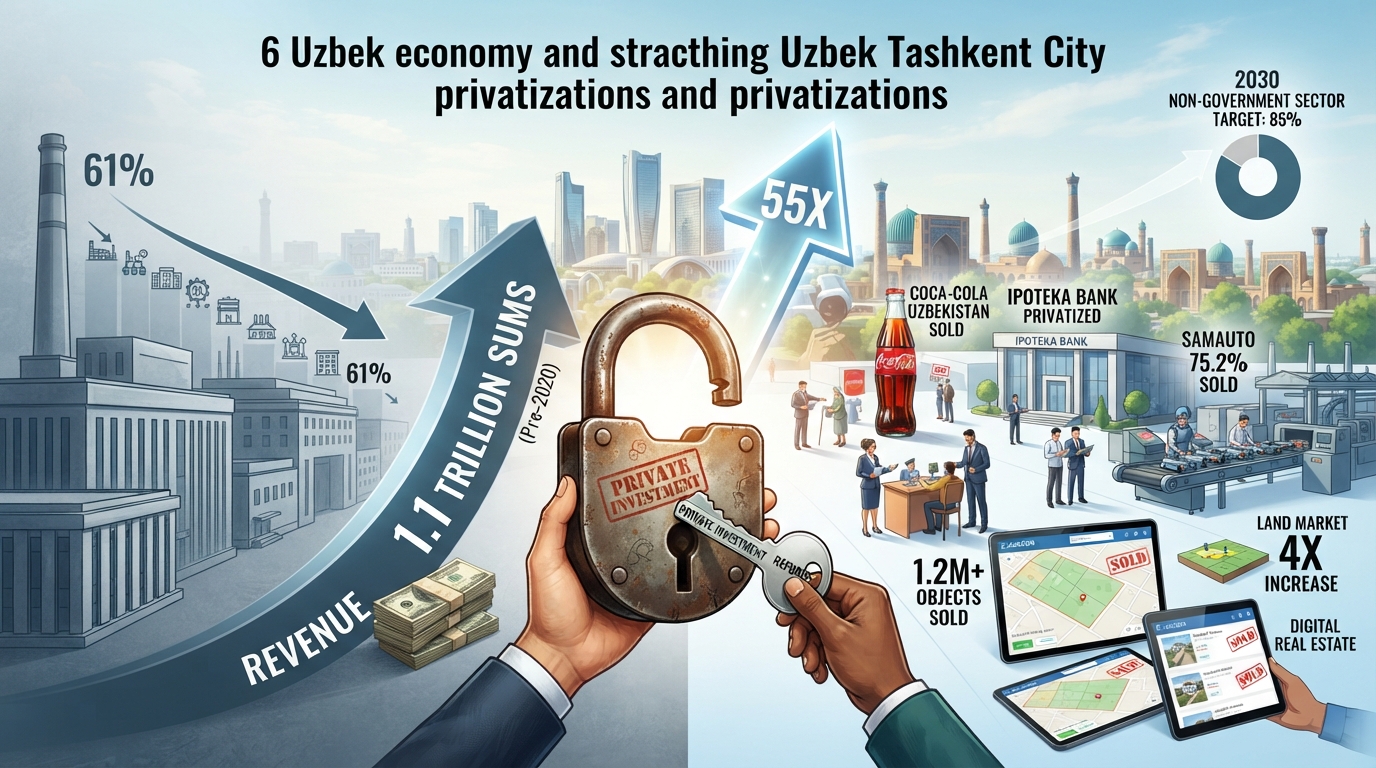
In Uzbekistan, the volume of privatization of state assets has increased 55-fold.
Tashkent, Uzbekistan (UzDaily.uz) — Since gaining independence, Uzbekistan has been consistently reforming its state asset management system, strengthening the role of private capital, entrepreneurship, and investment in the economy.
One of the key areas of these reforms has been large-scale privatization and the reduction of state participation in economic activity.
According to the press service of the State Assets Management Agency, the legal basis for these processes was laid by the new Law "On State Property Management," adopted in 2023, and the Law "On the Privatization of State Property" of 2024.
The volume of privatization reached 77.6 trillion soums.
The scale of privatization of state assets has increased significantly in recent years. While privatization revenues in the decade leading up to 2020 amounted to 1.1 trillion soums, this figure reached 77.6 trillion soums in the period from 2020 to 2025.
At the same time, modern governance mechanisms for state-owned enterprises are being implemented. In particular, the application of the "Sell or Explain" principle has reduced the number of state-owned enterprises by 61% between 2021 and 2025.
Major assets are being transferred to the private sector.
Considerable attention is being paid to attracting private and foreign capital through the privatization of large and strategic assets.
Among the most notable transactions:
— Coca-Cola Uzbekistan – sold for $252 million;
— Ipoteka Bank – for $324 million;
— 75.2% of the state's stake in the Samarkand Automobile Plant – for $80 million.
These transactions are seen as a practical result of policies aimed at improving the efficiency of state asset management, attracting private investors, and reducing the state's presence in the economy.
Digitalization of the real estate market and land relations.
In 2026, a new Law "On Real Estate Activity" was adopted, providing for a transition to a more transparent and digital model of market regulation. The document provides for the creation of a Unified Register of Market Participants and the implementation of a multi-listing system.
The new system will allow real estate organizations to operate on a one-stop shop principle and provide a wide range of services—from real estate transaction support and auction organization to trust management, information, consulting, and advertising services.
The land market is also actively developing. Between 2022 and 2025, the volume of land plots offered and sold at auctions on a freehold and leasehold basis almost quadrupled.
In the first half of 2026, 1,800 hectares of land were sold, significantly exceeding the figure for all of 2022. Moreover, the number of applications from individuals and legal entities for the privatization of non-agricultural land increased almost fivefold compared to 2022.
Over 1.2 million properties were sold through E-auksion.
The E-auksion electronic trading platform has become an important tool for increasing the transparency and accessibility of privatization processes.
To date, approximately 1.5 million properties have been auctioned through it, of which over 1.2 million have already been sold.
Opportunities for entrepreneurs to acquire state assets are also being expanded. Specifically, payment installments, discounts in certain cases, and long-term leases of state property with subsequent direct purchase are now available.
The share of the non-state sector will reach 85% by 2030.
The next stage of reforms will focus on further reducing state participation in the economy and expanding opportunities for the private sector.
By 2030, the share of the non-state sector is planned to increase to 85%, and the number of state-owned enterprises will be reduced by almost six times.
Thus, the ongoing reforms are aimed not only at privatizing state assets but also at creating a modern competitive environment, increasing the investment attractiveness of the economy, and creating new opportunities for entrepreneurship.