

Making politics 'fun, trendy, sexy': How Gen Z could shape Kenya's next election
A voter mobilisation campaign has registered huge numbers of young people but it is not clear who they are backing.
Making politics “fun, trendy, sexy”: How Gen Z could shape Kenya’s next election
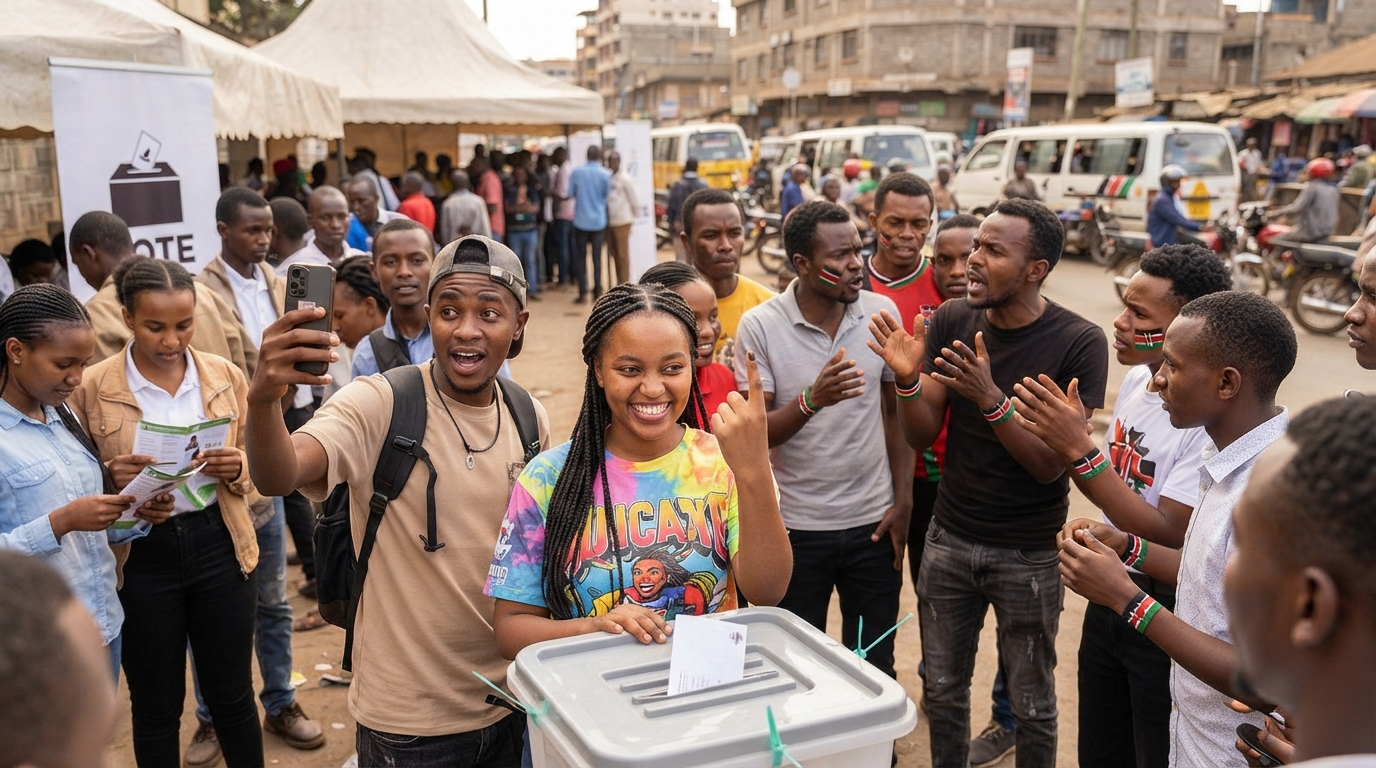
Ademba Allans is trying to make voting in Kenya “cool.”
The student journalist-turned-civic mobiliser kicked off a voter registration campaign on social media earlier this year, using catchy selfies mixed with music and humour to appeal to young people.
The outcome surprised him, along with many observers of Kenyan politics: by the end of the registration period, 2.6 million new voters nationwide had signed up. He now hopes to add another 2.3 million in the next round.
“It was the Gen Z way of doing politics,” he tells me. “Fun, trendy, sexy, fashionable. Because of how we created the hype around it, people had the fear of missing out. Everybody wanted to be involved.”
Gen Z, the label for people born in the late 1990s and early 2000s, exploded onto the scene two years ago with mass protests that forced the government to back down on a deeply unpopular tax bill. But that win was followed by a police crackdown that left dozens of demonstrators dead or injured.
Now many young Kenyans are preparing to shift from the streets to the ballot box, furious with a political establishment they accuse of corruption and police brutality.
And they have the numbers to matter: more than 30% of voting-age Kenyans are under 35.
Polls indicate President William Ruto is vulnerable.
But can Gen Z turn a decentralised, digitally driven rebellion into organised political power?
“These youth-led movements are a wild card, in that they are unpredictable,” says political analyst Tom Mboya.
“They don’t require much in the way of resources and can pop up at any time. The finance bill protests were political in nature, but the movement has not been tested at an overtly political level. So if they decide to support a candidate, then he’s likely to do fairly well.”
One of the advantages of the tech-savvy Gen Z activists is that they have managed to mobilise outside the party structures and ethnic loyalties that underpin Kenyan politics.
Allans has deliberately avoided backing any specific candidate or party, stressing leadership rather than politicians, and building what he says is a new force outside traditional tribal voting blocs.
“There has never been a case where there is a bloc that is not affiliated to any person or any party. They just want to vote in the right leaders, and this is what we created,” he says.
“It’s more of a swing vote because you cannot tell who we are going to vote for.”
Ruto and his United Democratic Alliance (UDA) are under heavy pressure with less than a year to go before the August 2027 vote.
More than three-quarters of respondents in a survey carried out in June said the country was heading in the wrong direction, while two-thirds said their personal finances had worsened since Ruto took office in 2022.
Still, analysts say the president does not need to be broadly popular to win. They argue he is a skilled political organiser with the backing of state resources.
His opponents are also divided, and it remains unclear whether they can unite behind a single challenge to him.
Senator Edwin Sifuna has managed to draw large and youthful crowds to his rallies
One figure who has drawn the attention of many Gen Z voters is Nairobi Senator Edwin Sifuna. He has become the face of a movement called Linda Mwananchi (Protect the Citizen), which is attracting strong backing from disillusioned young people.
Sifuna first won their attention when he tried to stop police from shooting protesters who were storming parliament during the 2024 demonstrations.
He is now leading a “people-led” movement that calls for the protection of human rights and the rule of law as set out in the constitution.
He has not yet formally announced a presidential bid, but he is already travelling the country to build support. The BBC met him on a recent visit to Meru county in central Kenya, a region that strongly backed Ruto in the last election.
“Young people want us to create an environment where everybody feels that they can compete fairly,” he told me before setting off on his noisy road show.
“We need to absolutely dismantle the system so that everybody has a fair chance at life, a fair chance at education, a fair chance at employment, and the opportunities to grow themselves.
“This election in 2027 is when this theory that the young people are advancing will be put to the test,” he said. “Our challenge as a leadership is to ensure you have a compelling message that then encourages people to come out, let them see the vision for the new country.”
Ruto also offered a compelling vision when he won power in 2022.
He pledged to reshape the economy from the bottom up, focusing on helping the marginalised. Since then, his government has introduced measures including major reforms that expand access to public healthcare, but many young people felt let down by his austerity policies and tax increases.
“I’m here to participate in a revolution change that we want a new Kenyan youth leader who knows the common problems that are facing the young people,” 23-year-old Brandon Muremi told the BBC.
I met him in a relatively quiet corner at the final stop of a hectic day of a “rolling rally” — Sifuna’s convoy visited four places, sometimes blocking traffic as he and local politicians climbed onto their vehicles and delivered fiery speeches at deafening volume.
“We are looking for a leader who sticks to his plans, not just talking the promises that he makes,” agreed Conrad Mutangili, a 19-year-old mechanical engineering student who had come out of curiosity.
“We are looking for somebody who can actually accomplish and actually bring to the people what they are talking about,” he said. “Because they promise sweets, but we don’t feel any sugar in our mouths.”
“We want immediate results,” said Yvonne Kileme, a 22-year-old computer science student, while acknowledging that government projects may take longer to bear fruit. “And one thing that we want as youths is employment, employment, employment, employment.”
Ruto strongly insists his government is creating jobs, and says the high level of youth unemployment is a problem that existed before he became president.
He has tried to reach Gen Z through a range of programmes offering grants and loans to small businesses and youth-led enterprises, technology hubs and digital work opportunities.
Kariuki Ngunjiri, the national youth leader of Ruto’s UDA, told the BBC he was confident of winning the election by a huge margin.
“The president is a listening president and he’s been able to now come down to the youth, get what their concerns are, give them jobs, and that has absolutely, even for the party, given us a head start,” he said.
“We are not worried about the social media buzz because we are people who actually engage the young people on real, actual, tangible development. What you see mostly on sponsored hashtags and sponsored headlines does not really concern us.”
He was speaking at a packed UDA town hall meeting in Kangema, about 100km (60 miles) north of Nairobi, as a senior sports official promised to expand the stadium-building programme with another venue.
Like many others, 23-year-old Shintah Mutahi was looking for work.
“I came to listen to what they were saying,” she said, “maybe find an opportunity for a job. I think they can give me a chance, they should just be given some time to do that.”
John Kiragu, a local UDA youth leader, said he understood the frustrations that had pushed young people to protest.
“There have been challenges,” he said, “but now the government is really trying hard to consolidate the youth. The government is implementing programmes that will really uplift their lives.”
It is still unclear which way young people will turn, but their voice will matter next year
Kiragu told me he was involved in a programme to tackle youth alcoholism — a serious issue in this area. Many of the young men at the morning town hall meeting were already drunk on a cheap local liquor.
The captain of the local football team, Calvin Ware, also came to hear the stadium announcement. He said he had heard similar promises many times before, especially ahead of elections, and this one would not affect how he voted.
“We have already made our mind,” he said. “The whole government should go home. We want to build a new Kenya, new youth, new people, fresh people from all over the country, and we are not basing on tribal [allegiances] or anything else. We just want a change, a change, and a change. Nothing else.”
As we were talking, we heard a loud cheer — the event had finished and people were lining up to collect cash handouts of 350 Kenyan shillings, about $3 (£2.20).
Paying people to attend political meetings is common in Kenya, and politicians can spend far larger amounts in attempts to sway votes.
“More so than many other parts of the world, money talks in an election here,” says political analyst Mboya. “The cost of politics is significantly higher than in other parts of the world.”
With less than a year to go before Kenya’s election, it does seem that politics may be shifting, and that the contest could be shaped by youth frustration with the political establishment. But while the Gen Z movement has rejected the “old politics” built on ethnicity and money, those have long been the foundations of election victories in Kenya.
No one yet knows what Gen Z voters’ energy will mean at the ballot box.